




India’s economic geography is frequently characterised by familiar dichotomies, such as the north versus south or, increasingly, urban versus rural. These frameworks dominate policy discussions, budgetary priorities and political discourse. However, they also obscure a more significant imbalance: One that extends not across the land, but along the coast.
Spanning over 11,000 kilometres, India’s maritime boundary is not merely a physical boundary; it facilitates nearly 95 per cent of the nation’s trade by volume and approximately 68 per cent by value. In theory, such an extensive coastline should promote regional growth distribution. In practice, however, it has achieved the opposite. Economic dynamism in India remains concentrated along the western seaboard. Gujarat and Maharashtra lead in exports, industrial output, and private investment. The Delhi-Mumbai Industrial Corridor has developed into a manufacturing growth backbone. Even when Bengaluru is considered, the broader western and southern axis continues to define India’s economic core.
The eastern coast, despite possessing comparable natural advantages, has not kept pace. This is a story of misaligned policy.
The illusion of balance
Upon initial examination, the data indicate an absence of significant issues. Cargo distribution appears to be evenly spread across coastal regions. In the fiscal year 2024-25, major ports processed 854.86 million tonnes, with consistent growth observed in key commodities such as petroleum (254.5 MMT), coal (150.1 MMT), and containers (193.5 MMT).
However, this aggregate data hides a critical distinction: The nature of the cargo being transported is as significant as the volume. Eastern ports, including Paradip, Haldia, and Visakhapatnam, are predominantly focused on bulk commodities such as coal, iron ore, and fertilisers. While these commodities are essential to the economy, they primarily represent upstream activities with limited value addition. In contrast, Western ports are more integrated into containerised trade and export-oriented manufacturing ecosystems.
The result is a paradox. Although the eastern ports handle a comparable volume of cargo, they capture a significantly smaller share of economic value. If economic potential were determined solely by the volume of trade, the Eastern regions would already be on par with the Western regions. However, this is not the case.
Also read: India needs to build dual-use ports on war footing. It’s critical for trade and security interests
A misleading parity
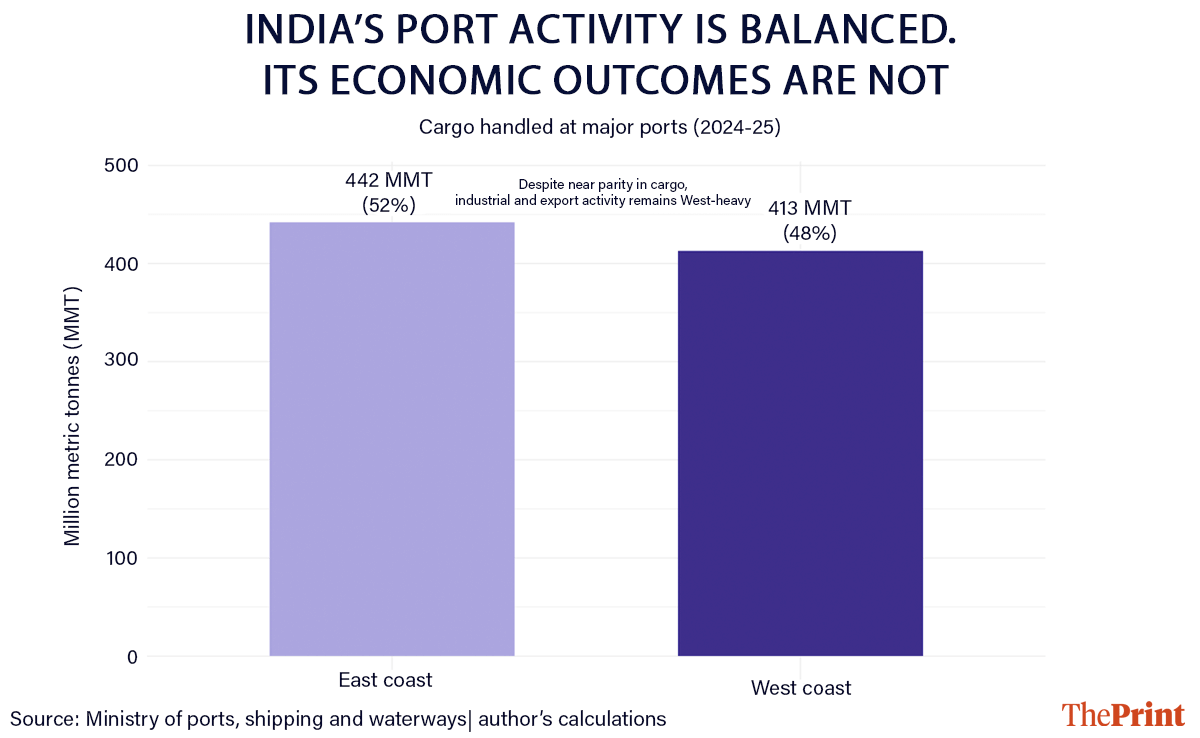
India has not underinvested in its eastern coast; rather, it has under-integrated it. The eastern coast is responsible for approximately 52 per cent of cargo handled at major ports, in contrast to 48 per cent on the western coast. On paper, the system appears balanced. However, the distribution of outcomes tells a different story. The western coast of India benefits from deeper natural harbours and relatively calmer sea conditions, whereas the eastern coastline is characterised by a wider continental shelf and increased exposure to cyclonic activity. However, these factors should be viewed as constraints rather than determinants. Globally, ports operate under far more challenging conditions. What distinguishes India’s western coast is not merely its geographical features, but rather the alignment of infrastructure, policy, and industrial ecosystems.
Port efficiency itself exemplifies this divergence. The average turnaround time at Indian ports is approximately 49 hours, yet this figure masks significant variation. Mumbai’s Jawaharlal Nehru Port operates at approximately 26 hours, whereas ports such as Kolkata exceed 80 hours. In the context of global trade, such disparities are critical. Time equates to cost, and cost influences investment.
More significantly, the western coast benefits from systemic integration. Ports are integrated within industrial corridors, logistics parks, and dense urban clusters. Conversely, the eastern coast remains fragmented—its ports are active, but its hinterland connections are weaker, and its industrial base is thinner.
This is precisely what the recent economic modelling of the East Coast Economic Corridor reveals. Infrastructure improvements alone yield limited benefits. In West Bengal, for example, road upgrades increase GDP by 1.6 per cent, special economic zones by 3.4 per cent, and reductions in non-tariff barriers by 2.6 per cent. However, when these interventions are combined, they elevate GDP by 7.65 per cent, demonstrating the efficacy of integration.
The lesson is loud and clear. Connectivity without coordination does not foster growth.
Also read: India needs access points into Europe beyond Marseille. Ports in Italy & Greece are the answer
Bridging the gap
India’s maritime strategy is notably ambitious. The Sagarmala programme envisions 839 projects worth Rs 5.79 lakh crore, while new initiatives such as the Rs 25,000 crore Maritime Development Fund aim to stimulate investment across shipping, ports and logistics. It is anticipated to be a public-private model. However, if these investments are spatially balanced, they risk worsening existing asymmetries. Addressing this issue requires a shift in approach. The primary challenge is no longer building additional infrastructure; it is optimising existing infrastructure as an integrated system.
First, the eastern seaboard should be regarded as an integrated economic system rather than a mere collection of ports. This entails aligning port development with industrial corridors, logistics parks and urban growth centres. Second, last-mile connectivity must become a central policy focus, rather than an afterthought. The East Coast Economic Corridor already identifies critical nodes such as Haldia-Tajpur, Kharagpur, and Siliguri, each possessing distinct industrial potential—from petrochemicals to logistics hubs. These nodes require sustained investment in rail, road, and multimodal connectivity. Third, India must prioritise industrial clustering near eastern ports, as ports generate value only when linked to manufacturing ecosystems. Without such linkages, they remain transit points rather than engines of growth. Fourth, trade facilitation reforms, particularly the reduction of non-tariff barriers, can have significant effects. Simulation results indicate that such reforms alone can increase regional GDP by over 2.5 per cent in eastern states. Finally, port efficiency must be improved. Turnaround times, digitalisation, and coordination across agencies are not mere technical details; they are indicators that influence investor behaviour.
Addressing this gap is not solely a matter of regional equity; it is about unlocking the next phase of India’s economic growth. The East is responsible for moving India’s inputs, while the West influences the outcomes. The ability to bridge this gap will be crucial in determining whether India’s coastline serves as a mere boundary or acts as a catalyst for economic growth.
Bidisha Bhattacharya is Consulting Editor (Economy) at ThePrint. She tweets @Bidishabh. Views are personal.
(Edited by Theres Sudeep)