









To protect ‘certain industrial sectors’, on 8 June, the European Council gave final approval to a near-halving of China’s duty-free import quota and a near-doubling of tariffs to 50 per cent on over-quota imports from 1 July. An anti-coercion instrument sits ready, but unused.
At a summit on 18 June, the European Union’s (EU) 27 leaders gave European Commission President Ursula von der Leyen a mandate to develop new tools to contain the effects of subsidised Chinese goods, directing the Commission, without naming Beijing outright, to develop and “eventually complement” the bloc’s trade-defence toolbox. It is a calibrated signal, with member states, including Germany, Spain, and Greece, still reluctant to antagonise a major commercial partner.
India faces a similar dependence on China. Following the Galwan Valley clash in 2020, New Delhi tightened restrictions on Chinese investment. Yet India’s reliance on Chinese goods has only deepened. Its merchandise trade deficit with China has more than doubled—from $48.7 billion in Fiscal Year 2019-20 to a record $112.1 billion in Fiscal Year 2025-26, when China overtook the US as India’s largest trading partner.
China’s capital may have been too risky to let in, but as a result, goods and equipment directly imported from China became even more vital to the Indian economy.
Despite their differences, Brussels and New Delhi may have several things to learn from each other. Moreover, a strengthened EU-India relationship could help both sides manage their China relationship better than either could alone.
However, that is possible only if both sides are honest about their differences as much as looking for what they share. The EU-India relationship is far from a natural strategic alignment. It’s more of a parallel response to a shared pressure environment.
Different beasts
The EU is a supranational body whose identity is bound up with rules, norms, and a decades-long commitment to open trade; it sees itself as a rule-setter for the world. For India, Viksit Bharat—the ambition to become a developed nation by 2047—is the organising logic behind its foreign policy. India primarily evaluates external relationships in realist terms—what do they mean for its development, economy, and security?
Then there is the highly controversial Russia angle. The war in Ukraine has become the lens through which Brussels approaches nearly every external relationship. India has not condemned Russia’s invasion and has continued to engage with Moscow throughout the war. That position remains one of the biggest sources of friction with Europe. A key reason is India still relies on Russian-origin platforms for an estimated 60 per cent of its defence equipment in its existing military inventory, even as it works to diversify and indigenise.
The China relationship is situated differently in each capital’s threat perception, but the position and priorities of the two countries are coming much closer. On India’s end, China is the pacing, near-permanent security threat at the border and increasingly in the Indo-Pacific. However, technological dependence and trade imbalances are causes for increasing attention to the economic dimension. For the EU, China has long been an economic and trade concern. But the war in Ukraine has brought security considerations into much sharper focus, even as economic ties remain central to the relationship.
Also read: How the Chinese view Europe’s evolving China policy
Similar problems experienced separately
The asymmetry between India and Europe is structural. The EU-India partnership cannot be built on an expectation of full alignment or a singular grand bargain. Cooperation can only be sought in specific, well-chosen areas where the two sides face a similar problem.
Escalating tensions between the US and China have come to dominate geopolitics. For India and the EU, strategic autonomy, resilience, and security are common concerns in almost all policy areas, from defence spending to energy policy, rare earths, and supply chains.
Very high on the list is China. Both economies depend on China for intermediate inputs and critical materials that their own industrial bases cannot supply at scale or competitive cost, and both have learned that de-risking is genuinely difficult. It takes time and capital, and a policy consistency that is hard to sustain, harder still when each side attempts it alone.
For India, diversification away from China is no longer mainly a question of willingness. It is now a question of capacity, which, moreover, varies enormously from state to state. China’s manufacturing ecosystem is unique in the world, and India will take many years to get close. Investment from European and other foreign firms pursuing the “China+1” strategy could be part of the solution. In non-strategic sectors, this may also include Chinese capital and firms.
The EU is having a version of the same argument now. It has arrived at the debate later than India, but perhaps more conspicuously. Europe’s manufacturing base is being eroded by Chinese competition. However, its impact and urgency vary greatly between member states. Many European firms are deeply connected with China as a market, a manufacturing base and an environment for research and innovation.
Like India, Europe is highly dependent on China in several policy priority areas, including but not limited to the energy transition. De-risking, therefore, comes at a very high price and remains strongly contested. Like India, investment from China may be part of the solution.
Nevertheless, a consensus is forming in Brussels that confronting China’s trade practices is unavoidable, even at the cost of retaliation, with debate ongoing over which tools to sharpen — anti-dumping measures, a proposed “overcapacity instrument,” and/or tariffs.
Also read: Why trust in international relations needs to be incentivised
What could each side learn from the other?
India’s experience shows what it looks like to absorb short-term economic friction for strategic reasons, faster than a 27-member consensus body realistically can. Despite criticisms, its Production-Linked Incentive (PLI) scheme offers one of the best real-world case studies of what de-risking costs actually. The programme provides subsidies to encourage investment in domestic manufacturing.
The EU, for its part, has built tools India is still developing: more calibrated trade-defence instruments, and, through its Corporate Sustainability Due Diligence Directive, genuine supply-chain transparency infrastructure. Indian firms hoping to become serious suppliers to European companies will need to meet these standards regardless, which gives India a practical reason to engage with the EU’s frameworks now rather than later.
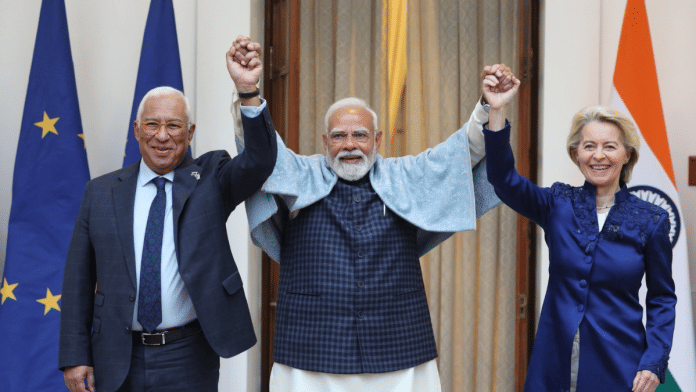
This can be, in effect, the logic for the relationship more broadly. In January of this year, the EU and India agreed on a Free Trade Agreement (FTA) and signed a Security and Defence Partnership. Although the FTA is still awaiting ratification, it should be seen as a foundation, not the end goal. The FTA should evolve toward a more modular and targeted partnership — built sector-by-sector and issue-by-issue rather than around a single comprehensive bargain — to allow for the structural differences that will continue to inform the relationship.
Dependence on China is one of the clearest candidates for such a targeted and conditional approach. China requires a domain-specific track where the EU and India create a framework for common approaches on specific issues and an exchange on what each side is learning as it manages, rather than eliminates, its reliance on Beijing. This is not limited to trade, but also includes investment and finance, as well as technology and innovation.
Also read: Logistics is the new frontier of weaponised interdependence. China has the upper hand
Where cooperation could start
None of this argues for a principled alignment against China, which neither side wants and which would not survive contact with the asymmetries above. Something more limited is needed. A structured channel — perhaps through the existing EU-India Trade and Technology Council — could support coordination and the exchange of information and experience in the areas where the underlying issues are shared.
Pharmaceuticals is the clearest case. India supplies roughly 20 per cent of the world’s generic medicines, and both India and the EU depend on Chinese active pharmaceutical ingredients (API) to make them. Joint investment in API manufacturing capacity in India could reduce exposure for both sides at once, while India’s PLI framework and the EU’s Global Gateway financing offer plausible co-investment vehicles.
Business services is less obvious, but arguably even more consequential. China has made it an explicit pillar of its next phase of industrial policy in a shift that will likely be felt most acutely in one of Europe’s areas of comparative strength. India, with its scale in IT and business-process services, could be a natural partner to strengthen this sector in the face of Chinese competition.
Supply chains and investments are a third area. A structured exchange on Chinese investment flows and supplier dependencies, rather than full joint screening, would let Indian firms draw on European transparency frameworks. European firms would gain visibility into India’s fast-changing supplier base in electronics and critical minerals. This would help enlist targeted Chinese investments for industrial upgrading in specific sectors. In other, strategically sensitive sectors — semiconductors, solar, defence — this kind of coordination may help build separate supply chains from China that serve both markets jointly.
These are starting points, not a finished agenda, and they should be treated as such.
Also read: India-China engagement key to a stable Asian century. Resist unrealistic expectations of trust
A frustrating relationship worth persisting with
At Davos earlier this year, Canadian Prime Minister Mark Carney called for middle powers to act together, issue by issue, with partners who share enough common ground, “because if we’re not at the table, we’re on the menu.” Collective investments in resilience are cheaper than everyone building their own fortresses. The EU-India relationship isn’t easy by any measure. Europeans tire of what they see as broken promises and slow delivery; Indian officials tire of what they experience as a steady stream of European norms and standards with little regard for India’s own developmental priorities. But as the largest of middle powers, India and the EU should actively work together where they must and where they can.
The EU-India FTA itself is estimated to generate only modest gains for both sides: 0.12 per cent of GDP for India, 0.13 per cent for the EU. More significant gains await the more targeted approach argued here, gains that cannot always be expressed in monetary terms. Both India and the EU face geopolitical pressures that threaten their long-term economic health. China is very prominent among these, and the one they share in a fundamentally similar way.
Whether they manage to make progress and build something durable in this area will say a great deal about how the relationship can develop further despite the continuing differences between them.
Frank Pieke is a cultural anthropologist and expert on modern China. Anisha Sircar is a resident fellow at the East Asian Institute, NUS, and author of ‘The Economy Is Personal.’
Views are personal.
(Edited by Saptak Datta)