








Geopolitical contestation has long manifested in battles for territory, resources, routes, access and influence. While the objectives of statecraft have hardly changed, the instruments through which they are pursued have. Almost anything can be weaponised with ease now. In this column, I make the case for attention to these new frontiers of geopolitical contestation.
One way to understand the present disorder is to separate three overlapping global orders: the security order, the economic order and the digital order.
The security order remains unipolar: the United States still possesses unmatched military prowess and power-projection capacity, even when that military power cannot decisively steer strategic outcomes. The economic order is more visibly multipolar, shaped by the leverage of the United States, China, the EU, assertive trade blocs and emerging markets.
The digital order is far more complicated. While Europe is a consequential third pole in regulation, competition in innovation, computing, AI and organising data at scale has hardened around the big two — the United States and China.
This third order is unique in that it cuts across the other two and is evolving fast. Data, standards, computing power and AI do not occupy a separate realm floating above geopolitics and geoeconomics. They increasingly determine who can manufacture efficiently, anticipate shortages, reroute supply chains, identify vulnerabilities and sustain military operations as precision weapons and AI play an ever-growing role in warfare. Whoever shapes the digital order is set to acquire disproportionate influence over both the economic and security orders. That is the paradigm shift.
No country has acted to gain an advantage on this front more systematically than China. Its rise cannot be explained only through cheap labour, subsidies, unfair practices, export promotion or the Belt and Road Initiative’s tally of completed and incomplete projects. Its greater, and mostly obscure, achievement has been the integration of industrial, infrastructure and data policies.
One of the clearest—and least discussed—examples is LOGINK, and just how early the CCP started building it.
Also Read: SHANTI Bill, SMRs and now Australian uranium—why India’s nuclear pieces are falling into place
The power of LOGINK
LOGINK—China’s National Transportation and Logistics Public Information Platform—had a humble beginning in Zhejiang in 2007 as an effort to standardise fragmented trucking and logistics information.
Within about a year, 15 provinces had joined LOGINK, and China’s Ministry of Transport drove a national rollout between 2009 and 2012. In 2010, LOGINK entered the Northeast Asia Logistics Information Service Network, linking Chinese, Japanese and South Korean ports. Standards work accelerated in 2013, the year Xi announced the BRI. In 2014, Beijing made international logistics-information exchange a formal policy priority, and by 2021 the integration of the logistics sector’s vast data troves was complete.
That chronology must be noted. LOGINK was not a digital prop added after China became the factory of the world. It grew alongside the effort to connect factories, trucks, warehouses, railways, customs agencies, ports and shipping companies into a coherent system that evolved with the digital revolution.
The platform can process vessel and cargo status, customs and inspection information, transit conditions, truck geolocation, bookings, freight-price inquiries, financing, insurance, billing and document exchange. It aggregates data from hundreds of thousands of users, millions of trucks, and warehouses, ports, shipping companies and public databases across the world. A peer-reviewed 2026 study in Marine Policy notes that the network spans 24 countries and 86 ports. While direct contractual presence and data visibility through interconnected networks are not the same thing, both can expand strategic reach.
What makes LOGINK attractive is that it is free, reduces friction and allows users to locate, track, price and clear goods through a common interface. But there are no free lunches. Participants have to adopt compatible technical standards, and each additional user makes the network more useful to the next. Scale produces data; data improves services; better services attract more users; and this chain of dependence becomes self-reinforcing—may I say, mutating.
In a 2015 presentation to the UN Economic and Social Commission for Asia and the Pacific (UNESCAP), a researcher at China’s Ministry of Transport outlined a future LOGINK as a cloud-based “business process as a service” platform supporting partner management, settlements and contingency planning.
China subsequently widened its standard-setting ambitions and, in 2023, created a National Data Bureau to coordinate the integration and use of data resources. The direction is unmistakable: logistics data is being treated not as an administrative task but as a potential strategic asset.
Industrial policy needs a strong data policy
LOGINK sits within a much larger Chinese maritime-industrial ecosystem. Chinese firms build ships, own fleets, operate terminals, manufacture containers and supply port machinery.
The figures are mind-boggling. OECD data show that since 2023, China has accounted for around half of global ship deliveries by compensated gross tonnage and held nearly 60 per cent of the global orderbook in 2025. In 2024, Chinese shipyards received, relative to revenue, about ten times the subsidies received by OECD shipbuilders.
That scale gives China the capacity to connect finance, manufacturing, infrastructure, standards, servicing and information across an entire chain as one seamless asset.
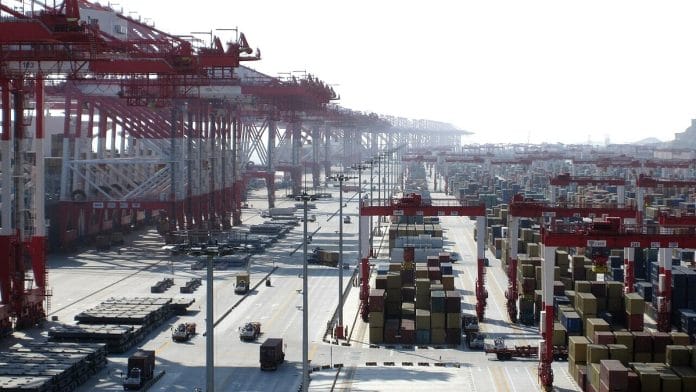
Consider the ubiquitous crane. A modern ship-to-shore crane is no longer merely a giant steel arm. It is a networked machine integrated with terminal operating systems, remote-maintenance tools and cargo-management software. It generates operational information: what enters a port, how rapidly it moves, where congestion is developing, which routes matter and which customers depend on them. And China dominates the market for cranes deployed across ports worldwide.
While not every Chinese crane is necessarily a spying device, the variables described above can create an information asymmetry and, at the same time, the possibility of surveillance or disruption in a hot or grey-zone crisis.
The US recognised this and, in 2023, enacted restrictions barring a range of government agencies, ports and other covered entities from using LOGINK. An April 2026 maritime advisory also warned that LOGINK, Chinese scanners and remotely serviceable ship-to-shore cranes could expose sensitive logistics and operational data.
The concern is therefore no longer hypothetical. Washington has begun treating logistics software as critical infrastructure. But the response came late— the embeddedness of the Chinese is already at the next level.
US financial markets remain dominant, and the country still leads much of the technological innovation frontier. Financial capital, however, cannot rapidly build shipyards, merchant fleets, cranes, port software or the accumulated knowledge embedded in logistics networks over years and decades.
The EU faces the same problem but has fewer options. It has sophisticated ports, shipping companies, industrial capabilities and formidable regulatory power. But authority is fragmented among EU institutions, national governments, port operators and private platforms. Privacy protections, competition rules and common standards are democratic strengths, but they also make centralised aggregation harder due to overregulation.
China’s advantage lies precisely in fusing state policy, commercial scale and data access while retaining far tighter controls over foreign access to its own data. Most others frequently separate industrial policy, digital regulation, maritime infrastructure and national security into administrative compartments. Beijing treats them as components of the same seamless strategic system.
This is the new frontier of weaponised interdependence. How? Control over a network hub can create both a “panopticon” effect—the ability to see flows others cannot—and a “chokepoint” effect, the possibility of restricting access to a critical node. In an era in which currencies, energy, semiconductors, insurance, satellites and undersea cables can all be weaponised, logistics cannot remain as analytically invisible as it has been.
Also Read: A middle power defence synergy is on the rise. Don’t let it become another ‘Global South’
India must recognise the gap
Fortunately, India is not beginning from zero. The National Logistics Policy, PM GatiShakti, the Logistics Data Bank and the Unified Logistics Interface Platform (ULIP) are meaningful advances. By August 2025, ULIP had integrated more than 30 digital systems and enabled over 160 crore transactions; the Logistics Data Bank had tracked more than 75 million EXIM containers across 101 inland container depots. It is also encouraging that India had risen to 38th among 139 economies in the World Bank’s 2023 Logistics Performance Index—up from 54th in 2014.
But India still discusses logistics data mainly as an efficiency question: lowering costs, tracking containers, improving clearances and building multimodal connectivity—all necessary, but not sufficient. They are not the same as developing a strategic view of who owns the data, who sets the standards, where it is stored, which foreign platforms and smart machines sit inside Indian ports, and how logistics intelligence can support industrial policy, trade negotiations and resilience during crises.
The urgency is growing. India imported nearly $132 billion in goods from China in 2025-26, including machinery and intermediate inputs critical to Indian factories. This month, Reuters reported, citing three government sources, that India had identified $51 billion worth of critical imports for an immediate domestic manufacturing push. Yet import substitution by itself will not create industrial depth unless manufacturing policy is linked to research, transport infrastructure, supplier networks and information about how goods move.
Meanwhile, trade negotiations with Washington are placing fresh pressure on India’s domestic market-access and regulatory choices. A proposed transshipment hub at Great Nicobar may diversify shipping routes and help India capture cargo that currently moves through foreign ports. But it will not by itself give India command over the information architecture through which cargo is booked, priced, tracked, insured and redirected.
This is where much of the contemporary Indian debate on economic strategy still, for lack of a better term, falls short. It correctly identifies low manufacturing, inadequate research, excessive import dependence and persistent obstacles to investment. But these are often discussed as separate problems. China’s experience shows that industrial development cannot be separated from logistics, logistics from data, or data from strategic leverage.
The answer is not another grand mission that becomes a victim of bureaucratic hurdles. India should begin with a strategic audit of logistics data. It must then connect that knowledge to manufacturing, ports, customs, railways, trade policy and national security—with clear safeguards for commercial confidentiality and individual rights. It cannot happen overnight, but this is where the global order is trending.
Data may be the new gold, but gold acquires strategic value only when it is mined, refined and connected to an industrial purpose. China has done precisely that with logistics. The hidden hand of power today is the one that can see the whole chain and use it to protect and further comprehensive national power—Unus pro omnibus, omnes pro uno!
Swasti Rao is a Consulting Editor (International and Strategic Affairs) at ThePrint. She tweets @swasrao. Views are personal.
(Edited by Asavari Singh)
Logistics. Isn’t that what China’s Belt and Road Initiative is all about. Ports, railway lines, highways, airports. Supplemented in some cases by power plants. As the world’s top trading nation, this is the sort of infrastructure China wishes to create globally. Which is why all of Africa – barring one country which recognises Taiwan – has signed on. There have been teething troubles, the appraisal of economic viability was less rigorous than it ought to have been for some projects. However, China would waste $ 1 trillion of its own money to lure others into a “ debt trap “. The cost of finance is higher than, say World Bank, but not extortionate.