






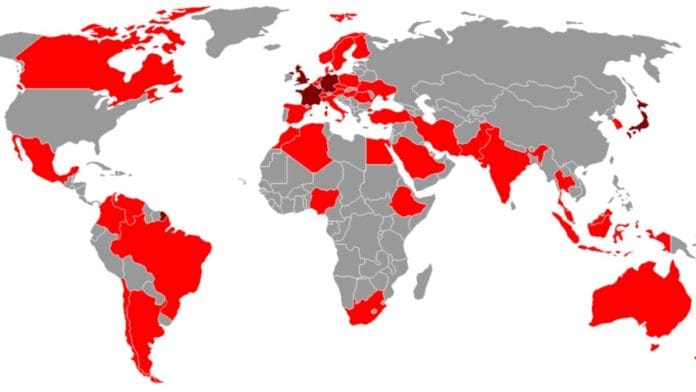


Isn’t ‘middle power’ a bit like ‘slightly pregnant’?” I heard a colleague chuckle during a coffee break after my third conference on middle powers in as many weeks. It is a fair question—what exactly is this sudden fixation with middle powers? More importantly, what does the phrase even mean?
Is it a measure of economic size? Military capability? Population? A country’s willingness to keep its options open? Or is it merely a polite way of describing states that matter enough to be invited to the table but not enough to decide the menu? Lately, “middle power” has acquired the remarkable ability to mean almost anything.
Then there is the question of agency. Is a middle power something a country calls itself, or something others call it?
India is perhaps a good example of the ambiguity. Much of the global strategic community happily describes India as a middle power. India, on the other hand, seems rather unhappy with the categorisation. Depending on who one listens to, India is a rising power, a leading power, a pivotal power, or an emerging great power. The semantics change, but ground realities do not.
Everybody seems convinced ‘the middle’ is suddenly where history is unfolding. The more one listens to disarrayed discussions on middle powers, the more one is reminded of the Stealers Wheel song: “Here I am, stuck in the middle with you.”
Strategic vogue
The renewed engagement owes much to Canadian Prime Minister Mark Carney’s Davos speech earlier this year. A Canadian colleague later told me that Carney had been preparing the speech for nearly a year, though its timing was as crucial as its content. Trumperica’s shocks to allies and partners, deepening militarisation, and growing uncertainty about the intent and durability of American security commitments resonated widely.
For the record, middle power is not a novel concept. The term acquired prominence during the 1970s and 1980s to describe countries such as Canada, Australia, Sweden, and Norway—states that were neither superpowers nor insignificant actors, but capable of exercising influence through diplomacy and institution-building. Over time, the club expanded to include South Korea, Indonesia, Turkey, and Mexico. The concept of Middle powers has never been static; it has always reflected the anxieties of a particular international order.
In addition to Trump turbulence, we also live in an era where almost everything has become weaponised: energy supplies, rare earths, shipping lanes, financial systems, data, semiconductors, insurance markets, and even logistics.
As Hervé Delphin, the EU envoy to India, recently remarked, we find ourselves in a peculiar paradox: the need for cooperation has never been greater, yet the willingness to cooperate is at an all-time low because of a looming trust deficit. From this reasonable lens, most middle-power engagement is trying to ‘de-risk’ from perpetual global uncertainty.
It is here that the conversation on middle powers begins to get productive.
While middle–power engagement could deliver a net positive on several issues, I want to focus on the learnings from the two recent wars, and the emerging middle power defence synergy.
Also read: India’s best defence against an AI cut-off is a coalition it should help lead
Era of cost-effective weapons
For decades, military superiority appeared almost synonymous with technological superiority and the ability to impose what scholars refer to as “technological lock-ins”. The US epitomises an ecosystem of high-end platforms, exquisite engineering, and unmatched power projection. It remains the most advanced military superpower of our times. Russia built its own formidable military-industrial base, and comes up in second place. However, the recent wars have complicated and transformed the inferences drawn from military superiority.
The Russia-Ukraine War became a live laboratory of the fastest mil-tech innovation anywhere in the world. The Iran War confirmed that expensive and advanced platforms would struggle against 21st-century war–fighting techniques based on inexpensive swarms of drones and missiles. Attrition, fast feedback loops, and cost-benefit industrial resilience have since emerged as the main strategic variables. Possessing the most advanced weapon cannot give strategic victory as wars quickly turn asymmetric. Increasingly, outcome depends on how quickly one can adapt to grinding wars of attrition in the most cost-effective manner.
This is where a less–discussed aspect begins to emerge.
Great powers continue to dominate frontier defence technologies with the world’s finest fighter aircraft, missile systems, stealth capabilities, and networks. Yet, these technologies come embedded within tightly controlled ecosystems where source codes remain inaccessible and software upgrades require approval. Weapon-usage remains tied to political conditions. Unresolved questions on industrial sovereignty plague even treaty allies. This is what resulted in the recent collapse of Europe’s Future Combat Air System programme.
That is the defence tech model built on technological lock-ins. However, another model is now taking shape. It is more fluid and cost-effective, with cross-cutting defence value chains.
Consider the following examples:
Countries such as Turkey, the UAE, and, in other ways, China and Pakistan have begun developing defence ecosystems that are considerably more modular. They are not attempting to outcompete the US in producing the world’s most sophisticated combat aircraft, which is especially the case with China. Instead, they are creating systems that are easier to localise, customise, integrate, battle-test and sell.
The Pakistani-Chinese JF-17 is perhaps the most familiar example. Not having any spectacular lead, it can incorporate various engines, radars, and payloads sourced from multiple countries as the customer requires. The objective is not technological perfection but flexibility. The JF-17 can be tailored to operational needs without requiring complete dependence on a single supplier at a fraction of the cost. The point is not to dismiss or exaggerate the aircraft—it is merely to analyse the dynamic.
Let’s consider another example. Much has already been written about drones being inexpensive and crucial to today’s wars. That observation, while true, still doesn’t take into account sub-system integration in drone warfare. Drones matter because they multiply combinations. Sensors, communications systems, surveillance, EW suites, and payloads can all be altered with remarkable speed based on feedback from the battlefield.
Turkish defence firms have developed a remarkable ability to integrate subsystems rapidly while constantly incorporating lessons from active battlefronts. In November 2025, Turkey became the first country to successfully battle-test the Gokdogan beyond-visual-range (BVR) air-to-air missile, launched from the Bayraktar Kızılelma uncrewed drone. This pathbreaking event took place off the coast of Sinop over the Black Sea in the Ukraine War.
The concept of BVR missiles launched from drones is now moving toward operational reality. As detection networks become increasingly integrated through airborne early warning systems, satellites, and AI-enabled targeting, air forces worldwide may find themselves reconsidering risking million–dollar fighter aircraft, especially when far cheaper autonomous systems can perform some part of the same mission.
Why this matters is also the speed with which the doctrinal experimentation is occurring in India’s backyard. Turkey and Pakistan have been working to merge their missile technologies, especially the long-range AAMs, to be deployed on J-17 Block 3 and potentially J-10Cs. Remember that China’s PL-15, used against India during Operation Sindoor, was another part of this same defence synergy.
Also read: US is retreating from the Indian Ocean. It has done this before, and regretted it
Issue-centric talk on middle powers
Equally interesting is the growing cooperation between Turkey’s defence industry and the UAE’s EDGE Group. On the surface, such collaboration appears counter-intuitive because Turkey has gotten closer to Saudi Arabia while the UAE has moved closer to Israel. Yet, their defence-industrial cooperation has expanded through joint integration of payloads, sensors, and operational expertise. The Edge Group routinely tests a variety of Emirati payloads on Turkish drones because of a high degree of technical integration. Once again, the objective is not to create a single revolutionary platform but to develop interoperable capabilities that can evolve quickly with battle-tested feedback.
It is also important to note that these countries are not abandoning the quest for indigenous capabilities, but they are also localising their comparative advantage.
What does that mean?
Instead of insisting on producing (or assembling) domestically, they are localising what they can, integrating what they cannot, and building resilient supply chains across multiple partners. Comparative advantage replaces complete self-sufficiency. This is why this middle–power engagement is more fluid than what meets the eye.
It is on this issue that I think today’s middle-power conversation deserves greater attention in a militarising world. Much of this activity receives lesser attention because it lacks the theatre of superpower competition, and yet, it may prove equally consequential.
None of this suggests that modular, integrated systems will outdo cutting-edge military technologies. But recent wars have demonstrated that technological sophistication alone does not translate into strategic success.
Perhaps that is also the real lesson hidden beneath today’s enthusiasm for middle powers, where the easier part of the discussion is on rhetorical speeches on the failure of multilateralism. The harder part, though, concerns specific issues where pathways start to differ and inferences have immediate implications. Needless to say, it has several ponderables for India.
International politics has suffered not from a shortage of semantics but from a shortage of clarity. An issue-centric discussion must remain central to middle-power discourse. Otherwise, it risks suffering the same fate as ‘Global South’—a term that everyone invokes and no one defines.
Swasti Rao is a Consulting Editor (International and Strategic Affairs) at ThePrint. She tweets @swasrao. Views are personal.
(Edited by Prasanna Bachchhav)