





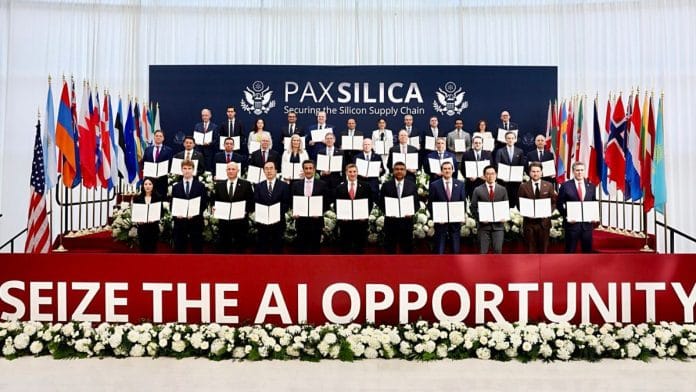


New Delhi: The United States has assured India that access to advanced artificial intelligence (AI) models will not be cut off abruptly for trusted partners, after Washington suspended Anthropic’s Fable model under an export control order, officials said on the sidelines of the second Pax Silica Summit on Thursday.
ANI quoted Ministry of Electronics and Information Technology (MeitY) Secretary S. Krishnan as saying that India had sought clarity from the US on the matter. “We sought an understanding of how exactly the US is looking at this particular aspect and what their concerns are and how in the future this could be a reliable source of technology because if it is something which is to be used and made available, we can’t have abrupt cutoffs,” the agency quoted Krishnan as saying.
“We were given an understanding of how the US looks at this particular issue and how going forward they will ensure that for trusted partners access will not be an issue,” he added.
US Under Secretary of State for Economic Growth, Energy and the Environment Jacob Helberg was asked whether the Fable model was discussed with India. “We continue to have ongoing conversations about this topic with our Indian friends. These are very sensitive national security discussions that are not quite right for public consumption,” ANI quoted Helberg as saying.
He said both sides understood each other’s perspectives, and that the US intended “to continue a gradual measured approach to how we release Anthropic’s models in a way that is safe, both for ourselves but also for our Indian counterparts as well as all our trusted partners”, including for critical infrastructure and the power grid.
The remarks come two weeks after the suspension of two Anthropic models. On 12 June, the US Commerce Department issued an export control directive, ordering Anthropic to halt access to its Fable 5 and Mythos 5 models for any foreign national, inside or outside the United States, including the company’s own foreign-national employees. Anthropic, stating it could not filter users by nationality in real time, disabled both models worldwide. The models had been launched three days earlier, on 9 June. Access to Anthropic’s other models was not affected.
The government cited national security authorities and, according to Anthropic, a reported method of bypassing the Fable model’s safeguards. Anthropic said it reviewed the technique, described the vulnerabilities as minor and previously known, and said it believed the action was based on a misunderstanding. The full text of the order has not been made public.
On the Pax Silica Summit, ANI quoted Krishnan as saying the focus was on building resilient supply chains across the AI stack. “The important element is the way that different countries in the world will come together to build a diversified and resilient supply chain for all that is needed in the AI stack—starting all the way from energy, the availability of infrastructure to build out the kind of data centres… the way that chips would get supplied… the way that applications would get built, models would get built, data would get shared or used,” he said.
Pax Silica is a US-led initiative on secure AI supply chains, trusted technology ecosystems and critical minerals. India signed the declaration on 20 February in New Delhi.
On his bilateral meeting with Helberg, ANI quoted Krishnan as saying the discussions covered ways for the two countries to deepen the technology relationship. “Ultimately the benefits of AI really come from its diffusion and deployment in various sectors, real sectors of the economy whether you are talking about manufacturing or agriculture or healthcare or education or governance,” he said.
He added that “no one country can do it on its own”, and that there was a need to build resilience “by having a diversification of supply chains by making sure that we are not overdependent on any one geography”. Krishnan said there was recognition that “India needs to play a much bigger role in the global supply chain”.
(Edited by Nardeep Singh Dahiya)