






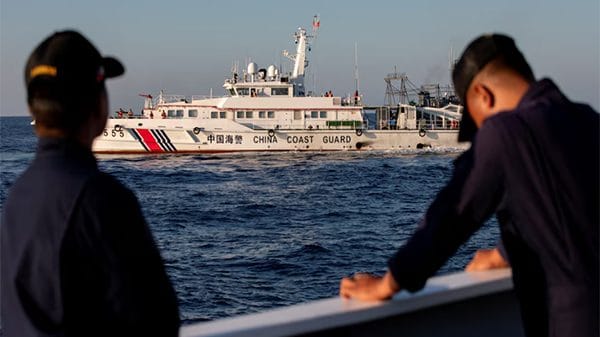


Another Pentagon-led name change was unveiled last week, when it was announced that the military’s US Indo-Pacific Command would be dropping “Indo” from its name and reverting to the long-standing US Pacific Command, or USPACOM. The move, according to a Pentagon release, “honors the command’s deep historical roots, fostering a sense of pride and collective spirit among all who serve in the Pacific.”
The renaming has drawn criticism. US Senator Tim Kaine, a member of the Senate Armed Services Committee, issued a statement that said, “Rather than taking steps to end this deeply unpopular war, this bill rebrands the Department of Defense as the Department of War, a juvenile move that sadly describes the reality of a President who has abandoned meaningful diplomacy in favor of starting doubtful wars in multiple locations and threatening even more.”
Senator Kaine, an ardent proponent of the Quad and one of those who considers Quad as an essential, non-exclusive construct of like-minded democracies addressing security challenges in the Indo-Pacific, actively supports Pacific Command initiatives regarding arms sales and security ties with India to counter regional pressure.
To understand what is being discarded, it helps to recall how the Indo-Pacific construct came into being.
Also read: How does China see US’ Indo-Pacific name change?
The US strategy toward the Indian Ocean
The US launched the Proliferation Security Initiative (PSI) in 2004 with the objective of curbing the proliferation of weapons of mass destruction. The countries and non-state actors on which the PSI focused covered a geographic arc stretching from Iran to North Korea — spanning the Indian Ocean and the Pacific Ocean — giving America the necessary reason to formalise the Indo-Pacific as a strategic region.
In August 2007, speaking in the Indian Parliament, then Prime Minister of Japan Shinzo Abe declared: “We are now at a point at which the Confluence of the Two Seas is coming into being. The Pacific and the Indian Oceans are now bringing about a dynamic coupling as seas of freedom and of prosperity.” He envisaged the Indo-Pacific as “the Arc of Freedom and Prosperity” formed along the outer rim of the Eurasian continent — an open network spanning the entirety of the Pacific Ocean, incorporating the United States and Australia, allowing people, goods, capital, and knowledge to flow freely. Little wonder that the US Navy saw great advantages in renaming its Asia-Pacific Naval Command accordingly.
The American strategy towards the Indian Ocean has always been shaped by the pressures of great-power rivalry and an urge to secure friends in the Indian Ocean Region (IOR). President Harry S Truman’s administration aligned with Pakistan as a Cold War ally to contain the Soviet Union in South Asia, West Asia, and the Indian Ocean. The move turned out to be a huge strategic error of judgement. The alliance increased India-Pakistan hostility, undermined regional stability, and pushed India closer to Moscow.
The Indo-Soviet Friendship Treaty of August 1971 was a direct consequence, signed as India-Pakistan hostilities loomed, resulting that year in the liberation of Bangladesh. At the height of that conflict, the Indian Ocean almost became an arena for superpower contestation: a squadron of six Soviet ships, including Kresta and Kynda-class guided missile frigates, entered the Ocean close on the heels of the USS Enterprise task force.
Securing a foothold in the Indian Ocean also led the Pentagon, in 1969, to construct a dredged anchorage, fuel storage, runway, and communications facility on Diego Garcia, facilitated by the Anglo-American BIOT Agreement of 30 December 1966 for about $37 million. New Delhi opposed the plan but was eventually convinced of the base’s utility within a broader regional maritime security architecture.
Today, Donald Trump’s administration is securing ties with Islamabad to contain China’s forays into the Indian Ocean, West Asia, and Iran — and to counter-balance India and Russia in building a regional security architecture. The parallel with the Cold War is uncomfortable and the errors may be similar.
Also read: Is the consensus around Indo-Pacific changing? The divergence has been long time coming
How should India respond?
It is strange that, at a time when the security architecture of the Indo-Pacific needs to be strengthened, the US Navy should choose to revert to the Pacific Command. The Trump administration could be in a hurry to close trade deals with China and, in the bargain, go slow on Indo-Pacific and Quad initiatives.
America is giving up its hold over “Indian Ocean” by withdrawing from the “Indo” of the Indo-Pacific. Instead of reverting to Asia-Pacific, it is limiting itself to “Pacific”. But future governments will find it difficult to make up for the lost opportunities and strategic space. As the world moves towards a new Cold War and asymmetries among contesting powers grow, a mere Pacific Ocean-centric US Naval Command will only end up exposing the US Navy to greater vulnerabilities.
India, for its part, can continue to focus on the Indian Ocean, where its navy reigns supreme. With the development of the Andaman and Nicobar ports and maritime facilities, India’s strategic capabilities in administering the Indian Ocean Region will only increase. Sooner or later, probably under a new leader in the White House, the advantages of reverting to the Indo-Pacific Naval Command will become apparent, bringing the US Navy closer to its strategic objectives.
In the coming years, the geopolitics of the Indo-Pacific region will be marked by two congruent developments: the US-China security rivalry, economic engagement, and the contest for strategic space; and the deep economic interdependence that will simultaneously impact the region’s future. The nature and direction of this race — between the US and China on one hand, and China and other countries in the Indo-Pacific on the other — will shape the future of Asia in general and India in particular, deeply influencing the emerging new world order.
Seshadri Chari is the former editor of ‘Organiser’. He tweets @seshadrichari. Views are personal.
(Edited by Prashant Dixit)
Call me a Little Indian, very mindful of the fisc. The Indian Ocean is where India’s maritime domain begins and ends. Keeping India impeccably safe. Blue waters that lie beyond are the concerns of others.