






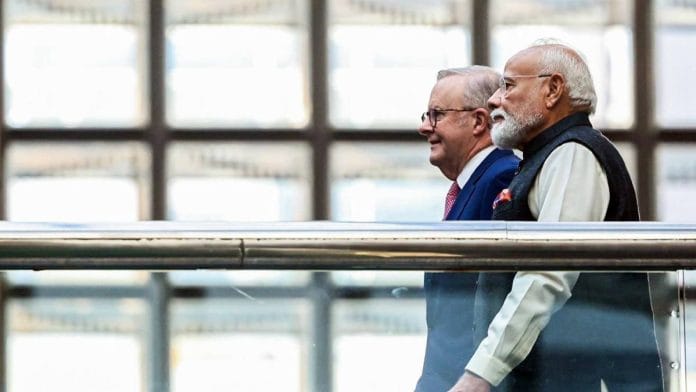

Prime Minister Narendra Modi’s latest visit to Australia has produced an outcome, among others, of considerable strategic consequence: arrangements have now been ironed out to enable Australian uranium exports to India. Australia holds the world’s largest known uranium resources and India has set an ambitious target of achieving 100 GW of nuclear power capacity by 2047. The complementarities are obvious.
Yet the importance of this agreement goes beyond simply purchasing uranium from yet another source. It should also serve as a trigger for understanding the pivotal moment in India’s civil nuclear aspirations, its painstakingly built ecosystem and the government’s seriousness to deliver.
India has understood the costs of energy dependence the hard way. Sanctions on oil-exporting countries and more recently continued disruptions in the Strait of Hormuz have left little to the imagination. New Delhi realises the strategic cost of dependence on imported hydrocarbons passing through narrow maritime chokepoints. Part of India’s response has been to diversify suppliers. Another has been to extract greater value from its own coal reserves by encouraging private participation in mining and coal gasification, which converts low-calorific-value Indian coal into syngas that can partly substitute for natural gas. But alongside, India is now also doubling down on nuclear power—a genuine gamechanger.
Like most strategic sectors, nuclear power is shaped by supply-chain geopolitics: who possesses uranium, who dominates reactor technology, who can finance and construct nuclear plants and who wins the race for Small Modular Reactors, or SMRs. The digital revolution has only sharpened this urgency further. Nuclear power is no longer only about electricity for homes and industries. It is increasingly about reliable, low-carbon baseload power for data centres, artificial intelligence infrastructure and future industrialisation. The IEA describes nuclear as the world’s second-largest source of low-emissions electricity after hydropower. There is renewed global interest in nuclear power as countries look for energy security and decarbonisation together.
The big picture
The global nuclear landscape remains dominated by a handful of countries. The US is still the largest producer of nuclear electricity. France remains the most nuclear-dependent major economy, generating about 67 per cent of its electricity from nuclear power in 2024. Russia’s state-owned Rosatom continues to be a major global pioneer of reactors and uses civil nuclear cooperation as a potent foreign-policy instrument. China, although a late entrant, has rapidly become one of the most important players in new reactor construction and SMR deployment, including the ACP100/LingLong One project in Hainan.
India entered the nuclear age almost immediately after Independence. The Atomic Energy Commission was first set up in August 1948, and the Department of Atomic Energy followed in 1954. Under Homi J Bhabha, India’s nuclear programme combined scientific ambition with a long-term strategic vision: limited uranium resources would be used carefully, while the eventual goal would be to exploit India’s abundant thorium reserves.
In those early years, India benefited hugely from the US Atoms for Peace programme and from Canadian assistance, including the CIRUS research reactor. But the boundary between peaceful nuclear technology and geopolitics was never simplistic. India’s 1974 Pokhran test, described by New Delhi as a peaceful nuclear explosion, triggered an immediate international backlash. Canada and the US halted cooperation, and an international association called the Nuclear Suppliers Group was created to restrict transfers of nuclear materials and technology. India’s refusal to join the Nuclear Non-Proliferation Treaty (NPT) effectively isolated it from much of the global nuclear market.
That isolation, however, also accelerated indigenisation. India expanded Bhabha’s three-stage nuclear programme. In the first stage, Pressurised Heavy Water Reactors use natural uranium to generate electricity while producing plutonium-239. In the second, Fast Breeder Reactors use plutonium to breed more fissile material while converting thorium-232 into uranium-233. The third stage aims eventually to use India’s thorium resources at scale. The Prototype Fast Breeder Reactor at Kalpakkam is therefore not just another technical milestone; it is central to the logic of India’s nuclear strategy.
India’s 1998 nuclear tests again brought sanctions. Yet they also eventually forced the world to recognise India’s exceptional position. India separated its civilian and strategic facilities, signed the India-US Civil Nuclear Agreement, and received the Nuclear Suppliers Group waiver in 2008. This allowed India to import uranium and engage in civilian nuclear cooperation while preserving the autonomy of its strategic programme and indigenous fuel-cycle ambitions.
Even during India’s years of isolation, two relationships stood out.
The first was the Soviet Union. India and the Soviet Union signed an agreement in 1988 for reactors at Kudankulam in Tamil Nadu. Post 1991, Russia reaffirmed its commitment even after the 1998 sanctions. Kudankulam Unit 1 began commercial operation on 31 December 2014, and Unit 2 followed shortly.
The second was France, whose position is more distinctive. Despite being part of the Western strategic bloc, France continued engagement with India in defence, space and nuclear cooperation after both 1974 and 1998 sanctions. After the NSG waiver, France became one of India’s most important civil nuclear partners.
The Jaitapur project in Ratnagiri, Maharashtra—six EPR reactors with a planned installed capacity of 9.6 GW—is designed to become the world’s largest nuclear power project when completed. Despite being sanctioned in 2005, construction has not begun because negotiations over cost, localisation, financing and liability have dragged on.
Why has the project remained stalled? To answer that, one must understand how the liability question became the primary roadblock.
India’s Civil Liability for Nuclear Damage Act of 2010 was shaped by legitimate anxieties after the Bhopal gas tragedy. But two provisions created deep uncertainty for suppliers. While Section 17(b) allowed the operator to seek recourse against suppliers for defective equipment, Section 46 raised concerns that other legal claims might remain open.
Western firms such as Westinghouse, GE and French suppliers feared open-ended exposure. Russia, with state-backed Rosatom and older agreements predating these laws, could manage the risk differently. But the private Western capital stayed away.
The course correction
Two course corrections began in 2025. First, the Union Budget 2025-26 announced a Nuclear Energy Mission with a target of 100 GW of nuclear power capacity by 2047. It also allocated Rs 20,000 crore for research and development of SMRs, with at least five indigenously developed SMRs to be operationalised by 2033.
The second was the much-awaited enabler. The SHANTI Bill, introduced in December 2025 and later passed by Parliament, consolidated India’s nuclear legal framework, replaced the Atomic Energy Act of 1962 and the draconian Civil Liability for Nuclear Damage Act of 2010, and opened the door to private participation under regulatory oversight.
This does not mean that India has abandoned state control over strategic nuclear activities. But it does mean that the civil nuclear sector can finally begin to attract private capital, joint ventures and foreign technology partnerships with greater legal clarity.
This is where SMRs return to the discussion.
India currently generates only a small share of its electricity from nuclear power. Conventional gigawatt-scale reactors require huge upfront investment, long construction timelines and complex site-specific infrastructure. SMRs, generally up to 300 MW per module, promise smaller reactor units, factory fabrication, modular deployment, passive safety features and the possibility of repurposing retiring coal-power sites.
For India, SMRs complement its three-stage programme. They can help bridge immediate power gaps, provide reliable electricity for energy-intensive industry and data centres, and create technological pathways that may eventually support alternative fuel cycles, including thorium. But they are not magic. Most SMR designs currently remain at demonstrative or early commercial stages. Their economics depend on standardisation, repeat orders and manufacturing scale. Waste management, regulation and public acceptance will remain hard questions to be managed.
India will therefore need international partnerships—not because its indigenous programme has slowed, but because the scale and urgency of its ambitions require capital, technology, risk-sharing and secure fuel supplies. Russia and France remain important. The new legal framework could finally make American participation more realistic. Canada has long been an important partner in supplying uranium to India. Australia could now become another reliable long-term supplier of uranium.
Uranium partnerships are not peripheral to India’s nuclear ambitions. They are central to operating an expanding civilian reactor fleet without counting on limited domestic uranium resources. Imported uranium can support safeguarded civilian reactors while India continues its indigenous fuel-cycle work.
Even if India falls short of the lofty 100-GW target by 2047, any credible progress towards more nuclear power will put us better off.
A last word on the wider geopolitical moment. Much has been said today about middle powers cooperating in a fragmented world. Civil nuclear energy—especially SMRs—could become one area for issue-based cooperation. While the discussion on de-risking from perpetual uncertainty is repeated at every strategic discussion, the way forward lies in creating practical mechanisms for cooperation on specific issues rather than getting lost in semantics.
India’s nuclear journey is fascinating because it contains all the ingredients of a young nation’s attempt to navigate a world divided between technological haves and have-nots. At heart a story of scientific temper and innovation, it is equally a story of geopolitics—acting alternately as trigger, impediment and catalyst. This conversation is far from over. In fact, a wider discussion on nuclear power and SMRs is likely to become a centrepiece of India’s strategic discourse.
Swasti Rao is a Consulting Editor (International and Strategic Affairs) at ThePrint. She tweets @swasrao. Views are personal.
(Edited by Prashant Dixit)
The spectacular rise of renewables, solar in the lead, continuing fall in costs, the problem of storage being gradually overcome, perhaps India will not need 1,00,000 megawatts of nuclear energy. After Fukushima, safety is a concern. The need to store radioactive waste for thousands of years.