




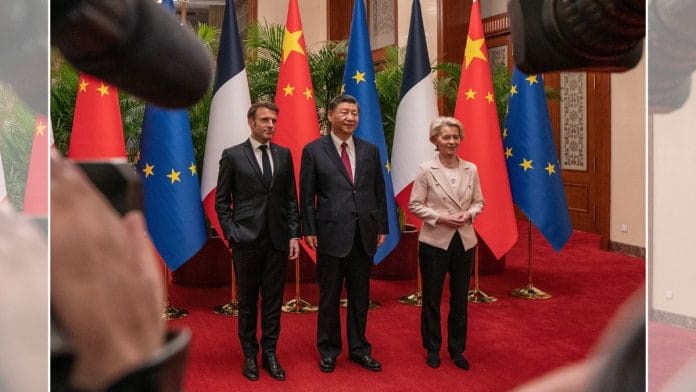

In Chinese discourse, Europe’s China policy is portrayed as strategically contradictory. Brussels seeks to compete with Beijing, reduce dependence on Chinese supply chains, and curb China’s influence, even as European economies remain deeply intertwined with China through manufacturing, technology, trade, and investment. Chinese commentary argues that Europe wants to preserve the benefits of economic engagement while avoiding the costs of competing with a rising industrial power.
The European Union’s tougher China policy, including its designation of Beijing as a systemic rival, anti-subsidy investigations, tariffs, and de-risking measures, is interpreted as a response to declining European industrial competitiveness. Germany’s dependence on the Chinese market, France’s export interests, and the more pragmatic positions of countries such as Hungary and Spain are cited as evidence that national economic priorities continue to hinder the EU from crafting a coherent China strategy. In this reading, economic interdependence is both Europe’s constraint and China’s leverage. Full decoupling is unrealistic, but trade friction is expected to intensify.
A ‘controlled trade war’
Chinese analysts characterise the EU’s current approach as a “controlled trade war”. Europe’s simultaneous use of tariffs, trade investigations, and industrial restrictions alongside continued diplomatic engagement is presented as evidence of this balancing act.
Dong Yifan, associate researcher at the Institute of Country and Regional Studies at Beijing Language and Culture University, describes the EU as “fighting while negotiating” with China. He argues that Europe is attempting to reduce dependence through unilateral pressure and protectionist measures while continuing to benefit from economic ties. In his view, this approach fails to recognise the mutually beneficial nature of China-EU economic relations and risks making differences more difficult to manage.
Ding Chun, director of the Centre for European Studies at Fudan University, offers a similar assessment. He argues that the establishment of the China-EU trade and investment consultation mechanism demonstrates both sides’ recognition that a full-scale trade confrontation would be mutually damaging. At the same time, Chinese commentators contend that Brussels’ insistence on deadlines and “tangible results” suggests dialogue is also being used as a means of pressuring Beijing while giving the EU time to manage its own internal divisions.
This interpretation is echoed in online discussions. A Weibo user argued that Europe is not pursuing an outright anti-China strategy but one driven by “fear, defence, and containment” in response to China’s industrial rise. Another suggested that protectionism would neither restore European competitiveness nor resolve its structural economic problems, but instead raise costs for European economies themselves.
Also read: Skyroot’s Vikram-1 success shows it’s time for ISRO to redefine its role
Is China really the problem?
A central theme in Chinese discourse is the rejection of the argument that China is responsible for Europe’s industrial difficulties. Instead, European trade restrictions are portrayed as an attempt to manage domestic industrial anxieties in a changing global economy, one where China has evolved from a manufacturing partner into a technological and industrial competitor.
A Weibo user argued that Europe is attempting to restore competitiveness by restricting Chinese competition rather than addressing its own structural weaknesses.
Chinese scholars likewise attribute Europe’s economic difficulties primarily to internal structural challenges, including high energy costs, weak industrial competitiveness, regulatory constraints, demographic pressures, and slow innovation.
Zhao Jizhou, associate researcher at the Institute of European Studies at the Chinese Academy of Social Sciences, argues that Europe’s slowdown exposes a combination of external shocks, including energy disruptions following the Russia-Ukraine War and US trade pressure, alongside longstanding domestic constraints.
Zhang Mengting, a researcher at Ningbo University, contends that China’s manufacturing advantage increasingly rests on technological upgrading, integrated industrial chains, and green transformation rather than scale alone.
Also read: Sri Lanka’s Sigiriya wasn’t Ravan’s palace. Here’s the real history
From trade disputes to a wider contest
Beyond trade, Chinese discourse frames EU-China tensions as part of a wider shift in Europe’s strategic outlook. Ding argues that competition is moving beyond isolated trade disputes toward a broader contest over industrial policy, market access, supply chains, and economic security. According to him, the EU’s earlier triple positioning of China as partner, competitor, and systemic rival is gradually giving way to a more security-centred approach driven by concerns over industrial competitiveness and technological dependence.
Chinese commentary also points to what it sees as a contradiction in Europe’s broader China policy. Li Cheng, professor of political science at the University of Hong Kong, argues that Europe wants Beijing to contribute more to addressing global challenges while simultaneously resisting any expansion of Chinese influence.
Paradox and contradiction now dominate Chinese interpretations of the EU’s China policy. Across official statements, academic analyses, and online commentary, Europe is portrayed as attempting to reconcile two competing objectives: benefiting from Chinese investment, technology, and markets while simultaneously attempting to reduce dependence on China. For Chinese observers, the central question is whether the EU can align its strategic ambitions with the economic interdependence that continues to underpin bilateral relations. How Brussels manages this tension is likely to remain one of the key forces shaping the future trajectory of China-EU relations, as well as the discussions in Beijing.
Sana Hashmi, PhD, is a fellow at the Taiwan-Asia Exchange Foundation. She tweets @sanahashmi1. Views are personal.
(Edited by Prasanna Bachchhav)
It is in Europe’s interest – going through a phase of anaemic economic growth – not to disable trade and investment ties with China. Place geopolitics in a separate silo. 2. Chancellor Angela Merkel visited China annually, accompanied by a large business delegation.