



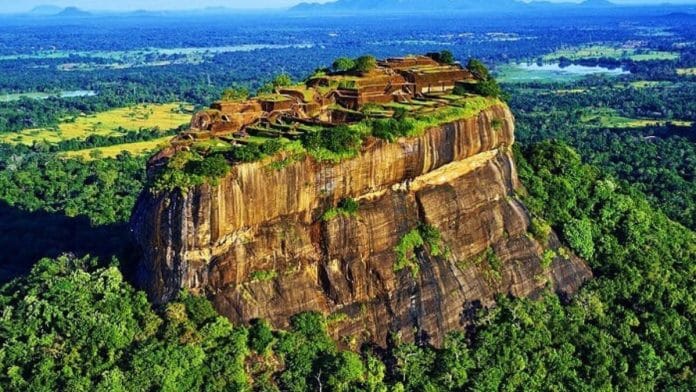
Deep in the heart of Sri Lanka’s dry zone and its undulating plains, rises the extraordinary site of Sigiriya. It was inscribed as a UNESCO World Heritage Site in 1982 not only for its dramatic history, but for the ingenuity of the engineers. They built a compelling fortress surrounded by water gardens in the 5th century CE. Positioned at the centre of the country’s Cultural Triangle, the 200-metre rock fortress draws millions of visitors who scale its heights each year, yet its origins remain hard to grasp. It’s unfathomable how the fortress came into existence and then went back into oblivion until mid-1800s, when British officers pushed through the surrounding jungle and local superstitions to explore it.
Indian travellers who visit Sri Lanka and ascend the rock fortress should set aside the version of its history pushed by social media influencers. This is not the mythical palace of Ravana from the epic Ramayana, nor the garden where Sita was supposedly held captive; it is the fortress built by King Kassapa I, after a brutal and calculated struggle for succession. But to understand why a king would build something this ambitious, fortified on a geological marvel, you have to trace back its history, and the archaeology that eventually brought it back to light.
A royal rumble
Sri Lanka’s ancient capital of Anuradhapura came under new rule around 455 CE, when King Dhatusena claimed the throne. His victory marked the founding of the Moriya Dynasty. The greatest achievement of his reign was the construction of the irrigation system, which significantly improved agricultural activities in the area.
But he was less admired on the personal front. Kassapa, the eldest of his three children, was born to a concubine and wanted the throne for himself. But his younger brother Moggallana, who was born to the queen consort, was the legitimate successor.
A breaking point came when Dhatusena’s daughter was tortured by her husband and the general of his army, Migara. The grieving king had her mother-in-law, who was also his own sister, put to death by fire. Migara was enraged and extended his support to Kassapa.
By 473 CE, Kassapa had successfully overthrown his father and taken him captive.
With power came privilege and resources of the region. Driven by the goal of immortalising his name, he shifted King’s seat from Anuradhapura, which was both a political and religious centre, to Sigiriya in 477 CE.
According to local legends, Kassapa built his fortress at Sigiriya purely as a defensive bulwark anticipating the war his exiled brother was sure to bring. But according to Sri Lankan archaeologist S Paranavitana, the story doesn’t entirely hold up under scrutiny.
Sigiriya’s palace and water gardens suggest a lavish royal estate rather than a pure military stronghold. The rock offered natural defence, but the garden below followed no defence architecture. Ramparts and moats enclosed over a hundred acres of pavilions, ponds, gateways along with a series of buildings. The twenty caves at the base of the rock have been used by monks since 2nd century BCE, as mentioned in one of the Brahmi inscriptions. There were carved thrones and cisterns among the boulders.
From the base of the rock, stone stairways lead to its western face, where lion paws are carved. From there another stairway leads toward the summit. The last lap of the stairway is missing, as evidenced by faint grooves that survive today. Atop the rock, spread across roughly three acres, lie the ruins of the royal palace, its outer wall set right at the cliff’s edge, with pavilions and gardens extending westward.
Apart from structural remains, the site includes a gallery on the western face of the rock with murals of celestial nymphs or court women in a pocket on the rock face. This extended to a length of about 500 feet from its starting point and must have been constructed at a great cost. The gallery joins a flight of steps built on the slope of the hill at the base of the rock on its northern face. Scholars hold that this feature of Sigiriya was intended to be viewed from the mirror wall, and was an unnecessary addition from engineering point of view. Today only a fraction of murals have survived.
Also read: Sri Lanka’s Ibbankatuwa shows what India gets wrong about archaeology
The fall
Kassapa ruled from Sigiriya for eighteen years as he was building his fortress full of pomp and luxury.
While it is true that the rock on which his palace complex stood was unscalable, scholars like Paranavitana think that defence was not the reason. It is argued that Kassapa’s motives were simply to create an extraordinary fortress, bigger and grand than that of Anuradhapura.
This is substantiated by a reference in Cūlavamsa (39, v.1.3.5) which states that Kassapa wanted the palace on the summit of Sigri to be a second Alaka where he would dwell like God Kuvera.
In 495 CE, Moggallana returned from India with an army, won the battle with Kassapa and took over the throne. Kassapa was devastated and took his own life. After his death, the palace on the summit was abandoned and the water gardens, caves and other buildings were given to Buddhist monks. The capital was again shifted to Anuradhapura.
Unearthing Sigiriya
In 1831, Major Jonathan Forbes and his party of English soldiers were the first Europeans to visit the remains of Kassapa’s remote palace and gardens. Twenty years later, British surveyors and mountaineers made the first recorded climb to the summit in the modern era. Formal archaeological excavation began under HC Bell in the late 19th century.
In 1894, Bell climbed the summit using a makeshift ladder. By the end of that year his team began to clear the jungle growth in preparations for a full excavation. Systematic excavation began in 1895 and continued till 1898, during which Bell and his team cleared and surveyed the entire rock and its immediate surroundings. This investigation led to the documentation of the palatial complex on the summit, the gallery, the boundary wall, rampart, moat and garden layout.
The results of these investigations were compiled into six volumes of the Archaeological Survey of Ceylon. This laid the foundation for later works undertaken by Senarat Paranavitana in the 1930s and 40s and the UNESCO and Central Cultural Fund (CCF), work from 1982.
What sets Sigiriya apart from many ancient sites is not just its survival, but the discipline with which it has been maintained. The CCF, the government body overseeing the site, enforces strict rules in order to maintain the site. The tanks and other water bodies within the walled complex are regularly cleaned by employees and volunteers. The landscape is well-maintained by the authorities. Moreover, regular restoration and conservation works are undertaken by the government in collaboration with universities, ensuring skill development and student engagement at the site.
What is equally striking was the ticket pricing at the site. As of 2026, Sigiriya’s foreign tourist ticket stands at $35, with a discounted $20 for travellers from SAARC nations. It covers not just the climb but the on-site museum. The funds are used for conservation work and the upkeep of the gardens and reservoirs. If similar ticket rates are implemented in India’s own heritage sites, ticket revenues will cover the conservation needs and upkeep.
Sigiriya’s story is still not done. Scholars from University of Kelaniya, Colombo and La Trobe University, Australia are all set to undertake lidar surveys of the site with the hope of finding more about it.
Disha Ahluwalia is an archaeologist and junior research fellow at the Indian Council Of Historical Research. She tweets @ahluwaliadisha. Views are personal.
(Edited by Theres Sudeep)