




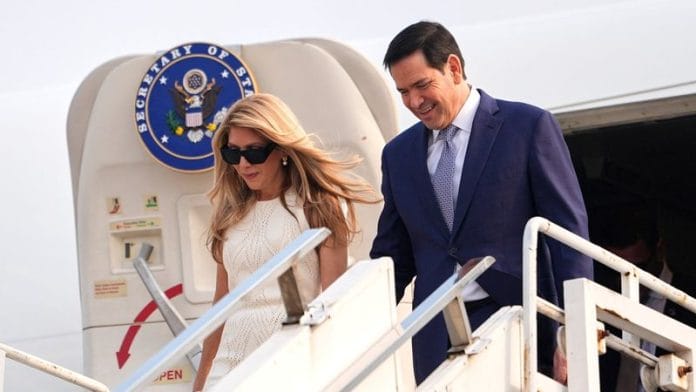

United States Secretary of State Marco Rubio’s four-day visit to India attracted significant attention on Chinese online platforms. Commentators repeatedly asked why Washington was suddenly projecting greater warmth towards New Delhi. A common view suggested that Rubio arrived with expectations of resetting and strengthening US-India ties across energy, trade, defence, and the Quad framework.
Particular attention was given to Rubio’s press interaction in India. When a reporter raised a politically charged remark without naming President Donald Trump, Rubio responded that “every country has stupid people”. His accidental response circulated widely in Chinese online discussions.
Strategic itinerary
Rubio’s itinerary itself became a focus of analysis. A Weibo post noted that his first stop was the Missionaries of Charity in Kolkata, where he met nuns associated with the organisation founded by Mother Teresa, rather than beginning in New Delhi or at a major Hindu site. Chinese observers offered differing interpretations, ranging from his Catholic background to a more instrumental reading of soft power diplomacy aimed at projecting humanitarian values alongside strategic engagement.
Another strand of commentary attached geoeconomic significance to the choice of Kolkata, described as eastern India’s largest industrial centre and a key Bay of Bengal port near China’s southwestern periphery. In this reading, Rubio’s meetings with West Bengal officials and local entrepreneurs were linked to supply chain restructuring and Washington’s “China+1” strategy, with eastern India cast as a potential manufacturing hub. The visit was thus read as signalling renewed US interest in a geopolitical stronghold along the Bay of Bengal.
In Chinese strategic commentary, Rubio’s India visit was also linked to his earlier engagements in Northern Europe. One commentator described the itinerary as a carefully designed diplomatic chessboard rather than a routine sequence of meetings. Rubio attended the NATO Foreign Ministers’ Meeting in Gothenburg, where discussions focused on European security and allied burden-sharing, before travelling to India for the Quad Foreign Ministers’ Meeting. Chinese discourse interpreted this sequencing as evidence of Washington’s effort to align its European and Indo-Pacific strategies.
Also read: Iran to Marco Rubio—Nice Taj Mahal photo, too bad our architects made it
Diplomatic signalling and strategic objectives
Within Chinese strategic discourse, Rubio’s India visit is situated in the context of Trump’s outreach to Beijing and interpreted as part of Washington’s broader Indo-Pacific strategy. Commentators identify three main objectives: repairing the US-India partnership, which they argue was strained by Trump-era tariff policies and US engagement with Pakistan and China; revitalising the Quad; and maintaining strategic balance amid intensifying great power competition.
The visit is also framed as part of a wider US effort to recalibrate Indo-Pacific influence through security coordination and economic statecraft. Chinese analyses emphasise Washington’s use of energy diplomacy, particularly efforts to expand US leverage through oil markets, supply assurances, and strategic inducements aimed at encouraging closer Indian alignment with the US-led order. A recurring claim is that Washington seeks to reduce India’s dependence on Russian energy while drawing it further into its orbit as a counterweight to China. One post characterised Rubio’s diplomacy as “cleaning up after Trump” through initiatives such as promoting Venezuelan oil supplies to India, while another described his ‘cultural goodwill” visit as nothing more than his effort to “clean up the mess” in US-India relations.
Qian Feng, a researcher at the Institute for National Strategic Studies at Tsinghua University, contended that US oil is unlikely to displace the Middle East’s central role in India’s energy mix in the near term and would function primarily as a tool for supply diversification rather than substitution.
Broader commentary suggests that successive US administrations have treated closer US–India cooperation as central to Indo-Pacific strategy, with sustained efforts to draw India away from non-alignment in order to counter regional power shifts and reinforce US influence. At the same time, analysts stress persistent uncertainty in the relationship, shaped by trade frictions and India’s continued emphasis on strategic autonomy. Chinese observers interpret the visit as easing bilateral tensions and strengthening cooperation in security, energy, and trade, while noting that divergent strategic priorities continue to generate friction and tactical hedging.
The Quad features prominently in these discussions. Some commentators describe it as an uneasy arrangement in which members pursue independent strategic calculations despite US efforts at coordination. Others argue that the Quad cannot function effectively without India, and that US Indo-Pacific strategy would be severely weakened were New Delhi to move closer to Moscow or Beijing.
A further strand of analysis insinuates that the Quad is no longer a coherent anti-China structure but an increasingly fluid framework shaped by shifting US priorities, including towards Russia. India is portrayed as the key balancing actor, leveraging US–China–Russia competition to preserve autonomy, while Japan and Australia face growing strategic uncertainty. In this reading, the Indo-Pacific order is moving away from rigid bloc formation towards a more fluid and multipolar configuration in which the Quad’s original purpose is gradually being diluted.
India’s balancing approach and broader contestation
Chinese online discourse ranges from dismissive commentary on India’s infrastructure to more analytical geopolitical assessments. Some posts mock Kolkata’s ageing airport, pollution levels, and extreme summer temperature in North India, using Rubio’s visit to reinforce perceptions that India remains distant from China’s level of economic development. Shanghai Institute for International Studies’ Liu Zongyi argues that the US, Europe, and Japan are seeking to support India’s industrial and supply chain development in order to reduce dependence on China, while questioning whether India can realistically replicate China’s manufacturing capacity.
Beyond such rhetoric, much of the discussion emphasises India’s strategic value. One strand argues that the US is attempting to use India as a counterweight to China, framing Rubio’s visit as part of a broader containment strategy. However, the same commentary also stresses India’s agency and resistance to external manipulation, suggesting that Washington is as concerned with reassuring India.
Chinese observers characterise Prime Minister Narendra Modi’s foreign policy as strategic balancing rather than alliance alignment, with India engaging multiple major powers while avoiding binding commitments in order to preserve strategic autonomy through flexible and pragmatic partnerships. This framing extends to India’s energy diplomacy as part of a broader multi-alignment strategy situating US-India relations within a wider Indo-Pacific contest.
The pattern of India-US engagement is viewed as generating ambiguity in Chinese assessments of US intent, while the consolidation of cordial US-India ties and Quad coordination is also seen as a source of strategic unease in China’s broader regional calculations.
Sana Hashmi, PhD, is a fellow at the Taiwan-Asia Exchange Foundation. She tweets @sanahashmi1. Views are personal.
(Edited by Prashant Dixit)