




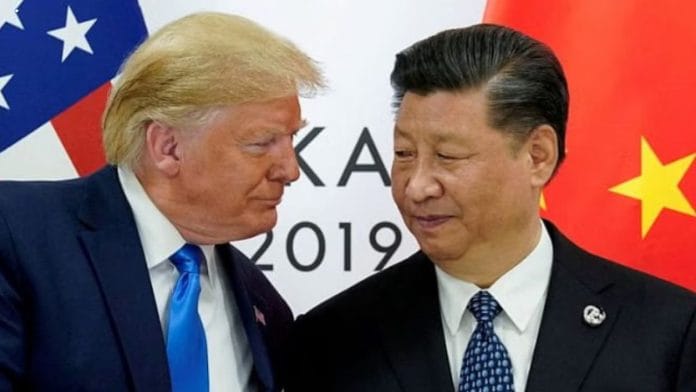

The pageantry in Washington was elaborate enough to make the Donald Trump-Xi Jinping summit look like a G2 truce. Trump personally received Xi at Joint Base Andrews. US aircraft such as B-2s and F-22s flew overhead, military bands marched, the White House rolled out a state dinner, Trump made Xi laugh and eventually discovered that the Chinese president shared his appreciation for one particular American asset: “he loves good granite”.
Strip away the granite, however, and a simpler question emerges: what kind of TRUCE did this truce actually achieve?
The answer can be decoded rather neatly by turning the word into an acronym.
T for trade truce extended.
R for reciprocal leverage retained — Chinese rare earths versus American technology controls.
U for an unsettled Taiwan.
C for competition contained, not concluded.
E for engagement expanded, particularly on artificial intelligence (AI), without much new institutional architecture.
TRUCE captures both change and continuity and shows the limits of G2. Washington and Beijing have bought themselves more stability, but they did not dismantle the instruments with which they compete or resolve the bottlenecks that engulf their strategic interests.
T: Trade truce, extended—not reinvented
The conversation around the economic truce did not begin at the current summit.
Its immediate foundations were laid when Trump and Xi met in Busan, South Korea, on 30 October 2025, following months of tariff escalation. Under the arrangement implemented from 10 November in the same year, Washington suspended its heightened reciprocal tariffs on China for one year while retaining a 10 per cent reciprocal tariff. It also cut 10 percentage points from tariffs imposed over fentanyl flows.
China, meanwhile, reciprocated by suspending retaliatory tariffs and several non-tariff measures, easing restrictions involving rare earths and critical minerals, resuming purchases of American agricultural commodities and tightening controls on fentanyl precursors.
The Busan arrangement was due to expire on 10 November this year. As Xi arrived in Washington, Treasury Secretary Scott Bessent announced that the truce would now continue until 10 January 2027.
This is where American political scientist Rush Doshi’s pre-summit checklist becomes quite useful to revisit. He argued that the duration of any extension would tell us something about the relationship itself. Beijing wanted a much longer period of stability while Washington preferred a shorter extension, partly because the US remained dissatisfied with Chinese compliance, particularly over critical-mineral supplies.
The outcome suggests quite convincingly that neither side wanted escalation, but Washington was unwilling to lock itself into détente in the guise of stability.
Also read: India-China reset has limits. Don’t mistake it for a boundary settlement — see Taksing
R: Reciprocal leverage retained
Doshi’s more provocative argument concerned China’s changing leverage.
Beijing, he had argued before the summit, believes its ability to squeeze rare-earth supplies has altered Washington’s calculations. The present phase — what he calls a “détente but not quite a détente” — suits the Chinese narrative that thinks time may increasingly favour it in the larger competition.
One need not accept that conclusion in entirety to see what has changed. Let me explain.
For decades, discussions of economic interdependence assumed that America’s advantages lay in technology and finance while China’s vulnerabilities lay in access to markets and advanced innovation. That part of the relationship is now considerably more reciprocal.
China has shown the geopolitical value of its dominance in critical-mineral processing. But Washington continues to wield formidable advantages through advanced semiconductor and technology controls.
During the current summit, neither has surrendered that leverage. Beijing’s official statement speaks of a “new joint arrangement” between the economic teams, but gives no dramatic new tariff concessions or the abandonment of Chinese critical-mineral leverage. It does not mention any major American relaxation of advanced-technology controls either.
Importantly, Beijing has released detailed official accounts of the summit in both Chinese and English. At the time of writing, there is no joint statement or a comparable detailed post-summit account from the White House. The Chinese version therefore provides the fullest available official account of the closed-door exchanges, but it cannot, by itself, establish what Washington agreed to.
The summit therefore did not conclude this coercive interdependence. It, however, established more political space for managing it.
That is a subtle but an important takeaway. US-China strategic stability increasingly depends not on resolving economic weaponisation, but on both realising how to manage the escalation around it.
Also read: Chinese commentary on Xi-Trump summit is a cross between flowers and daggers
U: Unsettled Taiwan
Taiwan, once again, offers the clearest evidence of the limits of this new stability.
Xi asked Washington to accept what Beijing called their position of “opposing Taiwan independence.” The key phrase in Mandarin is fandui Taidu — literally, oppose Taiwan independence.
Washington’s established formulation has been close but not identical. It says that the US does not support Taiwan independence. Beijing would prefer something stronger but which Washington does not endorse.
Experts specifically said that semantics would be one of the tests worth watching.
Yet Beijing’s own statement records Xi making the demand without mentioning that the US accepted it.
Continued ambiguity on Taiwan, therefore, matters as much as subtle changes in Trump’s overall rhetoric to respect Beijing’s position. Once again, this deliberate word play remains a part of the broader management, not a conclusive position on their most dangerous fault line.
Trump’s uncertainty can itself have strategic consequences. But so far there is no evidence that Washington formally shifted to Beijing’s preferred formulation on Taiwan.
Also read: Trump’s Greenland deal changes little. His bullying can change US-Denmark ties
C: Competition contained — and Beijing wants a Naamkaran
This is the most interesting part of the summit.
In May, Trump and Xi agreed in Beijing to pursue what both governments called a “constructive US-China relationship of strategic stability.” The White House itself used a closely matching phrase in its May fact sheet.
It is worth pausing here because “strategic stability” used by the US traditionally carries a narrower, almost Cold War nuance — nuclear deterrence, escalation control and preventing catastrophic conflict between major powers.
Xi’s formulation is much broader. China’s official explanation describes constructive strategic stability as a relationship in which cooperation is the mainstay, competition remains within proper limits, differences are manageable, and peace can be expected. In other words, cooperate where possible, compete without losing control, manage what cannot be resolved, and prevent the rivalry from escalating to war.
The phrase, therefore, does not mean an absence of competition and seeks to define the acceptable boundaries of competition.
And Beijing clearly wants to institutionalise it. Xi’s statement said the two sides should now turn this vision “into action”. He wants engagement between ministries, economic officials, militaries and other institutions to thicken.
This is why I would distinguish constructive strategic stability, the actual agreed-upon phrase, from the looser idea of “comprehensive strategic stability”. Beijing’s ambition may indeed be comprehensive — extending beyond traditional military stability into economics, technology and political behaviour — but it is still not the terminology both governments officially adopted in May.
Once again, the difference in approach between Xi and Trump becomes telling.
Edgard Kagan, former US Ambassador to Malaysia, and now at the Center for Strategic and International Studies (CSIS), has also drawn attention to the importance of the relationship between the two leaders and the differences in how they approach the bilateral relationship. I would frame it as Trump personalises, but Xi institutionalises.
Trump speaks the language of friendship, deals and leader-to-leader chemistry and uses Trumpian pick-up lines to further his style of diplomacy. Xi speaks of frameworks, limits, departments, mechanisms and the formal relationship between two major powers.
Also read: How China sees US calls for AI slowdown. Its companies now get more room to catch up
E: Engagement expands—but does it ‘thicken’?
AI may provide the best test here.
Before the summit, Bessent had already hailed emerging US-China AI discussions, and officials were exploring something more ambitious: communication mechanisms dealing with serious AI incidents and national-security risks.
Doshi, therefore, posed an excellent question before Xi arrived: would this dialogue become “thick” or remain “thin”?
If it indeed thickens — would agencies engage regularly? Would mechanisms survive political tensions? In a genuine emergency, would someone actually pick up the phone and make a call?
Washington Summit provided only a partial answer at best.
Xi proposed continuing AI dialogue, discussing both risks and benefits, preventing misuse and ensuring that artificial intelligence remains under human control. Trump, according to the Chinese statement, supported continued dialogue and cooperation.
But no genuine AI-safety regime emerged, and neither did any major bilateral mechanism come out. Trump has resisted imposing additional restraints on AI development, while Xi’s language repeatedly stresses human control.
So engagement has expanded enough for headlines, but its institutional architecture remains thin.
Also read: New India-US trade portal shows India is trying to liberalise and protect at the same time
More than spectacle, less than settlement
This brings us back to Washington’s pageantry.
Reporting by Reuters described a meeting heavy on symbolism but light on breakthroughs across trade, Taiwan, AI and Iran.¹³ The Financial Times had anticipated pretty much the same logic before the talks, ie Xi’s central objective was to consolidate the more stable environment established since Busan and Beijing, rather than pin its success on headline-grabbers.¹⁴
There were continuities elsewhere too. One did not see any major new military crisis-management mechanism. Iran, Ukraine and the Korean Peninsula were discussed without producing breakthroughs. Beijing’s statement expectedly does not record a significant outcome on detainees or human rights.⁶
Yet calling the summit inconsequential because the deliverables were thin would miss its larger importance where due.
Trump and Xi appear to have moved from repeatedly asking whether their rivalry can be resolved to how a rivalry that cannot be resolved can be managed.
That is where constructive strategic stability and lack of unending breakthroughs become reassuring, even if with a hint of discomfort.
Uncomfortable, because the concept could also become a vehicle through which each tries to constrain the other’s behaviour. Seeking strategic stability cannot be indefinitely politically neutral.
Also read: The India-China reset will be tested in the Northeast
The bipolar ceiling above a multipolar world
There is one reason why the Washington summit matters.
Writing in The Indian Express ahead of the summit, C Raja Mohan argued that multilateral institutions, however ambitious, operate within parameters set by great-power politics rather than independently determining the international order.
The Xi-Trump summit happened as leaders from across the world gathered around the United Nations, trying to assert their agency and space in the era of growing unpredictability.
At the granular level, the contemporary international system increasingly looks multipolar. Middle powers have become more active. New plurilaterals have proliferated — the latest being the Partners for Multilateralism that Canada floated with the EU, India, Brazil, Kenya, Australia and Barbados on board.
India, Europe, Japan, Australia and the Gulf states have been developing overlapping strategic partnerships. These middle-power initiatives promise issue-based cooperation outside traditional great-power blocs.
Yet the world’s most consequential strategic questions continue operating in an oddly bipolar world.
Whichever way the elusive G2 is defined, neither Washington nor Beijing can simply dictate outcomes to others. But they continue to shape an extraordinary portion of the international system’s grand strategic boundaries.
Therefore, the Washington truce is best understood as the TRUCE, shaping a bipolar international system amid its multipolar pushback.
Swasti Rao is a Consulting Editor (International and Strategic Affairs) at ThePrint. She tweets @swasrao. Views are personal.
(Edited by Saptak Datta)
Viewed from New Delhi, what does this ( return ) summit mean for the future of Quad. For the larger enterprise of Containment of China of which India became a part.
President Trump, as a deal maker from New York real estate, would understand the substance contained in over the top symbolism. An elaborate state dinner – sea bass, not millets – is par for the course. But receiving President Xi at the airport, sixty years after President Kennedy and Jacqueline did so for Prime Minister Jawaharlal Nehru and Indira, will be seen with awe throughout the world. Quite different from the tiny audiences PM Sanae Takaichi and PM Andy Burnham obtained from President Trump. For President Xi, this demonstration of China’s importance in the US scheme of things is itself a notable achievement. Some form of G 2 that can no longer be denied. China already the top trading nation in the world. On par with USA in R & D spending. Neck and neck or ahead of USA in most leading technologies, including renewable energy.