





Amid significant geopolitical fragmentation, New Delhi has brought together countries with widely divergent interests to secure the ambitious New Delhi Declaration. The BRICS Summit was everything that India envisioned it to be.
It was well coordinated, visually smart, carefully articulated, and achieved a consensus that was particularly significant given tensions within BRICS itself, including the conflict in West Asia and differences between Iran and the UAE. Yet, the grouping arrived at a common declaration and reiterated its commitment to dialogue, multilateralism and a more representative international order.
This was important to India as New Delhi has consistently resisted attempts to define BRICS simply as an anti-Western coalition. It prefers to position the grouping as a platform through which emerging economies can gain greater influence over global rule-making while developing practical mechanisms for cooperation.
And to that end, Paragraph 5 of the New Delhi Declaration commends India’s 2026 Chairship for its “practical, actionable, inclusive, development-oriented and people-centered approach” built around resilience, innovation, cooperation and sustainability.
The Modi-Xi meeting and the India-China reset
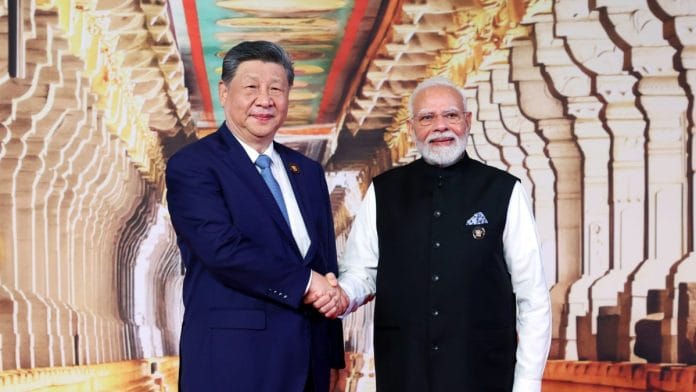
However, apart from carefully crafting the New Delhi Declaration and navigating the larger BRICS deliberations, the most watched meeting was clearly between Prime Minister Narendra Modi and Chinese President Xi Jinping. The meeting provided further evidence that the cautious reset of India-China relations is gathering momentum.
President Xi’s presence in New Delhi, his first visit to India in seven years, was itself significant. The two leaders discussed greater economic engagement, connectivity and people-to-people exchanges. But PM Modi made clear that any reset remains conditional and that peace and tranquillity along the border are fundamental to rebuilding the wider bilateral relationship.
This statement naturally brings one’s attention to India’s northeast. Because if India and China are genuinely entering a period of stabilisation, then the ultimate test will be India’s northeast.
Since the Galwan clash of 2020, attention has understandably been concentrated on eastern Ladakh. But the eastern end of the India-China frontier presents a different and, in some ways, a more complicated strategic challenge. China continues to claim almost the entirety of Arunachal Pradesh and calls it Zangnan, periodically issuing Chinese names for locations there. India categorically rejects the claim, calling the provocation ‘preposterous’.
More importantly, the northeast is where territorial security intersects with Tibet, transboundary rivers, climate change, border infrastructure and India’s connectivity towards Myanmar and Southeast Asia.
The northeast as the test of the reset
Even before BRICS, developments pointed towards a step-by-step reset. It was during the 25th Round of the Special Representatives Talks on the India-China Boundary Question in Beijing on August 25 that the two sides reached an eight-point consensus.
It included stronger LAC management mechanisms, additional senior military meeting points and military hotlines in the Eastern and Middle Sectors, expanded border exchanges and renewed discussions on transboundary rivers and hydrological data sharing.
This exchange between India’s NSA Ajit Doval and China’s Foreign Minister Wang Yi was followed by the first-ever senior-most military commander-level flag meetings, against the backdrop of recent tensions around Taksing in Arunachal Pradesh. Taken together with the Modi-Xi meeting, these developments make a compelling case for placing the northeast closer to the centre of India’s China policy.
The initial results of these engagements have been positive, with China scaling back troops on the LAC. But a genuine reset still needs to demonstrate that stability can be maintained across the entire frontier.
Also Read: Xi-Modi BRICS meeting signals thaw in ties. The Chinese say it is at a fragile stage
The Brahmaputra is also a security issue
But the northeast has other important challenges beyond stability on the LAC. The Brahmaputra enters India through Arunachal Pradesh as the Siang after flowing through Tibet as the Yarlung Tsangpo. China’s massive Motuo hydropower ambitions on the river have understandably generated anxiety in India.
Though the concern should not be limited to claims that China can simply “switch off” the Brahmaputra, the more immediate problem is the strategic asymmetry emerging when a downstream country depends partly on activities and environmental events occurring upstream.
Hydrological data, sediment flows, dam safety, and warnings of exceptional water releases, landslides, or glacial events therefore have serious strategic implications. Climate change adds to the urgency of addressing these issues.
Recent extreme weather events across the Himalayas, such as the devastation in Nepal, demonstrated how rapidly glacial instability and landslides can become transboundary problems. For Arunachal Pradesh and Assam, reliable upstream information is no longer a mere environmental issue but a national security requirement.
Interestingly, the BRICS New Delhi Declaration provides a framework for precisely this kind of cooperation. Paragraph 113 acknowledges water availability as a critical environmental challenge and calls for the integrated protection and systematic management of mountains and water resources, among other ecosystems.
The relevance for India’s northeast is evident, with the eastern Himalayas and the Yarlung Tsangpo-Brahmaputra system bringing precisely these two issues of mountains and water together.
The Declaration further states in paragraph 83 the importance of investment in sustainable resilience, prevention and anticipatory action and specifically emphasises stronger early warning systems and risk-informed planning. For a region exposed to glacial instability, landslides, extreme rainfall and transboundary flooding, these principles are directly relevant.
India and China have therefore jointly endorsed the broader proposition that climate resilience requires better information, early warning and cooperation. India should use the present thaw to translate those principles into a more predictable bilateral framework for the Yarlung Tsangpo-Brahmaputra.
A 21st-century border management framework can no longer concern itself exclusively with soldiers. It must also address water and environmental risks affecting populations downstream. India must simultaneously strengthen its independent satellite surveillance, remote sensing, river gauges and glacier monitoring.
Building a resilient frontier
But there is yet another reason why the northeast should be central to the reset. Resilient connectivity has been an important component of India’s wider BRICS agenda. For the northeast, the intersection between connectivity and resilience is significant.
Roads, bridges, tunnels and telecommunications near the LAC support civilian mobility and economic integration as well as military logistics. In an increasingly unstable Himalayan climate, resilience must become part of strategy.
Border villages should not simply be viewed as India’s last settlements before China. They should become India’s first settlements looking outward. Strong local economies, communications, tourism, transport and public services strengthen the frontier as strategically as military infrastructure does.
The northeast and India’s Act East strategy
The northeast’s importance also extends beyond China. It forms India’s principal land bridge towards Myanmar and Southeast Asia. Projects such as the India-Myanmar-Thailand Trilateral Highway and the Kaladan Multimodal Transit Transport Project are therefore more than development projects. They are instruments for integrating the northeast with India’s Act East strategy.
China approaches this geography from another direction, with its economic corridors through Myanmar providing southwestern China access towards the Indian Ocean. The northeast consequently sits at the intersection of India’s continental and maritime strategies.
China and Tibet to its north, Myanmar to its east and, beyond these, the Bay of Bengal make the northeast a critical strategic bridge between India’s land and maritime interests.
If an India-China reset is to happen, India must use this period of stability for accelerated investments. It must not hesitate to venture into new projects for strategic advancement, such as the reopening and construction of the much-debated Ledo Road.
Turning the BRICS vision into a northeast strategy
This is where the language of the New Delhi Declaration acquires concrete meaning. The resilience, innovation, cooperation and sustainability emphasised under India’s Chairship in Paragraph 5 translate, in the northeast, to stronger roads and bridges, hydrological and early warning capabilities, institutionalised transboundary cooperation and economically stronger and thriving border communities.
The success of the Delhi BRICS Summit demonstrated that India and China can negotiate common positions despite substantial differences. However, the harder test begins after the summit: applying that ability to cooperate to geographical interests.
Finally, the real test of the India-China reset will not be in New Delhi but in the northeast.
Rami Niranjan Desai is a Distinguished Fellow at the India Foundation, New Delhi. She tweets @ramindesai. Views are personal.
(Edited by Maryam Hassan)