




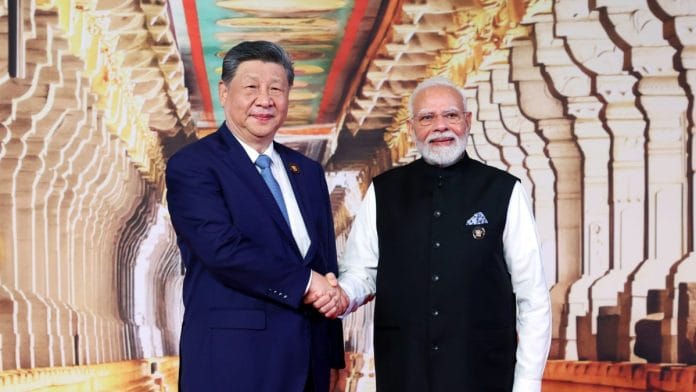

Chinese President Xi Jinping visited India after seven years, marking his first bilateral meeting with Prime Minister Narendra Modi on Indian soil since Mamallapuram in 2019. The Xi-Modi bilateral talk lasted about 45 minutes and covered the standard issues of the border, trade, and regional and global affairs. Xi’s presence in New Delhi became a hotly discussed topic across Chinese internet platforms, with much of the discussion suggesting that China and India are warming up to each other.
Warming of ties?
A commentary on Baijiahao noted that even with conflict and competition, communication never stopped between the two countries. This, it said, is the clearest signal from the China-India meeting and the basis for maintaining stable relations between the two major Asian powers.
Xie Chao, associate research fellow at Fudan University’s Center for South Asian Studies, pointed out that the easing of tensions is evident in the last two years. Following Modi’s re-election in 2024, he said, India began showing signs of substantially fixing ties with China, alongside greater introspection on the costs of its confrontational policies toward Beijing.
Much of the Chinese coverage has focused on cooperation in multilateral settings. Zhang Shuai, deputy director of the Center for Indian Studies at Lanzhou University and associate professor at the Belt and Road Research Center, contends that China and India see multilateral cooperation as an important tool for stabilising bilateral relations. Similarly, Victor Gao, Chair Professor at Soochow University and deputy director of the Center for China and Globalization, views the BRICS summit as an opportunity for China and India to exchange views, reach greater consensus on international issues and even discuss the territorial dispute. But the Chinese views are also skeptical about how far the improvement in ties can go.
A new normal and its limits
Hu Shisheng, deputy secretary-general of the Academic Committee of the China Institutes of Contemporary International Relations, described China-India ties as entering a new normal. It is stabilising after a decline, slowly recovering, and coexisting with competition. For Hu, this is a bottoming-out process, and cannot be called a reset. India’s shift, he argued, has been driven largely by real-world pressures, while the US factor is both pushing the two sides toward each other and limiting their relationship too.
This cautious assessment runs through other Chinese commentary. Lin Minwang, researcher and deputy dean of the Institute of International Studies at Fudan University, sees the relationship as improving but fragile. He pointed to the scope for economic cooperation, particularly as India seeks greater Chinese investment, while criticising restrictions on Chinese companies and visas. For Lin, reciprocity and mutual benefit will be important tests of whether India is genuinely prepared to move closer to China or is simply seeking greater room for manoeuvre while remaining dependent on the US. Zhang Sinan, a media commentator, similarly argued that India is unlikely to abandon its traditional position but will seek greater strategic space.
The limits are particularly clear on security. Another comment noted that the border remains unresolved and strategic trust is far from restored. India’s cooperation with China in BRICS alongside its continued participation in the US-led Quad is interpreted as part of a hedging strategy. The implication is that the thaw will remain uneven.
Economic interests nevertheless provide a reason to keep the relationship moving. A report by the Shanghai-based The Paper described the “melting of ice and snow” as a process that cannot happen overnight. From Kazan to New Delhi, it argued, progress will depend on both sides meeting each other halfway, maintaining candid communication and pursuing pragmatic cooperation.
Li Hongmei, researcher at the South Asia Research Center of the Shanghai Institute for International Studies, points to international instability, India’s uncertainty over the US and shared development needs as drivers of cooperation. Economic interdependence also matters, with China becoming India’s largest trading partner in 2025-26. But Li sees the détente as pragmatic rather than strategic. India is gradually easing visa and investment restrictions while maintaining security concerns over China’s role in South Asia. Border tensions, China-Pakistan relations, the Dalai Lama issue, trade imbalances and China’s growing presence in South Asia continue to complicate the relationship.
The same contradiction is evident in economic ties. One commentator argued that Modi’s ‘Make in India’ ambitions remain heavily dependent on Chinese supply chains even as New Delhi continues efforts to counter China politically and strategically. Damaged political trust, the border dispute and efforts to diversify away from China limit the scope for deeper economic cooperation. Stable border, a predictable business environment and greater mutual trust, the commentator argued, will be necessary if economic ties are to expand.
Interestingly, there is less hardline commentary calling for confrontation than before. One commentator sees the border tensions as part of a wider competition driven by India’s military build-up, nationalism, economic restrictions on China and closer alignment with the US. Yet the argument is that China should avoid both war and retreat.
The preferred approach, according to the Chinese commentary, should be firm but restrained where it has to maintain border positions and deterrence, respond proportionately, keep negotiations going and avoid a prolonged confrontation. The border dispute, in this view, is more likely to require sustained management than a one-off settlement.
Also read: The real BRICS story is what China, Russia want & India wishes
A fragile thaw
This time around, the discussion on the Chinese internet is more cautious than openly hostile or provocative. Much of it is critical of India’s handling of the border issue, but it also sees India-China ties moving toward normalcy.
At the same time, there is caution about the durability of the thaw. At best, it remains fragile, with the underlying differences continuing to influence India’s China policy. The border remains the biggest irritant and a major source of strategic mistrust. Commercial differences persist too, while India’s pursuit of strategic autonomy, including closer cooperation with the West, remains an important part of its foreign policy.
The setting of Xi’s visit is also telling. The Modi-Xi meeting took place on the sidelines of BRICS. Xi did not make a special trip to India focused on the bilateral relationship or addressing its underlying problems.
Clearly, the relationship has not returned to the pre-2020 status quo, and there is little indication that it will do so soon. Hu Shisheng described this as a “new normal”. This perhaps best sums up where India-China ties stand after Xi’s New Delhi visit.
But the future direction of India-China ties will depend on multiple factors. One high-level meeting can provide support and momentum, but it will take much more than that. It will also require a change in the narrative and a better understanding of India’s concerns and agency. Otherwise, the thaw and stability will remain fragile and temporary.
Sana Hashmi, PhD, is a fellow at the Taiwan-Asia Exchange Foundation. She tweets @sanahashmi1. Views are personal.
(Edited by Ratan Priya)