



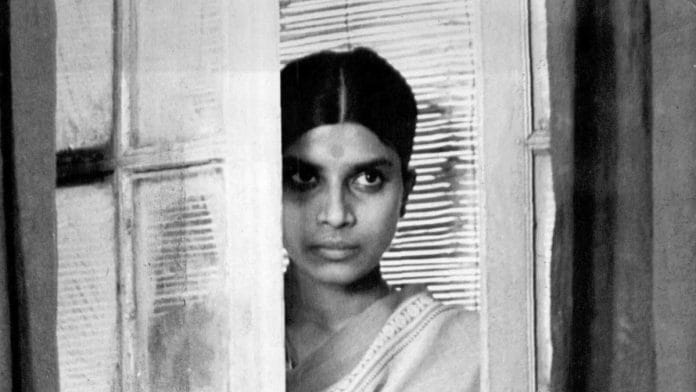

Kumar Shahani’s first feature film, Maya Darpan (1972), cost him 12 years of his filmmaking career. The film was almost forgotten soon after its release, but years later, critics called it one of the first formalist films in Indian cinema — a genre that prioritizes style, visual technique, and artistic manipulation over narrative realism.
Maya Darpan was released in 1972, and Shahani’s next film, Tarang, came only in 1984. Across a career spanning nearly four decades, Shahani made only seven feature films and a few shorts. He would often take years to work on one film, taking time to develop his subjects and find the way he wanted to recount the story.
The film’s characters were based on Shahani’s experiences as a child of Partition, while its visual and cinematic language came from what he had learned from his mentors and influences, including Ritwik Ghatak, Marxist historian DD Kosambi, and Robert Bresson, whom he encountered when he was a student in Paris.
The story of Maya Darpan centred around a woman named Taran, played by Aditi, who is trapped in a feudal world that is on the verge of collapse in 1947, as India slowly moves toward Nehruvian socialism. She is the daughter of a wealthy landlord, played by Iqbalnath Kaul, and lives with her widowed aunt, played by Kanta Vyas, in an old mansion. The mansion becomes a representation of the upper-class world that remains untouched by everything happening in the village. Outside, almost every corner of the streets is filled with protests fuelled by the new labour laws.
The film lacks the chaos found in many other films released around the same time. It is filled with poetry, a true example of parallel cinema. Even though the film is politically charged, that spirit of revolution never turns into on-screen chaos.
Instead, the film documents the life of a woman who is trapped in luxuries that are of no use to her. She wants to escape, but she is stuck in a golden cage. What makes Taran no different from the people around her is that she is also a prisoner of class.
The film was shot mostly inside a mansion, with camera movements that were not very prominent in Indian cinema at the time. While mainstream films preferred still shots, in Maya Darpan, cinematographer K K Mahajan’s camera moves with Taran. The soundscape created by Bhaskar Chandavarkar is unique too. We hear trains, bullocks and running taps, sounds that suggest the modernity of the mansion. At the same time, there are the sounds of sparrows and pigeons, lonely like Taran.
Also read: Malayalam cinema never had it so good. Big box office hits, OTT global reach
A crumbling mansion
Taran’s life is monotonous. She recites poetry, watches the outside world, cleans the mansion, and sits on bamboo chairs that are being eaten by termites, much like the mansion itself. It represents a system that is eroding from within, even as the external structure persists.
Taran’s father is a man who is drunk on the power that comes with class and caste divisions. The tension between Taran and her father represents a clash between two Indias. Her father is the old India, the feudal one that considers it a fundamental right to be able to discriminate against people on the basis of money and class. Taran is detached from worldly possessions, trying to find her own purpose.
There is no bittersweet love between father and daughter. Instead, their relationship built around the tension between the old world and the new one.
Meanwhile, Taran’s unspoken love for a local engineer, played by Anil Pandya, becomes a symbol of the change and transition that is slowly coming to India, something that no one can deny.
That transition becomes even more evident when Taran finally breaks away from the mansion and her father’s feudal ideology. She runs away to confess her love for Pandya at a place that bears no resemblance to the world where she grew up — a construction site.
Taran’s escape is hardly just a romantic one. The construction site represents a new India, still being built. Shahani does not portray this new world through a loud declaration. Instead, as Taran chooses to reject the class and caste structures that have defined her life, Shahani speaks through the silence.
(Edited by Janaki Pande)