





In the second half of the 5th century, two mathematicians living over 3000 km apart were working on the same fundamental number that relates the circumference of a circle to its radius. In southern China around 480 CE, the astronomer Zu Chongzhi estimated the value of π to be between 3.1415926 and 3.1415927. Writing in 499 CE at Kusumapura (modern day Patna), the Indian astronomer Aryabhata independently arrived at 3.1416. Neither scholar had ever heard of the other. These estimates reigned for a thousand years, until Madhava in Kerala and Jamshid Al-Kashi in Samarkand improved on them around the turn of the 15th century.
This historical convergence makes a philosophical point before it makes a historical one. The number π does not belong to any particular civilisation. It is neither Chinese nor Indian. Two distinct traditions converged on the same mathematical truth because the truth was there uniquely to be found. This is distinctive of science among human undertakings: it is arguably the only intellectual enterprise where independent efforts applied to reality, arrive at the same destination. Literature does not do this. History does not do this. Even Law does not do this. Only mathematics and the natural sciences do.
That peculiarity has implications for how rival geopolitical powers should approach science. The Tang court worked this out long before Delhi or Beijing had cause to think about it again.
A lesson in pragmatism from the Tang Court
In 718 CE Gautama Siddha, an astronomer of Indian descent born in Chang’an, translated the Indian Navagraha calendar into Chinese at the throne’s request, bringing with it Indian numerals, the zero, and a table of sines. Eleven years later a Tang meridian survey stretching from northern Vietnam to the steppe produced the Dayan calendar, formulated by the monk-astronomer Yixing.
In 733 CE Gautama Siddha’s son, Gautama Zhuan, formally accused the recently deceased Yixing of plagiarising the Indian work, a charge tied to his own family’s prestige and position. The Tang court did not settle the matter by deciding whose civilisation deserved the credit. It investigated, and found the charge false: the dynastic history records that it sprang from Gautama Zhuan’s resentment at being excluded from the reform, not from any fault in Yixing’s calculations. Historians still debate how much Yixing owed to Indian sources; his use of the tangent almost certainly did. But the court cleared him of copying.
The point is that a dispute from 1300 years ago is settled the way historians of science still settle disputes today — by returning to the calculations rather than asking which side one would prefer to be right. It is our argument for engagement between two states that will remain competitors on nearly every other axis. Diplomacy manages disagreement. Law adjudicates it. Science can dissolve it, because a well-posed question about the physical world has an answer that does not care who is asking.
Also read: The real BRICS story is what China, Russia want & India wishes
The BRICS 2026: Operationalising rhetoric
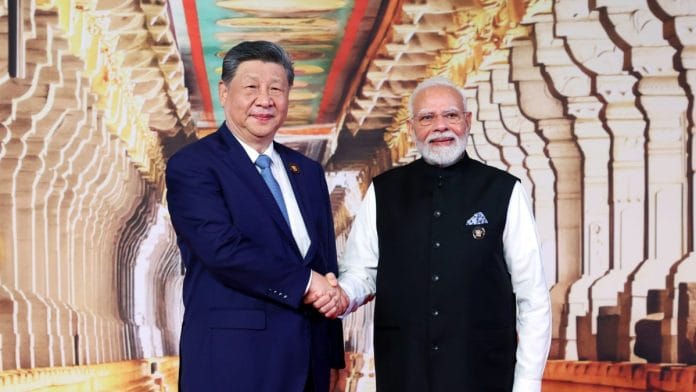
Chinese President Xi Jinping is in New Delhi for the 18th BRICS Summit under India’s chairship with the theme: Building for Resilience, Innovation, Cooperation and Sustainability. This is his first visit to India in seven years. At the Shanghai Cooperation Organisation summit in Tianjin last August, Prime Minister Narendra Modi told him that the interests of 2.8 billion people were bound up with cooperation between their countries which would pave the way for the welfare of all humanity. Xi reciprocated by calling both nations members of the Global South with a shared responsibility to advance human progress.
Taking the leaders at their word presents an opportunity to make them come true – that does not need either government to negotiate complex treaties, legislate new frameworks, or even trust each other to honour commitments. The mechanism is simple: point two advanced scientific instruments, two distinct datasets, or two independent research groups at the same unresolved physical question, and let the question perform the unifying work that traditional diplomacy cannot.
This requires looking at what already exists, built and paid for independently by two countries that were not primarily thinking of each other when they laid the foundations.
Cosmic arithmetic: FAST and the uGMRT
In June 2023, radio astronomical pulsar timing arrays around the world announced the first evidence for a background of gravitational waves with periods of years, the probable signature of supermassive black holes spiralling towards each other across the Universe. The Indian Pulsar Timing Array (InPTA) uses the upgraded Giant Metrewave Radio Telescope (uGMRT) near Pune, and they reported findings jointly with their European partners. China’s Pulsar Timing array (CPTA) uses the Five-hundred-meter Aperture Spherical radio Telescope (FAST) in Guizhou, the largest single radio dish on Earth, and they reported its findings independently.
The two instruments are not duplicates. FAST achieves excellent timing precision on individual millisecond pulsars by virtue of its sheer scale and raw sensitivity. The uGMRT, however, is uniquely capable of observing at much lower radio frequencies (300–500 MHz), where the smearing effect of interstellar plasma, known as the dispersion measure, can be carefully quantified and accounted for. The dynamic nature of the interstellar medium introduces slowly varying time delays in the measured time-of-arrival of pulsar signals, which can mimic or obscure the delays introduced by passing gravitational waves. FAST’s higher-frequency observations cannot easily determine this dispersion measure correction on its own.
Put the two datasets together and the measurement gets sharper in a way that neither telescope can achieve alone, just as Zu Chongzhi’s and Aryabhata’s estimates of π were each less useful than the interval they jointly defined. This is not a diplomatic nicety. It is how Nature works: two independent measurements of the same signal reduce the uncertainty on its value in a way neither measurement can on its own. The whole is indeed greater than the sum of its parts.
Subterranean synergies: Neutrinos in Jiangmen and Theni
A similar dynamic exists in fundamental particle physics. In 2012 the Daya Bay Reactor Neutrino experiment in China, led by physicist Yifang Wang, measured the last unknown mixing angle (θ₁₃) which determines how different flavours of neutrinos transmute through quantum mechanics into each other as they travel through space. Building on this achievement, China’s Institute of High Energy Physics then constructed the Jiangmen Underground Neutrino Observatory (JUNO), a 20,000-tonne liquid scintillator detector located 700 m underground and 53 km from the Taishan and Yangjiang nuclear power plants – a distance optimised for maximum sensitivity. JUNO began taking data recently, and involves over 700 scientists from 74 institutions across 17 countries and regions.
Noticeably absent from this collaboration is India which for many years has planned its own underground neutrino laboratory, the India-based Neutrino Observatory (INO), in the Bodi West Hills of Theni, Tamil Nadu. INO was designed to house a 50,000-tonne magnetised Iron Calorimeter (ICAL) to study atmospheric neutrinos. Its primary scientific objective, to determine whether the third neutrino mass state is heavier or lighter than the other two, is the same objective JUNO now pursues. But the INO project was stalled indefinitely amid baseless environmental litigation and protests instigated by local politicians, leaving a generation of trained Indian particle physicists without a domestic experiment to work on.
This is not an argument for political lobbying or for forcing an unnatural partnership. It is simply to emphasise a stark misalignment of resources. Decades of human expertise, built at real financial cost over many years in India, sits geographically adjacent to a Chinese experiment built to use exactly that calibre of expertise. The wall separating the physicists in Theni from the data in Jiangmen is entirely of human construction. It is not a physical barrier, nor is it a boundary recognised by the neutrinos passing harmlessly through the Earth.
The fault lines that bind: Himalayan seismology
The Himalaya offers a similar argument in geology. The mountain range forms a single, dynamic tectonic system, regardless of where a political border is drawn through its peaks.
On 7th January 2025, a magnitude 7.1 earthquake struck Tingri County on the southern Tibetan Plateau. The seismic rupture occurred along conjugate normal faults within the Dengmecuo graben, driven by the ongoing east-west extension of the crust. The shockwaves were felt from Kathmandu in Nepal to Patna in northern India. The geopolitical boundary between them means nothing to a propagating seismic wave. The glaciers of this same plateau feed both the Indus and the Brahmaputra river systems; the ecological and hydrological fate of both nations depends on them. Whether they coordinate or not, seismologists in Lhasa and Dehradun are already studying the same fault system from opposite ends. The only variable is whether they do this analysis with each other’s data or without it.
In 132 CE, the Han dynasty polymath Zhang Heng built the world’s first seismoscope, an instrument using mechanics and gears to discern the cardinal direction of earthquakes up to 500 km away. His name now graces a newly announced scientific fellowship in Beijing. Were he alive today, the problem of modern data isolation would be immediately apparent to him: a single instrument reveals only that the Earth moved. Understanding why it moved and predicting the next rupture requires more than one vantage point on the same ground.
The human element in the age of artificial intelligence
Mathematics offers the argument in its purest form, because mathematics needs the least material infrastructure of any science. At the Beijing International Congress of Basic Science last month, the Fields medallist Martin Hairer argued that although artificial intelligence will change how mathematics is done, it will not end it.The Congress Chair Shing-Tung Yau emphasised that while AI will greatly enhance scientific research, the essence of scientific discovery will always depend on human creativity, imagination, and independent thinking.
If that diagnosis is right, the scarcest resource of the coming decades will not be computing power but trained human judgement, creativity, and intuition: a resource that neither artificial intelligence nor a single national tradition can manufacture at will.
Together, India and China award more first degrees in science and engineering than any other two countries on earth. The Indian National Science Academy (INSA) and the Chinese Academy of Sciences (CAS) ran a formal scientist exchange programme that, over the 24 years between 1995 and 2019, sent a mere 88 Indian scientists to China and brought just 72 Chinese scientists the other way. That is an average of under seven visits a year between the two largest reservoirs of young scientific talent. In the terminology of physics, this is effectively a null result, and such a null result is worth serious analysis.
The ascent of a scientific civilisation
Over fifty years ago, the Polish-British historian of science Jacob Bronowski concluded his book behind the major BBC television series The Ascent of Man by issuing a stark warning: “If we don’t take the next step in the ascent of man, it will be taken by people elsewhere — in Africa, in China”. He did not name India, a detail that reveals more about the parochialism of England in 1973 than it does about the potential trajectory of the global scientific future.
However Bronowski’s underlying test survives the limited vision of his era. He defined the modern world as a scientific civilisation, one in which the integrity of knowledge is the ultimate currency, and argued that the ascent belongs to whoever keeps faith with evidence, not to any specific ethnicity or nation. That test now faces New Delhi and Beijing. It does not require the two governments to trust one another’s geopolitical ambitions. It asks a much smaller, far more answerable question: will their scientists trust each other’s empirical data?
The complementary pulsar timing arrays pointed at the nanohertz gravitational wave background, the parallel neutrino physics communities seeking the mass ordering, the shared Himalayan fault lines dictating seismic risk, the vast mathematical talent pools gathering in both capitals: none of these are new diplomatic proposals. They already exist. What is missing is not a sweeping bilateral agreement, a complex visa regime, or a heavily negotiated joint communiqué. What is missing is the much smaller, far less negotiable act of two human beings, standing on either side of a border that neither physics nor mathematics recognises, agreeing to look at the same evidence from Nature and accept what it says.
Gautama Zhuan and Yixing’s successors managed to achieve this over a calendar, under an emperor neither of them could disobey. It should not require an emperor for the scientists of India and China to do it again today.
Subir Sarkar is Professor emeritus at the Rudolf Peierls Centre for Theoretical Physics, University of Oxford. He served on the Global Committee for Physics at the International Congress of Basic Science 2026 in Beijing. Pranav Sharma is a historian of science who lives and writes from New Delhi, India and Paro, Bhutan. Views are personal.