




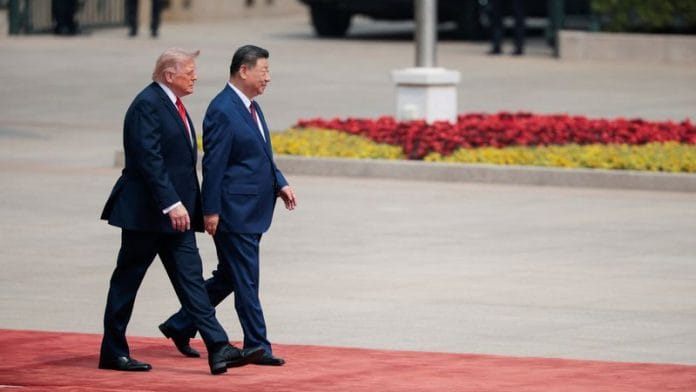

For all the tensions between Beijing and Washington, Donald Trump will personally receive Xi Jinping at the airport when the Chinese president arrives in the United States on Wednesday for his three-day state visit.
On Weibo, the summit is attracting attention through trending hashtags such as “China-US leaders chart the course for bilateral relations”. Trump’s decision to receive Xi at the airport has also drawn notice. Wu Xinbo, director of the Center for American Studies at Fudan University, said the gesture showed the importance Trump attaches to Xi and his respect for him. With the US midterm elections approaching and Trump facing domestic and foreign pressures, Wu also suggested that Trump may see the visit as a chance to improve his image, pointing to his repeated praise for Xi and references to their personal friendship.
But the bigger concern in Chinese commentary is what comes after the meeting. Few expect Beijing and Washington to settle their differences but expect the two countries to ensure that the differences don’t disrupt the wider relationship. The idea of a “constructive, strategic and stable China-US relationship”, introduced at the Xi-Trump meeting in May, has become an important part of the Chinese discourse.
A Shanghai Institute of International Studies report says the concept exhibits willingness on both sides to manage crises and keep ties stable over the long term. One commentator put it more vividly: “The bigger the storm, the more you need a ‘navigator’; the more critical the situation, the more a ‘fixed star’ is needed.” The “fixed star”, in this case, is regular US-China consultation.
Sun Chenghao, Associate Researcher at the Center for Strategic and Security Studies at Tsinghua University, makes a similar argument: the two leaders set the direction, government departments follow through, and regular channels deal with disputes before they get worse. Xiong Yuan, Chief Economist at Guosheng Securities, described Vice Premier He Lifeng’s 19-23 September visit to Washington as preparation for the Xi-Trump meeting and part of keeping the relationship on a stable footing.
Also read: What China’s state media is saying ahead of Xi-Trump Summit
How Chinese commentary sees Xi-Trump summit
Chen Jing, a member of the Fengyun Society, wrote on Weibo that there have been signs of easing tensions between China and the US and that Washington’s thinking has clearly changed.
For Victor Gao, Chair Professor at Soochow University and Vice President of the Center for China and Globalization think tank, regular dialogue between the two leaders is crucial. He argues that China and the US should deal with each other as equals, while China must remain strong and the US recognise that strength.
Jin Canrong, professor of International Relations at Renmin University, claims that China-US relations have undergone tremendous changes over the past eight or nine years. The most important change, he said, is in how the US positions China: from a “partner with shortcomings” to its “only strategic competitor”.
The view running through much of this commentary is that competition cannot simply be wished away. But it can be contained. Economic ties are a big part of that argument. In an AI-generated video, commentator Li Wei asked why China-US relations have not collapsed despite years of tension. Comparing the relationship with the Cold War rivalry between the US and Soviet Union and US-Japan trade tensions around the Plaza Accord, he argued that the two countries are too closely connected for their relationship to be purely zero-sum. US companies manufacture in China, while Chinese platforms such as Douyin (TikTok) are widely used by young Americans. In this view, the economic relationship itself puts limits on confrontation.
Artificial intelligence offers another example. In Chinese view, it is both a new area of US-China competition and a possible area for cooperation. Gao contrasts the US focus on proprietary systems with China’s emphasis on open-source development. He argues that China’s industrial and technological base will allow its open-source approach to catch up with or surpass the US, while eventually creating room for cooperation.
Also read: World keeps pushing Russia, India, China together. Then RIC tears itself apart
Optimism on the surface, pessimism beneath
On the surface, the language is flowery. Chinese official media repeatedly invokes mutual respect, peaceful coexistence and win-win cooperation. At the Xiangshan Forum earlier this month, National Defence University’s Zhang Chi made a similar point: the world is big enough for both China and the US to prosper, and both sides should uphold these principles while working to improve bilateral relations.
But that is not the whole picture. Chinese commentary becomes more guarded when it moves from diplomatic language to the realities of the relationship.
One commentary warned against expecting a breakthrough from the Xi-Trump summit. Its focus is more practical: keep competition under control, reduce the risk of confrontation and make cooperation on trade, security and global issues more predictable. The aim is to make a constructive, strategic and stable relationship work in practice, rather than assume that the underlying differences can be settled. The same discussion is critical of Japan’s diplomacy, portraying Prime Minister Sanae Takaichi’s visit to Washington before Xi’s as an effort to strengthen Japan’s position in the US-China rivalry, while arguing that Japan cannot fundamentally alter the course of US-China relations.
Other voices are considerably tougher. Shen Yi, Assistant Dean of the School of International Relations and Public Affairs at Fudan University, contends that China-US relations have turned a whole new page and that China will no longer back down. A video meme makes the same point in a lighter form: an orange cat tries to prank a tabby cat twice, only to end up covered in foam each time. The meme portrays attempts by the US to catch China off guard as backfiring. Another meme mocks Trump’s proclivity for fawning praise and imposing tariffs.
The contrast is hard to miss. The official line stresses coexistence and cooperation; more pragmatic voices focus on managing competition; and harder voices stress that China will not retreat. Across these different strands, however, there is little suggestion that the underlying rivalry has disappeared. Taiwan, Japan, AI remain particularly sensitive issues, while competition with the US is expected to continue and the relationship remains fragile.
Sana Hashmi, PhD, is a fellow at the Taiwan-Asia Exchange Foundation and George HW Bush Foundation for US-China Relations. She tweets @sanahashmi1. Views are personal.
(Edited by Prashant Dixit)
Difficult to recall the last time POTUS received a foreign leader at the airport. 2. Have seen images of JFK and Jacqueline Kennedy greeting Prime Minister Jawaharlal Nehru, accompanied by his daughter, at his aircraft itself.