




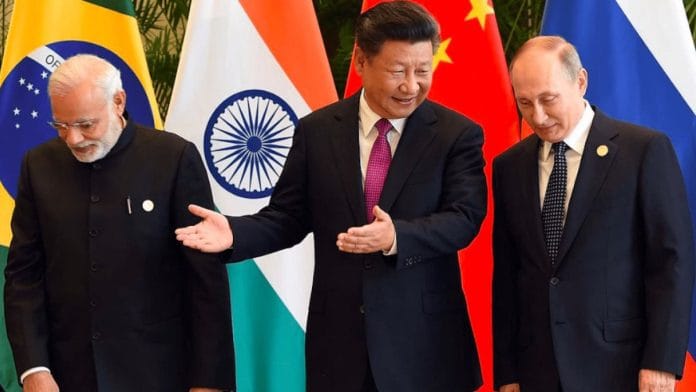

Two high-profile summits in the past few weeks put the non-Western world on centre stage. One was the 26th Shanghai Cooperation Organisation Summit in Bishkek, Kyrgyzstan, held from 31 August to 1 September. The other was the 18th BRICS Summit on 12-13 September in New Delhi, India. At both events, the optics of leaders of Russia, India, and China coming together arguably captured the world’s attention. The nations are, after all, the biggest powers in both groupings, even as Iran is emerging as a major regional power in its own right.
The spotlight on Narendra Modi, Xi Jinping, and Vladimir Putin was expected after they were photographed last year displaying unusual bonhomie at the 25th SCO Summit in Tianjin, China. This was fresh on the heels of the United States imposing steep tariffs on India. The timing led observers to surmise that New Delhi was signalling to the US that the latter’s actions were miscalculated and that it had other options.
“Looks like we’ve lost India and Russia to deepest, darkest, China. May they have a long and prosperous future together!” President Donald Trump posted on Truth Social at the time.
Every time the three leaders are seen together, the question of a Russia-India-China (RIC) revival surfaces. It is more pertinent in today’s context, when there are many extraneous pull factors. On 18 September, Trump signed into law the ‘Lindsey O. Graham Sanctioning Russia and Iran Act of 2026’, giving him authority to slap tariffs of up to 100 per cent on the top five importers of Russian oil and gas. China and India, respectively, are the two biggest buyers of Russian crude. Even if the tariffs are aimed at Russia, New Delhi can’t help but feel it will be impacted.
But is an RIC even feasible today? Or is the geopolitical gravity that pulls them together outweighed by the pressure pulling them apart?
Russia–China prepared, India shy
The RIC trilateral was conceptualised by Russian statesman Yevgeny Primakov in the late 1990s to counterbalance US unipolarity. It aided the emergence of major non-Western institutions such as the BRICS and SCO. Though RIC overlapped with these multilateral mechanisms, it had value on its own, and still retains some of it. Russia, India, and China rank among the world’s largest nations, and collectively possess heft across sectors to walk the talk on critical global issues. So long as they remain major powers with an appetite for a reformed, multipolar order, the revival of RIC will be worth exploring.
The first informal meeting of RIC Foreign Ministers was held in New York in September 2002 on the sidelines of the 57th UN General Assembly. The ministers have since convened 18 times. The last meeting was held virtually in November 2021. At the leaders’ level, RIC has so far met three times, with the last meeting on the margins of the G20 Summit in Osaka in June 2019. The 2020 Galwan clashes between India and China and the Russia-Ukraine War have put RIC on the back burner.
Of the three, Russia has shown the most interest in breathing new life into the troika because it makes perfect sense for Moscow’s foreign policy. Russian Foreign Affairs Minister Sergey Lavrov has even occasionally called for the RIC’s revival. China has quietly supported it, but India has been most hesitant. In July 2025, when asked whether an RIC meeting would be held soon, India’s external affairs ministry spokesperson said it would be worked out among the three countries in a “mutually convenient manner”.
However, New Delhi’s diminishing confidence in Washington’s reliability—with the latter’s imposition of tariffs, newfound bonhomie with Pakistan, and unilateral measures—could trigger a rethink in India’s calculus, slowly prodding it toward the RIC framework to safeguard its interests. This is not to say that India’s relationship with the US is not vital, but a realisation has begun to permeate New Delhi’s strategic community that it needs more bargaining chips with Washington. The RIC serves as one, though obstacles abound.
Also read: Pakistan just set a reserve record. Much of it is borrowed money
Limitations, opportunities
Bilaterally, India-Russia ties are resilient and have withstood the test of time. On the other hand, Russia-China relations have deepened, but to an extent that analysts have examined whether Moscow’s dependence on Beijing has reduced it to a junior partner, even a vassal.
But the biggest inherent limitation within the RIC is the India-China relationship, over which long-running border disputes and the 2020 Galwan clashes have cast a dark shadow. Though both are testing a fresh thaw and engaging in multilateral fora, China remains committed to undermining India bilaterally and constraining its regional aspirations, especially in the neighbourhood. That China announced the Boundary Joint Commission with Pakistan a few days after Xi travelled to India for the BRICS Summit is the latest testament. Beijing likely premeditated the timing to reassure Islamabad of their strategic partnership.
It’s worth noting that India is also seen as the ‘weakest link’ within the Quad for opposing its securitisation and an explicitly anti-China orientation. This shows how closely India guards its strategic autonomy and how wary it is of bloc formation.
The question for India is: does its seat at the RIC table offer any utility that a bilateral China policy or engagement through SCO or BRICS wouldn’t? Both Russia and India want to hedge against Chinese dominance within shared institutions as well as overlapping geographical areas of influence. While RIC is not meant for bilateral issues, its members inevitably operate with keeping bilateral equations in mind. Can they rise above these and converge on issues that affect all of them, such as energy security, technological advancement amid an intensifying AI race, and shared unilateral sanctions?
Then there is the US factor. RIC may be a trilateral, but it will always be a quadrilateral in the sense that America’s moves will always guide the shape it takes and the agendas it espouses. Trump had labelled his meeting with Xi as ‘G2’. Who will tell the mercurial American president won’t eventually propose a ‘G3’, involving Russia? The Trump administration, after all, was seeking to normalise ties with Russia last year. Washington is free to convene with countries it considers competitors as well as its allies, such as New Delhi. So, why can’t India?
RIC states don’t have to see eye to eye on every issue. They indeed do have competing visions. RIC’s true value lies in keeping a channel open among Eurasia’s major powers. It would be a format, a functional arrangement for issue-based dialogue or crisis management—a sounding board, if you will—not an alliance or a political bloc. To think of it as more would be wishful and may result in its undoing.
Yet, to write off RIC entirely would be premature. Even in its non-institutionalised, informal form, RIC serves to benefit India in more ways than one, by exercising diplomatic leverage over the US and letting China know it can be engaged with for the greater good. There is economic logic to this. Russia and China have both featured among India’s top five trading partners consistently from FY 2023-2024 through FY 2025-2026.
It may be time to restart the RIC, starting at the foreign ministers’ level, either on the sidelines of a summit or as a standalone dialogue.
Bantirani Patro is a staff writer at ThePrint. She tweets @bantirani_patro. Views are personal.
(Edited by Prasanna Bachchhav)
If RIC works – I understand it faces Himalayan challenges – that would be great for India. Create stability for India’s biggest foreign policy and national security challenge. More needed now that the assumptions and calculations of what USA could deliver are being revisited quite drastically. Unlike Pakistan, which India can largely afford to ignore, just keeping war off the table, the economic content of the engagement with China is irreplaceable.
Dear author, why do you assume that RIC has torn itself apart? That’s wrong assumption.