



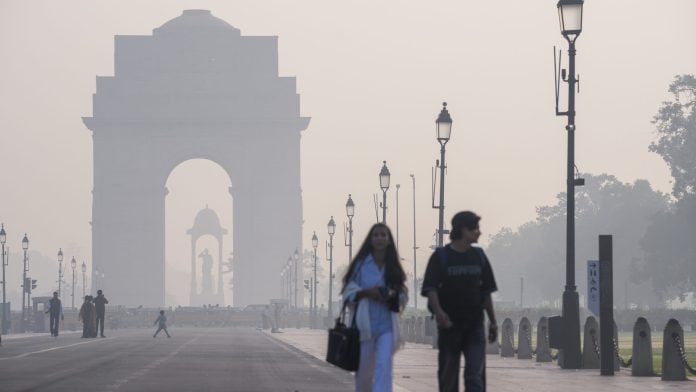
On 8 November, Delhi’s average Air Quality Index or AQI settled at 376, in the ‘very poor’ category. By 10 pm, 20 of the 59 monitoring stations reporting data were in the ‘severe’ category. The next morning, IQAir reported readings above 1,000 in Shahdara, using an index different from that of the Central Pollution Control Board, which ends at 500. Claims above 2,000 could not be traced.
Environmentalists described the situation as a public health emergency, but no government authority formally declared one. In 2019, the Supreme Court-appointed Environment Pollution (Prevention and Control) Authority had done so.
Plans keep multiplying. Delhi announced an Air Pollution Mitigation Action Plan in April and a Winter Action Plan from 1 November, with construction restrictions, staggered office hours, and curbs on older vehicles. In July, the administration announced the Rs 8,300-crore ‘Clean Air, Healthy Delhi’ programme—financed 65 per cent by the World Bank—running to 2033.
Yet, Delhi’s annual PM2.5 concentration has hovered around 100 micrograms per cubic metre. Who, by name and office, is responsible for cleaner air?
Comparing with China
Beijing offers a useful, if imperfect, comparison. Its annual PM2.5 fell from 89.5 micrograms per cubic metre in 2013 to 27 in 2025—a 69.8 per cent reduction. Heavily polluted days fell from 58 to one. Cleaner fuels and industrial restructuring helped, as did a system that assigned responsibilities and reviewed performance.
Five questions reveal the institutional gap between the two countries:
1. Who owns each task?
Beijing’s 2013 clean-air campaign designated the task owners: a lead agency and official, with each department and city government allocated a certain task. In addition, target-responsibility letters were used at the level of the central government with provincial governments. Delhi’s World Bank-supported programme involves several agencies, while key levers, including land use, lie with the Union government. It allows every institution to point fingers at others.
2. Who gets reviewed, and how often?
While Beijing carried out monthly evaluations of districts and townships, the national rankings comparing it with other cities created even more pressure. Delhi now monitors pollution in real time. A monthly scorecard could help track the progress of individual agencies in reaching their targets without penalising neighbourhoods due to pollution they experience.
3. What happens if there is failure?
Between 2016 and 2017, central inspections for environmental protection in China covered all provinces and made more than 17,000 officials responsible for failure. This year, new rules reiterated that senior officials would face lifelong liability for serious ecological and environmental damage, even after leaving their positions. In 2024, India’s Supreme Court asked why the Commission for Air Quality Management (CAQM) had not acted under Section 14 of the CAQM Act against officials ignoring its directions. No power helps if it remains unused.
4. Who controls the numbers?
Data must be trustworthy. China has relocated monitoring and enforcement activities from local officials to an independent body. Delhi also needs to secure independent control over monitoring. Each station must be independently audited and cross-checked with satellite data, with information on concentrations of pollutants available along with the AQI data.
5. Who pays for actions over the border?
The Chinese clean air initiative has come further. As far as 2015-16, it helped cities in the Hebei province, such as Langfang and Baoding, to get rid of coal-fired boilers. A new mechanism ensured coordination between the national ministries and provincial governments. In India, emissions in the NCR come from constituent cities as well as other states; therefore, cooperation tends to end up in disputes about seasonal stubble burning. An airshed doesn’t respect state boundaries; why should investments and accountability?
Also read: Bilkis Bano case and the moral cost of putting community before conscience
What Delhi must do
Science is critical for success in this initiative, but it doesn’t provide an institutional solution. Delhi is rapidly developing a five-year project to identify the sources of PM10, with the involvement of IIT Delhi. In October, the earth sciences ministry, under Mission Mausam, initiated the Integrated Atmospheric Chemistry and Aerosol Toxicity Analysis Laboratory (AATAL) at the IITM Delhi Centre. It also helps identify sources of pollution and possible effects on human health. Yet, institutions must have the responsibility, budget, as well as authority to take measures.
The case of Beijing has to be viewed realistically: the results achieved are prone to reversal, and PM2.5 levels in the city remain higher than the WHO guideline of 5 micrograms per cubic metre. Delhi’s sources are more varied, as there is not just one source of pollution—it may come from transport, construction sites, industrial plants, burning waste or crops. India doesn’t have to replicate the Chinese political system, but it could at least adopt China’s clear-cut allocation of tasks and evaluation system.
Delhi could start by making its chief secretary responsible for the clean-air target; assigning one lead agency and budget to each action taken; implementing monthly scorecards; auditing data on pollution levels independently; creating an airshed compact of NCR; and cooperating with neighbouring states with joint funding. Union government must also participate in the process, as it holds many powers.
All these measures must be applied to the National Clean Air Programme. Funding, laboratories, and forecast centres are vital, but so is accountability.
Disha Sharma is assistant professor, Sustainability Management and Centre for Policy and Governance, IIM Mumbai. Views are personal.
(Edited by Prasanna Bachchhav)