



War, riots, and sudden storms of violence leave behind only ash—a trail of shattered homes and quiet despair where women and children bear the heaviest brunt of violence. And when the violence ends, what remains is a wounded society, trying to put the pieces of its life back together. The Gujarat riots of 2002 were no different.
Healing is a slow, arduous process, and the road back to ordinary days is long. Yet, what breathes life back into a wounded society and offers the promise of a kinder world is the light of justice. The story of Bilkis Bano is one such example. Her long struggle for justice reminds us that even after unimaginable suffering, the fight for truth and accountability can make a difference.
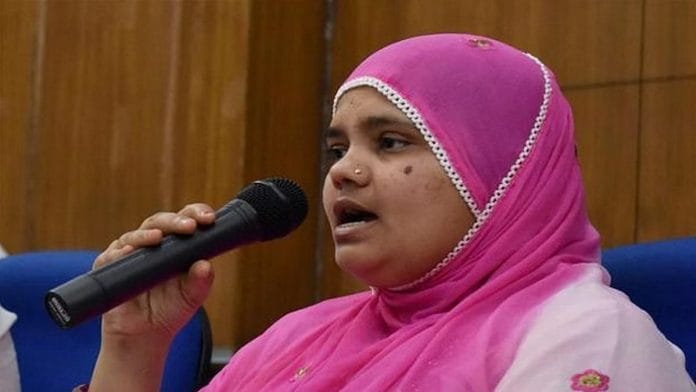
Bilkis Bano was 21 years old and five months pregnant when she was gang-raped during the 2002 Gujarat riots. Her mother was also sexually assaulted, while her three-year-old daughter was brutally killed in front of her. Seven members of her family were murdered. Following investigations, the CBI arrested 11 convicts in 2004.
Bilkis, however, has spent almost her entire adult life fighting for justice. More than two decades later, she finds herself forced to flee Gujarat once again, gripped by the same fear, after the Supreme Court suspended the sentences of two of the eleven convicts and granted them bail.
It is an echo of a wound already reopened. In 2022, all 11 men were released after the Gujarat government granted them remission. One of the members of the remission committee, a BJP MLA, publicly defended the men, describing them as “Sanskaari Brahmins”.
And when the convicts walked out of prison, they were welcomed with garlands and sweets. The nation’s conscience erupted in outrage, but it was only in 2024 that the Supreme Court overturned the remission and ordered the men back to prison.
Yet here we are again, discussing the release of two convicted men while the woman who fought for justice for so many years is once again living in fear.
When community loyalty overrides conscience
There is a bitter truth we must look in the eye: some people are willing to defend convicted rapists and even welcome them with garlands simply because they belong to a community they consider their own.
For such people, loyalty to their community seems to matter more than the basic question of right and wrong, or even the ideas of dharma and adharma that they otherwise speak so much about. Because, deep down, they believe their own survival is tied to that allegiance.
This is something we need to understand, rather than simply dismissing these people as monsters or strangers from another world who have nothing to do with the rest of us. They are not aliens. They are human beings, just like us, living in the same society. What we need to question is the mindset that makes someone defend a terrible crime simply because the person who committed it belongs to their religion, caste, community, or family. Nor is this shadow confined to any single group—it is a fracture that runs through any society still bound by communal allegiance, where belonging matters more than conscience.
Also read: Bilkis Bano wants to move on and find peace but court battles continue to haunt her, says her lawyer
Seeking justice becomes a punishment
Returning to Bilkis Bano’s case, the latest developments raise another troubling question about the place of survivors in the justice system. In 2026, bail was granted to two of the convicts without notifying or hearing the survivor—a quiet erasure that counters the Supreme Court’s own recent guidelines affirming a victim’s right to be heard.
Ultimately, bail was granted to Bipinchand Joshi and Pradip Modhiya citing prolonged incarceration, medical disability, and pending legal questions—not because they expressed remorse, acknowledged their guilt, or showed any change of conscience.
What happens to a victim’s sense of justice when the legal process continues for decades, and decisions affecting her safety can be made without her being heard?
At this point, I sometimes wonder whether fighting for justice becomes a punishment in itself for the victim.
The consequences extend beyond one case. This is one reason why so many people in India hesitate to approach the courts. When the process takes years, costs money, and demands endless emotional strength, how many ordinary people can afford to keep fighting?
We have seen controversial bail and temporary release decisions involving high-profile convicts such as Asaram Bapu and Gurmeet Ram Rahim, while other people spend years in prison waiting for their trials to conclude.
This is no longer about Bilkis Bano alone; it is a mirror held up to our country and the society we are building. If a case that has remained under the brightest national spotlight can unfold like this, what fate awaits the thousands of voices fighting in the dark?
Such cases chip away at the fragile trust holding our institutions together. The real test of justice is not only whether the guilty are punished. It is also whether the person who fought for justice can finally live in peace.
Amana Begam Ansari is a columnist, writer, and TV news panellist. She runs a weekly YouTube show called ‘India This Week by Amana and Khalid’. She tweets @Amana_Ansari. Views are personal.
(Edited by Maryam Hassan)