



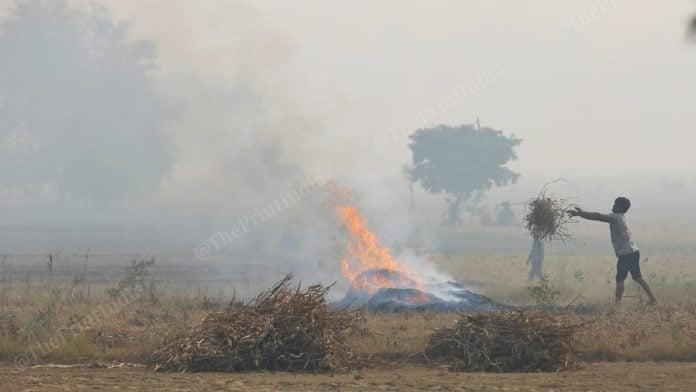
Each year, as Diwali approaches, the nation hears about ‘Delhi’s poisoned air’ and conveniently blames it on Punjab. The National Capital Territory’s, or the NCT’s, lack of infrastructure, the over-concentration of infrastructure in Delhi and its uncontrolled internal air pollution are swept under the carpet.
This should stop. While paddy stubble burning does add to particulate pollution for three to four weeks, it is misleading to blame this as the main source of pollution in the National Capital Region (NCR).
Let us analyse how polluted Delhi really is and separate it from Punjab’s farming.
The geography of Delhi’s air pollution
The first thing to consider when looking at why Delhi’s air becomes so polluted every winter is the geography of Delhi. As a landlocked basin located within the Indo-Gangetic plains, Delhi can be compared to a huge bowl. When the surrounding landmass meets cold winter temperatures, atmospheric thermal inversion occurs. This causes the air to become trapped under a layer of warm air. Wind speeds can drop to almost zero, meaning any pollution in and around Delhi cannot be dispersed and thus stays in.
This means that Delhi will suffer from dust and soot, with PM2.5 and PM10 coming from all directions. One of the main reasons remains that Delhi is surrounded by polluting industries, including numerous manufacturing units, metal works, chemical plants, and processing units operating across the NCR in industrial hubs such as Faridabad, Gurugram, Noida, Ghaziabad, and industrial zones within Delhi itself.
These Industrial activities and power plants across the NCR contribute approximately 10 per cent of Delhi’s annual average PM2.5 pollution. Another factor adding to this is traditional brick kilns also lining the periphery of NCR, which burn high-emission coal, biomass, and rubber tyres, releasing heavy black carbon, sulfur dioxide, and particulate matter. So we now have a fair view of what contributes how much from outside Delhi.
However, the key question is what causes the bowl to get filled? Even after the final crop residue fire in Punjab has finished, Delhi’s AQI remains at severe and hazardous levels throughout December and January. This is due to the pollution being created inside Delhi plus the surrounding NCR.
Also read: Delhi-NCR has no borders—except when the air turns bad
Sources of pollution within Delhi
Scientific studies and source apportionment studies show that Delhi’s pollution comes from urban sources all year round.
First, more than 87 lakh vehicles plying in Delhi itself set the base of air pollution. On average, at least 5.7 lakh vehicles enter Delhi daily, along with an additional 38,500 to 52,000 heavy-duty and commercial goods vehicles.
Second, the industrial corridor within Delhi adds to the pollution. Uncontrolled industry and overuse of diesel generators with poorly maintained Retrofit Emission Control Devices (RECD) add harmful heavy metals and sulphur oxides to the air. Solid waste is also burnt within Delhi. Massive waste-to-energy plants fail to comply with strict emission regulations. Also, open burning of waste is done with little control.
Third, dusty construction and demolition practices create large amounts of PM10. Despite the NGT continuously enforcing rules, sites fail to follow procedures to stop dust, and authorities fail to enforce these due to lack of monitoring, corruption and political interference.
Also read: Go beyond Diwali and parali. Delhi pollution debate ignores landfills
Aviation and local issues
A huge yet very much underestimated contribution to NCR’s bad air quality comes from aviation. Indira Gandhi International Airport in Delhi is one of the busiest airports in South Asia. When aircraft land and take off, it creates huge amounts of particulate matter and unburnt hydrocarbons, carbon monoxide and ultrafine particles. These are released into the lower troposphere.
This is compounded by the traffic coming to and from Indira Gandhi International Airport. Hundreds of people and freight from Punjab, Haryana, Himachal Pradesh and Western Uttar Pradesh travel to Delhi to fly internationally.
Why do we need massive amounts of aviation concentrated into a highly polluted city? We need to reduce aviation pollution pressure by spreading it out. Increasing international flights and domestic flights to Amritsar (Sri Guru Ram Dass Jee International Airport), Mohali/Chandigarh (Shaheed Bhagat Singh International Airport), Halwara and Adampur airports and new infrastructure in Haryana will reduce the amount of jet fuel being burnt in Delhi and reduce pollution from thousands of long-distance vehicles coming into NCR. This will make a massive difference.
Many legal and scientific organisations have pointed out that we cannot blame urban areas and shift blame to rural areas. Former NGT chairpersons and benches have said that they cannot stand idly by.
During court sessions discussing Delhi’s air quality, they have said, “Air pollution is a threat to life. Severe air quality in Delhi is not caused by one day or one source.” They have also blamed local authorities for failing to control simple waste management, construction dust and industrial waste.
Studies have also shown that whilst there is a slight increase from agricultural fires in October and November, most pollution is caused by local biomass, dust and fossil fuels. Blaming Punjab’s farmers is a political excuse to delay changes in Delhi urban areas.
Also read: Delhi model of air pollution has reached Goa. Nobody is responsible for air quality
From EVs to spread out infrastructure
Punjab is moving toward reducing the burning of paddy straw with machines, bio-decomposers, and crop residue being used in industry. However, even if stubble burning were stopped completely tomorrow, Delhi would still suffer from smog in the bowl due to the lack of control over its internal sources of pollution.
To improve air quality in Delhi, the authorities must follow these four things in the future.
Zero tolerance for local pollution: Enforce strict fines on open burning of waste and monitor waste-to-energy stack emissions. All construction sites must also have strict dust control.
Electric transport: All public and commercial transport must be fully electric. Heavy diesel trucks must have strict access rules.
Spread out infrastructure: Encourage international flights to go to regional airports such as Amritsar, Mohali and Chandigarh.
Year-round public health approach: Treat air pollution as a multi-sectoral public-health issue that requires sustained action throughout the year, rather than focusing only on Delhi’s winter pollution.
Delhi cannot blame Punjab’s fields for pollution caused by its own chimneys, cars and burning. They need to take responsibility for the urban geography of the basin and work on systematic solutions.
Col Jasjit Singh Gill (retd) is an environmentalist. He is a member of the DISHA Committee, Ludhiana, and a former member of the Punjab State Task Force on Budha Darya Rejuvenation Project. He tweets @JASSGILL44. Views are personal.
(Edited by Saptak Datta)