



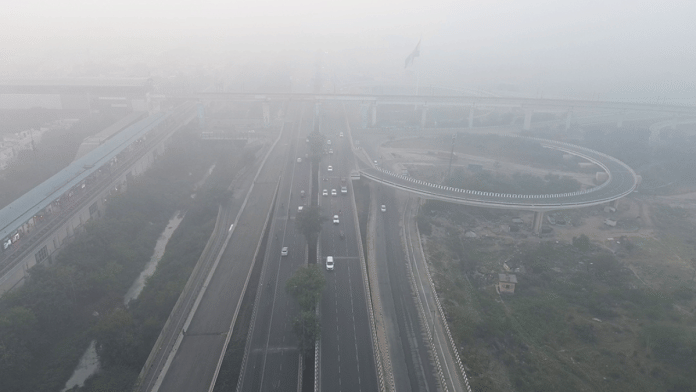
Every winter, Delhi discovers that pollution does not respect administrative boundaries. Unfortunately, the discovery does not influence the government’s response.
This winter, the problem has acquired an international dimension. Lahore recorded the world’s worst air quality this week, while Delhi is not far behind. The two cities may belong to different countries, but both lie within the wider Indo-Gangetic region, where weather patterns, geography and pollution sources interact. The atmosphere connects places that political boundaries divide. Governments, however, continue to approach the problem largely within their own jurisdictions.
The same disconnect is visible much closer home. The National Capital Region was conceived as an integrated urban and economic entity, with Delhi at its centre and neighbouring towns providing the space, infrastructure and economic opportunities that the capital could no longer accommodate. People live in Noida and work in Delhi, commute from Ghaziabad to Gurugram, and travel between Faridabad and the capital as routinely as they might cross neighbourhoods within a city. Businesses and public services operate across these boundaries.
Come winter, however, this integration seems to acquire an expiry date.
Also Read: Delhi is choking on more than stubble burning. Records worst pre-Diwali levels since 2019
The limits of restrictions
The latest pollution-control measures bring back a familiar assortment of restrictions. From 1 November, non-BS-VI vehicles registered outside Delhi face entry restrictions; parking charges are doubled under specified conditions, office attendance is curtailed and construction activity is restricted. Some are part of Delhi’s winter action plan, while others are stage-based measures under the revised Graded Response Action Plan (GRAP).
Each may have an individual justification. But taken together, they raise a larger question: are we reducing pollution, or merely rearranging the inconvenience and, potentially, the pollution?
Consider the vehicle restrictions. A car registered in Noida or Gurugram may be used every day by someone working in Delhi. Its emissions do not become more harmful simply because its registration certificate carries a different state or city. The case for restricting older, more polluting vehicles is sound. The difficulty lies in drawing a hard administrative line across a region whose residents and economy depend on daily cross-border movement. A common regional problem cannot be addressed coherently through rules that treat the same journey differently depending on where a vehicle is registered.
There is also a practical environmental question. A vehicle prevented from taking its usual route does not necessarily vanish. It may take a longer diversion, join another congested road or be replaced by a different vehicle. Longer journeys, queues at checkpoints, idling engines and bottlenecks can add to fuel use and emissions. Freight vehicles diverted to peripheral routes may also travel farther. These effects will vary with the route and the availability of alternatives; they should be measured rather than assumed away. A restriction is not automatically an environmental gain simply because it is intended to reduce pollution.
The problem is compounded by inadequate public transport integration. We ask people to leave their cars behind, but have we created a system that makes this possible? Can someone living in Greater Noida or Ghaziabad conveniently reach an office in Delhi, or a resident of Faridabad a workplace in Gurugram, without depending on a private vehicle? Metro connectivity has improved, but first- and last-mile links, intercity buses, feeder services and coordination between transport agencies remain inadequate. Restricting mobility before providing credible alternatives transfers the burden of policy to the commuter.
Construction restrictions, too, need a wider perspective. Controlling dust is essential. But blanket stoppages can delay infrastructure, including public transport that could reduce future dependence on private vehicles. The answer is to enforce dust-control standards consistently, rather than make compliance a seasonal exercise.
Also Read: Delhi model of air pollution has reached Goa. Nobody is responsible for air quality
The missing regional response
The deeper problem is institutional. The NCR functions as a single urban economy but is administered by multiple governments, municipal bodies, development authorities and transport agencies, each with its own jurisdiction and priorities.
The NCR Planning Board’s transport planning recognised this challenge. Its Functional Plan on Transport called for better links between regional centres and Delhi, unrestricted movement of buses, taxis and auto-rickshaws across the region, and the creation of a Unified Metropolitan Transport Authority for NCR. The fact that such integration remains an aspiration tells its own story.
GRAP is necessary as an emergency response. But emergency restrictions cannot substitute for environmental governance. Compatible vehicle-emission rules and enforcement, reliable cross-border public transport, regional freight planning, effective waste management and an airshed-wide approach to pollution sources are needed. Delhi, Haryana, Uttar Pradesh and Rajasthan cannot pursue disconnected policies and expect the atmosphere to respect their jurisdictions.
The air does not carry a Delhi registration number. Perhaps our pollution-control policies should stop behaving as though it does.
Naini Jeyaseelan is a retired IAS officer and former Delhi environment secretary. Views are personal.
(Edited by Asavari Singh)