


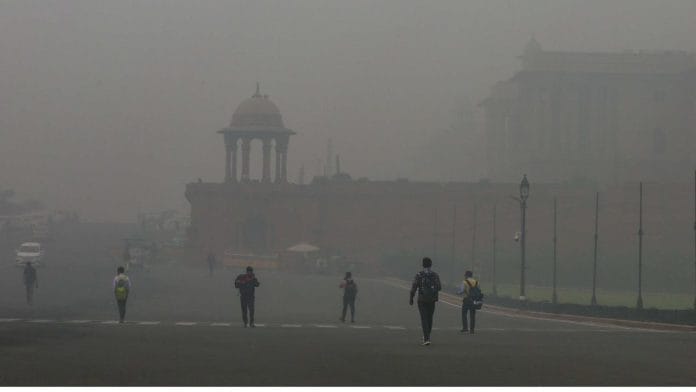
New Delhi: Delhi’s air quality saw a steep decline on Friday, with the pollution levels reaching the worst pre-Diwali levels since 2019, data shows.
A pre-Diwali air quality analysis by the Centre for Research on Energy and Clean Air (CREA) shows that the level of ultra-fine particulate matter (PM2.5) started rising steeply on 5 November, when the PM 2.5 levels reached 227ug/m3. By 6 am on Friday, the hourly PM2.5 concentrations reached 300ug/m3–five times higher than India’s 24-hour national ambient air quality standards (NAAQS) and the worst pre-Diwali pollution spike since 2019.
The levels deteriorated further to 309ug/m3 and then 323ug/m3 in the early hours of Friday before showing a minor improvement.
What’s behind this increase?
Delhi’s air quality index (AQI) has consistently remained in the very poor category for four days, according to Central Pollution Control Board (CPCB) data.
On Thursday, Delhi’s AQI was 369, only a few points better than Wednesday’s 377. On Tuesday, the pollution levels in Delhi settled at 350.
“Delhi is experiencing its worst pre-Diwali pollution period since 2019. Stubble burning is often blamed for Delhi’s pollution, but government estimates attributed only 14 per cent of Delhi’s PM2.5 pollution to stubble burning on 5 Unfavourable weather, stubble fires and local pollutants. The remaining 86 per cent came from other sources, including industries, vehicles, residential cooking and heating, power plants and other combustion activities,” Manoj Kumar, analyst at CREA, told ThePrint.
Senior India Meteorological Department officials explained that winds from the northwest, which are bringing stubble smoke from parts of Pakistan, Punjab and Haryana, are the primary contributor to Delhi’s poor air at this time. The slow winds are also trapping Delhi’s local pollutants and not allowing dispersion to happen.
Punjab Pollution Control Board (PPCB) data showed that between 15 September and 5 November, the state had recorded a total of 2787 stubble fires. Haryana reported 62 fires in the same period.
“There is no forecast of a relief at least for the next few days. It may worsen further during and after Diwali depending on the cracker bursting,” a senior IMD official said, on the condition of anonymity.
(Edited by Insha Jalil Waziri)