



The onset of Delhi’s fabled winter once began with the saptaparni. The potent fragrance of the Alstonia scholaris, or the Indian devil tree, was meant to drive one to madness. But, accompanied as it was by a pleasant chill in the night air, the torturous summer and monsoon firmly in the past, it only ever signalled joy to Dilliwalis. Now, the honeyed scent sets off a different kind of madness: If the saptaparni has bloomed, can the arrival of the season of deadly air be far behind?
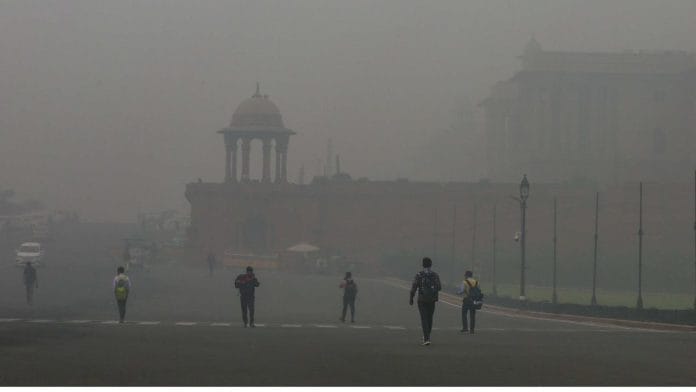
Every November, a fresh obituary for Delhi is written. The sky turns a sullen grey, while the AQI ticker on TV screens goes from flaming orange to throbbing maroon. We read complex explainers about the difference between PM 2.5 and PM 10 as easily as watching a reel cutaway from The Great Indian Kapil Show. Citizens fighting for their right to breathe are ranged against citizens fighting for their right to burst crackers. Once a publication puts a photograph of India Gate, enshrouded in smog on the front page – nowhere is the aesthetic of air pollution as dramatic as in Delhi – the rest of the country settles in to watch the capital choke in real-time.
But air pollution is no longer a Delhi problem. The spread has taken over smaller cities across the country. Last year, the world’s most polluted city was Loni, a sprawling town in Ghaziabad, Uttar Pradesh. Here, the annual PM 2.5 levels were 22 times the WHO limits, and three times India’s far more permissive limits. The year before that, it was Byrnihat, an industrial town home to cement factories and distilleries on the Assam-Meghalaya border.
A few years ago, Goa became the escape hatch for Delhi’s “pollution refugees”. In the years since the pandemic, the state has continued to accommodate professionals and families seeking clean air for their children. They’ve calculated that a house among paddy fields is likely cheaper than a lifetime of hospitalisations.
Over the last few weeks, however, the AQI in parts of Goa shot up to 190, putting the state in the “unhealthy” category. Last December, Panaji’s average PM2.5 levels were at 88 micrograms per cubic metre, 18 times the WHO limit. And this in a city embraced by the Mandovi and the Arabian Sea. Porvorim, further afield from the state capital, witnessed rising cases of respiratory ailments during the same period when an elevated corridor was then under construction.
How did a city on the sea become as breathless as those on the Indo-Gangetic plain?
Rise of personal transport
There were some answers to be found at Emergence, a festival-conference organised by the Goa-based Transitions Research in Panaji last week. An illuminating session on air quality in emerging cities brought together experts from across the country, though there was little agreement on who was the biggest pollutant in Goa.
A source apportionment study from Panjim-Margao-Vasco by Urban Emissions in 2018, found that over 30 per cent of emissions came from transport (including road, rail, aviation, and shipping), another 30 per cent came from dust generated by road re-suspension and construction activities, and another 24 per cent from small, medium, and heavy industries (including power generation). The model showed that by 2030, transport’s share would climb to 40 per cent.
This is entirely unsurprising in Goa, where there are 1.35 million registered vehicles for a population of 1.59 million residents. It isn’t entirely by choice: A personal vehicle is a necessity in a place where public transport is extremely unreliable and inadequate. These major factors are compounded by a series of smaller ones, including lax construction norms for the gated communities carved into the state’s hillsides, the resumption of mining activity, and the mixed garbage that’s set alight every evening.
Sree Kumar Kumaraswamy, Programme Director, Clean Air at WRI India pointed out, mixed waste that includes plastic, rubber, and other complex materials is often set on fire owing to lack of proper disposal systems. These release carcinogens like dioxins, furans, and chemicals.
A WRI India working paper published recently studied the effects of open-waste burning in 11 Indian cities. It found that burning was three times higher in winter than summer, and was most concentrated in poorer neighbourhoods where garbage collection is at its worst. The fires also peak between 7-10 am and 5-10 pm, coinciding with the hours that children and the elderly are out on the street.
Still, there is plenty that smaller and mid-size cities can teach bigger metropolises.
“Scale and space are problems for larger cities,” Kumaraswamy said. “But smaller and mid-size cities can put systems into place and demonstrate that it can be done.”
He cited the example of Pune, where SWaCH workers have dedicated spaces within public gardens to sort through the waste before it heads to the landfill.
Panaji, in particular, has set an excellent example with its solid waste management model. Kumaraswamy said that given the high volume of tourist influx into Goa, bulk waste generators like hotels could minimise their waste by segregating it at source.
“There is a lot of entrepreneurship, lots of job opportunities waiting to take off in this area,” he said.
Also Read: Why Delhi’s pollution is rising ahead of Diwali
Whose air is it anyway?
To put any of these systems in place, smaller cities need funding. Most of it comes from the National Clean Air Programme, launched in 2019 to cut particulate pollution by 40 per cent in 130 “non-attainment” cities. A new report from Janaagraha Centre for Citizenship and Democracy, a Bengaluru-based collective, offers a comprehensive tracking of how the funds were used.
According to “Whose Air Is It Anyway?”, roughly two-thirds of Rs 7,600 crore was spent on road dust mitigation. This included paving, pothole repair, mechanical sweepers, and water sprinklers. Meanwhile, industrial pollution and household fuel received under 1 per cent each. Of the 69 cities with usable data, only 10 met their targets, while 31 ended up with dirtier air than when they started. Crushingly, the report found no statistical link between how much a city spent and how much its air improved.
Anand Iyer, Chief Policy & Insights Officer at Janaagraha, told me that the inordinate amount of money spent on road dust boils down to what the urban local body is capable of handling. Municipal bodies have control over roads and sweeping, but cannot control other sources of pollution like industrial, transport, or burning stubble.
“Who is responsible for air quality in an urban local government? The simple answer is no one,” Iyer said.
The solution is often to appoint a nodal officer – often someone without technical qualifications – who is also in charge of several other responsibilities.
“But you can’t just spray and pray,” he said.
Janaagraha’s recommendation is to put together a clean air cell with 5-7 technical staff members in each city. This must go hand in hand with proper measurement facilities. Iyer’s colleague Prabhat Kumar, Director, Public Finance Management at Janaagraha, said that high-level schemes often triggered a scramble for compliance.
“Are we designing for the right things? Can we move with greater agility?” Kumar asked.
Any proposal, Kumar said, was only as good as the coordination it produced between siloed government departments.
Until then, India’s smaller cities will default to the Delhi model: an air purifier in every room, masks indoors, eyes wide shut.
Karanjeet Kaur is a journalist and a partner at TWO Design. She tweets @Kaju_Katri. Views are personal.
(Edited by Ratan Priya)