



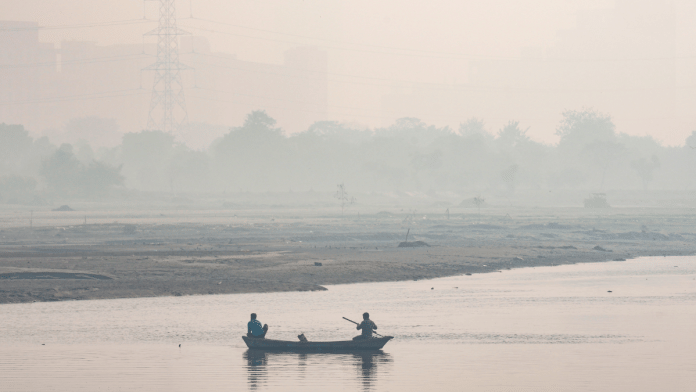
New Delhi: After recording its cleanest October air quality in more than eight years, Delhi’s air deteriorated to the ‘very poor’ category on Monday, with AQI touching 324. Experts attributed the rapid decline to a rise in stubble-burning incidents in Punjab and Haryana, falling temperatures and sluggish winds, which have once again pushed the national capital toward its annual winter pollution peak.
According to data, PM10—coarse pollutants with a diameter of over 10micrometres—remained the most prominent pollutant, followed by the finer PM2.5 at most stations in Delhi. The level of PM10 climbed to 400ug/m3 in some areas, while PM 2.5 also peaked at over 400ug/m3 in many stations during the day.
ThePrint explains what is causing this sudden spike in pollution levels ahead of Diwali.
Increased stubble burning cases and slow winds
Satellite data observed by the India Meteorological Department (IMD) showed that from late Sunday, plumes of smoke from the northwest side of Delhi-NCR, including Pakistan, Punjab and Haryana, started blowing into the city.
Central Pollution Control Board (CPCB) scientists explained that Delhi has been experiencing clean air days due to the recent cyclonic storm, Arnab, that hit the coast of Andhra Pradesh and Odisha last week. The impact of the cyclone led to rain and increased winds in the region, dispersing pollutants that usually clog the city’s air this time of the year.
However, with the storm now cleared, the winds have switched back to the northwest. This means that it is carrying the smoke from the agrarian pockets.
“Because of the recent rain, many farmers were unable to harvest their fields in October. The problem is that many of them will now rush to do that, which will lead to an accumulation of stubble fires, leading to a sudden spike in pollution levels in Delhi-NCR,” a senior CPCB official said, adding that there was no forecast for relief in the coming week.
Punjab government data showed that on 31 October, the state recorded the highest number of single-day stubble fires in the season. In just 24 hours, 194 stubble fires were reported, taking the season’s total count to about 1,007.
“There is no weather system that could bring relief. In fact, if there is intense cracker bursting during Diwali, things would only get worse,” the official said.
Officials also said that the drop in temperatures and the low wind speeds are also becoming conducive to pollution accumulation. The cold temperatures and lack of ample sunlight through Monday resulted in pollution particles remaining trapped closer to the ground. This condition is expected to get worse as the season progresses and temperatures fall further.
Also read: Exclusive: NGO questioned in Kuno leopard poaching case gets Delhi wildlife board seat
Pollution control measures
Looking at the rising pollution in Delhi-NCR, the Commission for Air Quality Management (CAQM) imposed stage two of the Graded Response Action Plan (GRAP).
Under GRAP-2, authorities across Delhi-NCR have been directed to intensify dust and vehicular management measures. The municipal agencies have been asked to increase regular mechanical sweeping of roads, sprinkle water and use anti-smog guns to control dust levels.
There would also be restrictions on industries, brick kilns and power plants.
Due to rising pollution levels, the Supreme Court has permitted the use of certified green crackers only on 7 November and 8 November. The court said that a complete ban on cracker bursting will be restored from 9 November.
(Edited by Saptak Datta)