




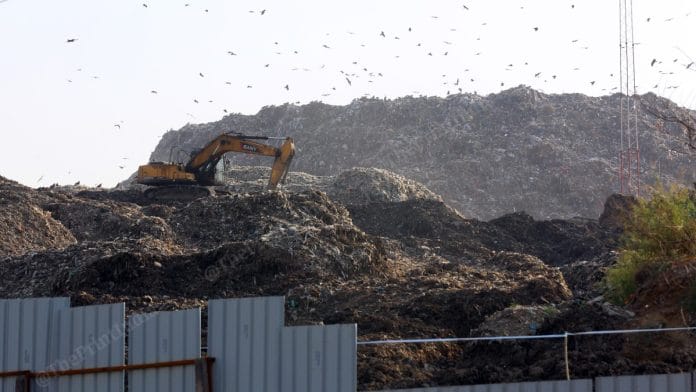
On 21 October, Delhi’s air turned ‘poor’ for the first time this season. The Air Quality Index climbed to 245, its highest in about 100 days, and the first stage of the Graded Response Action Plan was invoked. Patparganj, a short distance from the Ghazipur landfill, was among the stations recording ‘very poor’ air. As is the case every winter, our air pollution debate is obsessed with Diwali and parali, with vehicles and dust close behind. Yet landfills are left out even as they quietly hurt children’s health. Why do they get a free pass?
The link between how a city manages its waste and the health of its children is easy to miss. But evidence from Delhi’s landfills reveals it.
In 2019, before biomining began, Delhi’s three oldest landfills — Ghazipur, Bhalswa and Okhla — stood between 55 and 65 metres high and held an estimated 28 million tonnes of legacy waste. Together with the newer Narela-Bawana site, they still catch fire, release smoke, methane and leachate, and draw flies. Hundreds of thousands of children live within a few kilometres of them.
Also Read: Delhi’s garbage mountains are finally coming down. New ones are rising
What the data show
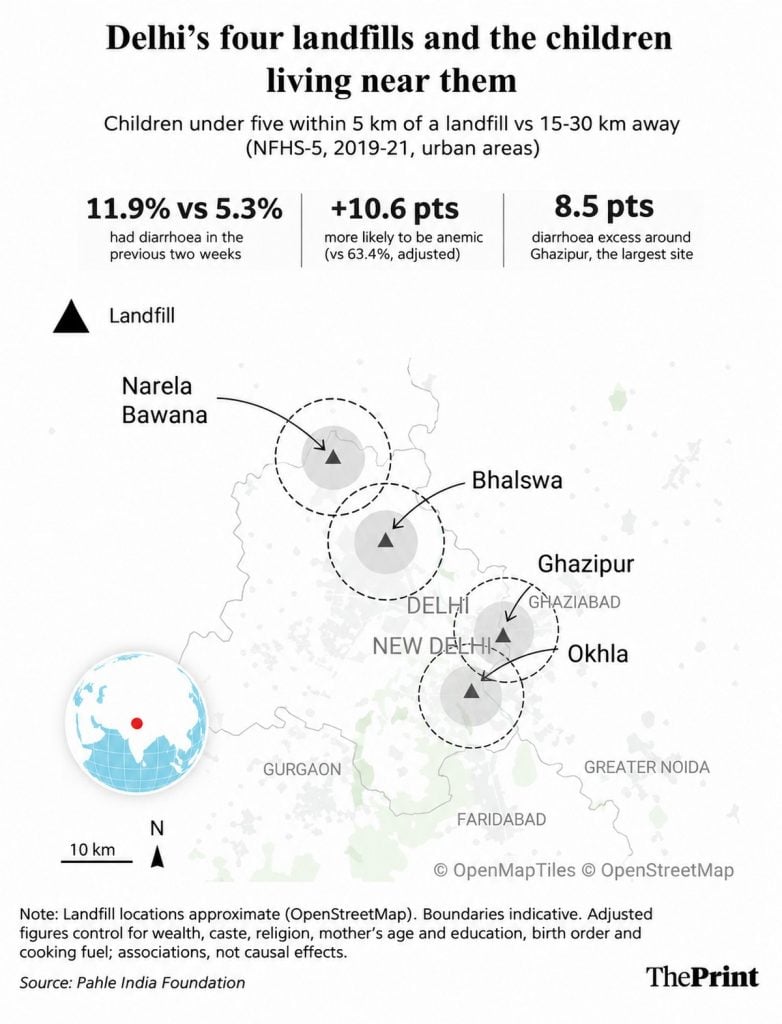
At Pahlé India Foundation, we linked the geo-referenced fifth National Family Health Survey (NFHS-5, 2019-21) to the four landfills, covering 518 urban survey clusters in Delhi, Haryana and Uttar Pradesh. We compared children living within 5 km of a landfill with otherwise similar urban children 15-30 km away, accounting for wealth, caste, religion, the mother’s education, birth order and cooking fuel.
Among children under five living closer to a landfill, 11.9 per cent had diarrhoea in the previous two weeks, against 5.3 per cent farther away. After adjustment for other factors, the excess is 4.2 percentage points. And it does not shrink when piped water, toilets and drainage are accounted for.
Anaemia is worse too. Among children tested, 63.4 per cent of those living 15–30 km from a landfill were anaemic. After controlling for socioeconomic and other household and child characteristics, children within 5 km were 10.6 percentage points more likely to be anaemic than that comparison group.
How smoke thins the blood
Landfills burn because they make their own fuel: decomposing waste releases methane, and air seeping into uncovered garbage feeds fires that can smoulder underground for days. Burning mixed waste emits fine particulate matter (PM2.5), carbon monoxide and dioxins. When Ghazipur burned in March 2022, PM2.5 at nearby monitors rose 20-60 per cent on the first day.
We usually treat anaemia as a nutrition problem. But fine particles also trigger low-grade inflammation throughout the body. Inflammatory signals prompt the liver to produce more hepcidin, the hormone that controls iron. High hepcidin locks iron away and cuts its absorption from food, so the body cannot use the iron it has to make red blood cells. A 2021 study by IIT Delhi and Harvard researchers found that each 10 µg/m³ increase in a child’s PM2.5 exposure was linked to 0.14 g/dl lower haemoglobin and 9 per cent higher odds of anaemia.
Our findings are consistent with this possibility, though they do not establish that landfill smoke causes anaemia. The diarrhoea excess is concentrated among poorer families and around Ghazipur, consistent with possible pathways involving flies, contaminated food or water, and sanitation. The anaemia excess is different: larger among girls (13.1 percentage points) than boys (5.4), and present even in the richest households (10.9 points). A family can buy clean water and better food but it cannot buy cleaner air for a neighbourhood.
We also statistically tested whether similar patterns could emerge simply by choosing arbitrary locations across Delhi. Each time, we randomly selected four hypothetical landfill locations within Delhi and repeated the analysis 500 times. In only 7 per cent of these exercises, the estimated anaemia association was at least as large as the one around the actual landfills and in the same direction. For diarrhoea, the corresponding figure was 20 per cent.
These are associations from a single survey, not proof of cause. Poorer families may settle where land is cheap, and the landfills sit near industry and highways. But policy does not need a perfect causal estimate to act. The findings identify neighbourhoods where children’s health needs attention, and where better monitoring and basic public health services can make a difference.
Also Read: Delhi model of air pollution has reached Goa. Nobody is responsible for air quality
What Delhi must do
Clearing the mounds will take years. The Municipal Corporation of Delhi has made real headway: biomining has reclaimed about 100 acres across Bhalswa, Okhla and Ghazipur. The corporation’s latest target is to flatten Okhla by December 2026, Bhalswa by February 2027, and Ghazipur by December 2027. Our findings suggest this is also a child health programme: every fire prevented and every acre cleared should mean cleaner air and fewer flies for the families nearby.
First, build on current fire-prevention work at the sites. Daily soil cover, compaction, methane capture and thermal scanning for hotspots prevent fires before they start; each fire prevented is smoke a child does not inhale.
Second, put air-quality monitors at every landfill’s edge, alert nearby schools and anganwadis during fires, and recognise landfill fires as a local source under the Graded Response Action Plan.
Third, screen children, especially girls, near the sites for anaemia, with follow-up that looks beyond iron. Iron tablets alone will not fix anaemia caused by inflammation.
Fourth, make these neighbourhoods priority zones for sanitation and fly control, and ensure ORS and zinc reach every child with diarrhoea.
Delhi debates its garbage mountains and, every winter, its air. For the children growing up beside these landfills, the two are one daily reality. Their health should be central to both debates.
Sila Mishra is an Economist and Payal Seth is Chief Research Officer at Pahlé India Foundation, New Delhi. Views are personal.
(Edited by Asavari Singh)