








I was in Kolkata a few weeks ago. I stayed at one of its iconic, slightly crumbling, colonial institutions. I met uncles and aunties I have known all my life. I went to Naihati, to Bardhaman, to Birbhum, to Bolpur. I ate at the hippest new restaurant in Kolkata, Yokocho, and an old Durga Pujo favourite of my childhood, Aaheli. I went to Salt Lake, where my parents still have a flat, and to Park Circus, where our clan once lived.
The overwhelming sense was that Kolkata was Schrödinger’s City—at once dead and alive.
The tragedy of modern Bengal is not merely a story of economic stagnation; it is a profound narrative of cultural and existential disorientation. For nearly half a century, the state has been caught in a pincer movement between two styles of populism that, while ideologically distinct, have been remarkably similar in their results: The erosion of the individual, the glorification of the lumpen, and the systemic destruction of the Bengali middle-class aspiration.
To understand how Bengal lost its path in the last fifteen years, one must view the era of the Trinamool Congress (TMC) not as a departure from the Left Front’s thirty-four-year rule, but as its logical, more aggressive continuation. The shambolism that defines Kolkata today—the crumbling Victorian facades layered with blue-and-white paint, the streets choked by political hoardings, and the pervasive sense of a city that has stopped dreaming—is the physical manifestation of a deeper intellectual rot.
When the Communist regime fell in 2011, there was a fleeting moment of hope that the party-society model—where every aspect of life, from getting a job to resolving a neighbourhood dispute, required the mediation of a party cadre—would be dismantled. Instead, it was simply rebranded. The CPI(M)’s disciplined, ideological machinery was replaced by Mamata Banerjee’s street-fighting social welfarism, a form of populism that thrived on volatility (sometimes violence) rather than institutional stability.
Today, a new generation has come of age in Kolkata and across the Bengali diaspora. This demographic, comprising young Bengalis, as well as the significant non-Bengali populations who have called Kolkata home for generations, feels no kinship with the red flags of the past or the populist theatrics of the present. They are the children of the internet and the globalised economy. They look at the rapid transformations in Bengaluru, Hyderabad, or the NCR, and then they look at the stagnant landscape of Bengal with a sense of profound alienation.
This generation wants the state to grow at the pace of the rest of India and the world. They are tired of being told that Bengal is culturally superior, while they have to migrate to other states to find a decent job in technology, finance, or research. For them, the romanticism of the ‘intellectual’ (‘antel’, to use the colloquial Bengali word) sipping tea at Indian Coffee House while the state’s GDP lags is not a sign of sophistication; it is a sign of surrender.
Also read: BJP’s West Bengal win doesn’t mean 2029 Lok Sabha election is in the bag
Weight of its success
One of the ironies of the last fifteen years is that Mamata Banerjee had delivered a form of development. Rural electrification, better roads in the hinterlands, and a plethora of direct cash-transfer schemes have reached the grassroots. However, much like the Soviet Union under Mikhail Gorbachev, the system has begun to buckle under the weight of its own minor successes.
When the Soviet Union introduced Glasnost and Perestroika, the small shoots of openness didn’t satisfy the people; they served only to highlight how far behind the rest of the world they truly were. Similarly, the marginal improvements in Bengal’s infrastructure have only whetted the appetite for a genuine modern economy—one that the current political structure, built on the foundations of the syndicate (the local extortion cartels) and political patronage, is incapable of providing. The hunger for more has expanded, but the state’s ability to provide high-value growth remains stunted by its own thuggery.
For every successful Mir Afsar Ali, a much-loved radio presenter and actor and much else, the hit momo chain Wow! Momo, headquartered in Kolkata, and Auroni Mukerjee, the wizard chef at Yokocho, more than 6,600 companies relocated out of Kolkata between 2011 and 2025.
Kolkata was both growing and collapsing, like the Durga Puja festival becoming world famous and getting listed as a global ‘intangible heritage’ but losing its core devotional aspect and being reduced to a ‘sarodiya utsob’ (only an autumnal festival). Saraswati Pujo, the worship of the goddess of learning in a place which was ever snooty about intellectualism, was rebranded as ‘Bengali Valentine’s Day’—the cultural insipidity and vacuousness were staggering and built deep resentment.
Also read: BJP Bengal win dissolves the old Bhadralok order. It kept Dalits and their issues out
Rule of the strongman
The cultural loss is most evident in the everyday violence that has become the wallpaper of Bengal’s politics. The thuggery of extortion is no longer a localised grievance; it is a systemic tax on existence. Whether it is a small shopkeeper paying a ‘protection fee’ to a local club or a homebuyer being forced to purchase substandard building materials from a party-aligned syndicate, the individual’s agency has been systematically stripped away.
The horrors of Sandeshkhali and the tragedy at RG Kar Medical College are not isolated incidents of administrative failure. They are the inevitable outcomes of a culture where the rule of law has been replaced by the rule of the local strongman, the ‘dada’.
Underpinning this entire decline is a demographic fear. The bhadralok class is witnessing its own eclipse. With the birth rate in Bengal among the lowest in India and the constant brain drain of the educated youth, there is a palpable fear that the cultural custodians of Bengal are becoming a historical footnote. This demographic shift has led to a defensive, almost xenophobic strain in local discourse, which only serves to further isolate the state from the national mainstream.
Perhaps the most tragic aspect of this journey is the loss of Bengali pride. Bengalis are tired of being ashamed of their capital’s decay, tired of being associated with political bloodshed, and tired of the feeling that there is nothing left to feel proud about.
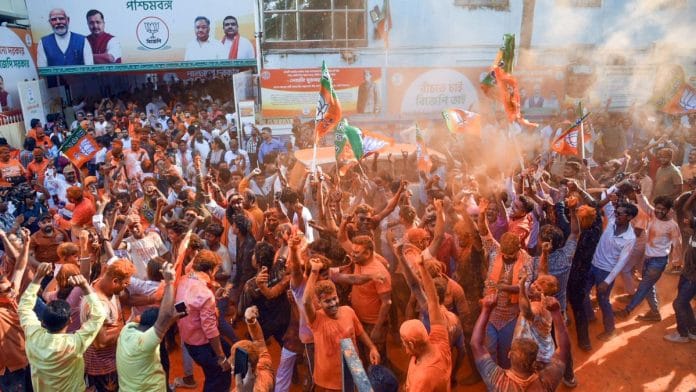
And now, the new generation has chosen what it believes is its one chance for real change (as a young Bengali wrote yesterday on social media, “the last train to civilisation”). They have chosen a shot at valuing the individual over the cadre, and progress over the parade.
Hindol Sengupta is a historian and author of 13 books. Views are personal.
(Edited by Theres Sudeep)