



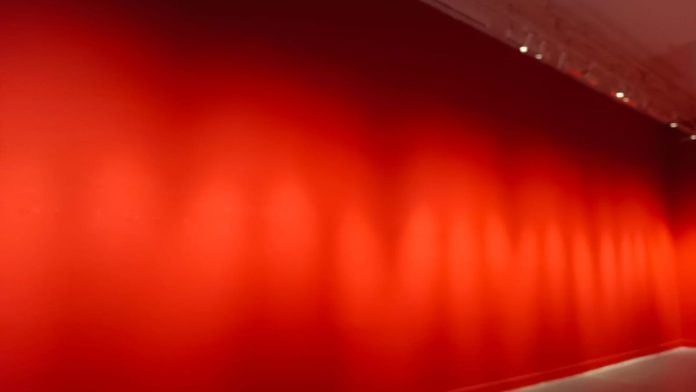

On the evening of 21 October, visitors to No Idea Is Final, a photography exhibition at Delhi’s Bikaner House, found empty red walls with the nails still in them, and a catalogue showing what should have hung there. The photographs were by 26-year-old Raihan Vadra, son of Congress leader Priyanka Gandhi Vadra and nephew of Leader of the Opposition Rahul Gandhi. ThePrint reported that 75 of the 105 photographs had been ordered removed that afternoon, failing which the exhibition would be cancelled. Most documented this year’s protests in Delhi: demonstrators, policemen and detentions. Two were photographs of the national flag.
Raihan Vadra has said he received a written removal notice citing non-compliance with Bikaner House’s booking policy, and was told the photographs were “too political”. Bikaner House has yet to put its version on record. If it indeed issued a written order with reasons, it should publish it.
Article 19(1)(a) guarantees citizens freedom of speech and expression, which the Supreme Court has long held to include photography, painting and cinema. The Constitution permits restrictions by law on eight grounds only: sovereignty and integrity of India, security of the State, friendly relations with foreign States, public order, decency or morality, contempt of court, defamation and incitement to an offence.
The framers drew up that list deliberately. “Too political”, “bad timing” and “the exhibitor’s family” are not on it.
Content that is genuinely dangerous is already covered by criminal law. Promoting enmity between communities (the old Section 153A of the Indian Penal Code, 1860, now carried into the Bharatiya Nyaya Sanhita, 2023), deliberately outraging religious feelings and obscenity are all offences. The police also have a statutory duty to prevent cognisable offences. Had any photograph on that wall been inflammatory or obscene, the police could have acted, on record, subject to challenge in court. Nobody invoked any of this. Photographs of citizens protesting in a public place, many of them already published in newspapers, are not offences. The State cannot treat as contraband in a gallery what it permits on the front page.
Also Read: Sharjeel Imam wants to pick up where 1946 left off. A Sikh reads the fine print
Whose wall is it?
A private gallery may hang or refuse whatever it likes. Bikaner House belongs to the Government of Rajasthan and is therefore “the State” for constitutional purposes. Once the State opens a cultural space to the public, it may not choose exhibitors by viewpoint. Article 14 forbids it from applying to one exhibitor a rule it waived for another. The artist says a political installation was shown at the same venue in September last year.
In S. Rangarajan v. P. Jagjivan Ram (1989), the Supreme Court held that expression cannot be suppressed because someone threatens trouble. The danger must be proximate, “like a spark in a powder keg”, and the State may not plead its own inability to keep order. In Indibility Creative v. Government of West Bengal (2019), where informal official pressure had driven the political satire Bhobishyoter Bhoot out of cinema halls, the Court held that the State cannot achieve by telephone what it could not lawfully achieve by order; it also imposed costs.
The two Tiranga photographs went last. In Union of India v. Naveen Jindal (2004), the Supreme Court held that displaying the national flag with respect is itself protected expression. An official who classifies a photograph of the Tiranga as “political content” treats the national flag as partisan property.
Clearance by telephone
The proposal for Raihan Vadra’s exhibition was approved months in advance, and the layout was shared a week before the opening without objection. According to the artist, the first call came at about 6 pm on Tuesday, 20 October. The next afternoon, he said, the Principal Resident Commissioner inspected the rooms, telephoned the Chief Secretary of Rajasthan and an officer in the Chief Minister’s Office, and at 3.30 pm set a 5 pm deadline to take down the pictures. The blank frames that replaced the photographs then had to come down as well.
I served as District Magistrate, Batala, and Deputy Commissioner, Amritsar, between 1989 and 1996, when weighing public order was the daily work of the job. A public-order assessment is written, reasoned and signed by the officer who owns it. A decision assembled by telephone, passed upwards and executed four hours before the doors open assesses nothing; it transfers risk.
The exhibitor is the son of a Congress general secretary and the nephew of the Leader of the Opposition. The government in Jaipur is of the BJP. It seems that an officer in Delhi did not want to be the one who let the photographs hang. The reflex remains State action, and it answers to Article 19 like any other.
Also Read: Mohan Bhagwat doesn’t decide if Muslims belong in India. The Constitution does
Blank spaces, then and now
On 28 June 1975, three days after the Proclamation of Emergency, The Indian Express appeared with its lead editorial column left blank. The Statesman followed. On 29 June, the censor issued revised guidelines forbidding blank spaces too. I was a schoolboy in Patiala that summer.
At Bikaner House, the artist hung blank frames, and officialdom ordered those down as well. The proportions are not the same, of course: nobody has been jailed and no newspaper has lost its electricity. The censor of 1975 acted under a Proclamation that suspended Article 19. Today, there is no such proclamation and Article 19 is in full force. The censor of 1975 had a legal instrument; the officer of 2026 had a telephone.
The irony is that the takedown has magnified the reach of the exhibition.
A five-day photography show in a heritage building in Lutyens’ Delhi might have drawn a few hundred visitors. The empty walls drew national coverage on opening night. The removed photographs survive in a catalogue that every visitor carries away, and will circulate online at high resolution. The photographs will travel to a Bengaluru gallery in December with an audience the officials have built for them.
A government venue does have a legitimate interest in neutrality while an agitation is live, but it exercises that interest at the booking stage, through a published policy applied to every exhibitor alike, and not four hours before an opening.
Every state, Punjab included, runs a Bhawan in Delhi with rooms to let. Each should publish a short policy for its cultural spaces, framed within the eight grounds of Article 19(2). Rajasthan can start by publishing Wednesday’s order, if there was one.
KBS Sidhu, IAS (retd.), superannuated as Special Chief Secretary, Government of Punjab, in 2021. He is Founder-Editor of The KBS Chronicle (kbssidhu.substack.com) and Convener of the Shiromani Punjab Forum. Views are personal.
(Edited by Asavari Singh)