





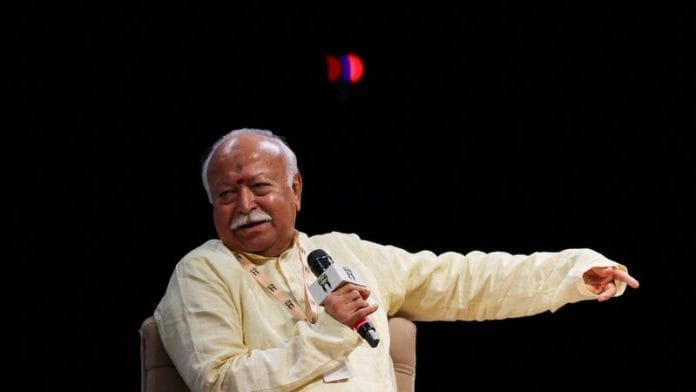

In my previous article, I wrote what RSS Sarsanghchalak Mohan Bhagwat got right in his New York addresses of 29 August. He rejected the expulsion of Muslims as incompatible with being Hindu, said protection cannot be conditional on obedience, and told Indian-Americans that loyalty is owed first to the United States, which is the most statesmanlike thing said to the diaspora in years.
Those are real commitments. In this article, I argue whether they translate into constitutional law, and if not, what actually decides who belongs to India.
What secular means here
Almost everybody in this argument, the Sangh and its critics alike, proceeds from one misconception: that secular means the state has nothing to do with religion.
It has never meant that in India. If it did, the state would be in continuous breach of its own Constitution, because it touches religion daily. It administers Hindu temples and their endowments, regulates Waqf properties, recognises the kirpan by name in the fundamental rights chapter, legislated the Anand Marriage Act so a Sikh marriage may be registered as one, and funds both mission colleges and a central university founded for the education of Muslims. In the very article protecting freedom of religion, it empowers itself to legislate for social reform and to open Hindu religious institutions to all classes, which is how untouchability was assailed at the temple door.
Indian secularism is the state’s equidistance from religions: active, engaged and deliberately even-handed, dealing with every faith with due regard to its social norms and beliefs, and granting none of them ownership of the Republic.
That cuts both ways. Take the June 2025 proposal, floated by the RSS and endorsed by then-Vice President Jagdeep Dhankhar, to reconsider the words ‘secular’ and ’socialist’ in the Preamble. The 42nd Amendment added no new principle in 1976, which is why the Janata government left it standing while dismantling much else of the Amendment, and why the Supreme Court in November 2024 called secularism a facet of the right to equality. Delete it and you remove the anchor of the equidistance while leaving every entanglement in place. An unbound state is not a more honest one.
Nor does the looser liberal argument fare better. Even-handedness is harder than abstention, because it must be re-earned at every counter.
Also read: Muslims, Sikhs, Christians—how minorities are reading Mohan Bhagwat’s New York speech
Equality does not wait on theology
Article 14 guarantees equality before the law and Article 15 forbids discrimination on the ground of religion. Neither requires a Muslim and a Hindu to agree about the Atman first. This matters because Bhagwat’s universalism, that all paths converge on one truth, is generous from within a Hindu frame and useless as a basis for citizenship. A Muslim may hold that tawhid is not one formulation of the Atman among several, a Christian may say the same of the Incarnation, and an atheist rejects the premise entirely. The Constitution protects belief and disbelief equally, which is more capacious than any universalism, because it does not ask the citizen to concede he was never really different.
Where the question is being settled
The Citizenship Amendment Act: Passed in December 2019, with rules notified only in March 2024, a four-year gap that is itself an admission of difficulty. It names six communities (Hindus, Sikhs, Buddhists, Jains, Parsis, and Christians) from three countries (Pakistan, Bangladesh, and Afghanistan) and omits Muslims. In Assam, where the National Register of Citizens (NRC) excluded over 19 lakh people in 2019, including some five lakh Bengali Hindus on the chief minister’s own accounting, the Act was promoted as the remedy. By mid-2026, six persons had obtained citizenship through it, while tens of thousands of cases continued before the Foreigners Tribunals. The nationwide register sits in a condition peculiar to Indian administration: repeatedly invoked, never notified, never withdrawn.
The passport: On 24 June, asked at a Passport Seva Divas briefing whether a passport proves citizenship for the electoral roll revision, officers of the Ministry of External Affairs (MEA) said it does not, calling it a travel document. In mid-July, the ministry’s spokesperson reiterated it, citing the Passports Act of 1967 and noting that fewer than 8 per cent of Indians hold one.
As law, it is defensible, and a 2013 Bombay High Court ruling supports it. As administration, it was gratuitous. The state demands proof of birth or domicile, sends a police officer to the applicant’s home to verify antecedents, and finally issues in the President’s name a document that requires foreign states to protect the bearer, a request made only for those it claims as its own. It does all that and then says the document proves nothing about the holder’s citizenship status; it tells a hundred million holders that their best-verified document is worthless for the purpose that now matters. And if the best document is not proof, what does the other 92 per cent produce to prove citizenship?
The electoral roll: The Constitution and the Representation of the People Act, 1950 lay down only three conditions: 18 years of age, citizenship, and ordinary residence. The Special Intensive Revision (SIR), whose power the Supreme Court upheld in May 2026, adds a fourth by executive instruction. The voter must map themselves to the roll of the last intensive revision, or produce either parent’s entry on it. Verification is legitimate and rolls do decay. But a condition of inheritance falls hardest on the migrant labourer, on the woman married across a district boundary whose natal and marital records carry different names, on the flood-displaced household, and predictably on the Muslim household whose papers already attract additional scrutiny.
The Census: Phase II arrives in February 2027, recording caste for all communities for the first time since 1931. The Census Act of 1948 protects the individual’s census answers absolutely, and census slips have never been evidence in any proceeding. That separation must hold, because within 12 months, a household will face an enumerator, a booth-level officer, possibly a tribunal, and a government that has already told them their passports are useless as proof of citizenship. Four statutes, four purposes, no legal connection between them. But a household experiences administration as a sequence of knocks on the door.
The test that counts
Proof of even-handedness is administrative and dull: a booth-level officer applying the same standard at both ends of the lane, a tribunal whose orders survive reading, a citizenship statute that includes the seventh community or explains itself without embarrassment, a ministry that thinks first about the 92 per cent who hold no passport. No speech delivered 8,000 miles from the constituency can stand in for any of it.
The Constitution already tells 170 million Indians that the country is theirs by right. Nothing said from a platform, however warmly meant, can add to that, and nothing needs to.
KBS Sidhu is a retired IAS officer who superannuated as Special Chief Secretary, Government of Punjab. He is the Founder-Editor of The KBS Chronicle. He tweets @kbssidhu1961. Views are personal.
(Edited by Prashant Dixit)