




A critic who cannot concede a good sentence can’t examine a bad one.
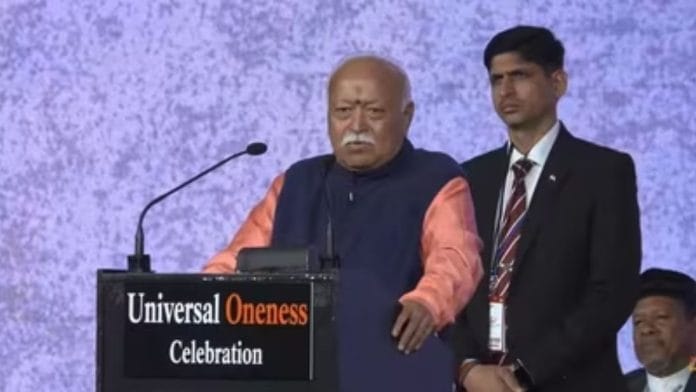
RSS Sarsanghchalak Mohan Bhagwat, at an interfaith summit in New York on 29 August, recalled Muslims who had asked him after his Delhi lectures of 2018 whether they would be driven out of a Hindu Rashtra. He replied that expulsion would not be Hindutva at all, and that a Hindu who wants a Bharat without Muslims will not remain a Hindu.
Those dismissing this statement as public relations are being lazy. Consider the domestic weather in which it lands: a decade of election seasons conducted in the vocabulary of infiltrators and graveyards, bulldozers that arrive before charge sheets, and television studios where a Muslim panellist is invited so that four others may shout at him. In this atmosphere, the head of the Sangh telling a section of his own following that they have argued themselves out of the faith they claim to defend is worth having. Indian commentators who could not bring themselves to say so should ask themselves why.
He said more that deserves recording. Diversity, he told the Madison Square Garden crowd, must be accepted, respected and protected. Those who extend protection only to the obedient, he said, conduct themselves as rakshasas (demons). Both propositions, taken seriously, indict a great deal of what is done in his name. Having said that, I have to report what three sets of Indian readers actually heard.
The Muslim reading
A Muslim citizen who reads the sentence closely notices its construction. His right to exist in India is established by way of a proposition about what a Hindu must believe. The whole load is carried by Hindu self-definition.
Persuade enough Hindus that the Sarsanghchalak has misdescribed their faith, which a loud section already believes he has, and the protection goes out with the theology. The constitutional sentence is built the other way round. Muslims belong to India because India is equally theirs. Their citizenship is neither granted by nor dependent on the goodwill of the majority. That version survives a bad decade—and a change of Sarsanghchalak.
The second thing an Indian Muslim notices is the word ‘shelter’. Bharat, Bhagwat said, gave shelter to those who had nowhere safe to go. As history that is honourable and true of the Parsis at Sanjan and the Jewish people of Cochin. Applied to Indian Muslims, it is a category error with a long tail. Their ancestors’ labour, languages, architecture, jurisprudence and military service are constituents of India rather than guests within it. The Urdu in which much of the freedom movement was argued is not a loanword. Maulana Azad was not a lodger.
Bhagwat answered the question of expulsion and left untouched the question of ownership, the one that has been live all along.
The Sikh reading
For Sikhs, the difficulty is simpler. He said nothing about us at all.
Sikhs are absent from Bhagwat’s New York speech. And it is now a pattern. Bangkok, November 2023, at the World Hindu Congress: Islam referenced, Christianity referenced, Sikhism absent. Kochi, August 2025: a Sikh vice-chancellor proposes a chair on Vedic resonances in Sri Guru Granth Sahib in the Sarsangchalak’s presence, uncorrected from the dais. Nagpur, October 2025: Guru Tegh Bahadur invoked in the 350th year of the martyrdom and framed as Hind ki Chadar, the shield of Hindu society. Mumbai, February 2026: gurdwaras praised for their cleanliness, referenced as material for a general point about temples.
The Sangh has said the necessary sentence before, under pressure and in private. In January 2001, after the uproar over KS Sudarshan, the fifth Sarsanghachalak of the Rashtriya Swayamsevak Sangh, describing Sikhism as a sect of Hinduism, the RSS spokesman M.G. Vaidya handed Sardar Tarlochan Singh, then at the National Commission for Minorities, a written note recording that Sikhism is a separate religion with a distinct ideology. In August 2005, Ashok Singhal of the VHP issued a letter to the same effect. Neither has been repeated by a Sarsanghchalak from a public stage.
Sikh history also supplies a harder test than oneness. In 1675, at Chandni Chowk, Guru Tegh Bahadur gave his life for the religious freedom of the Kashmiri Pandits. He did not ask them to accept the Sikh understanding of the divine. Nor did he tell them that beneath their janeu and his own kesh ran a single thread making all faiths ultimately one, a claim that would have recast the coercion of a minority by the state as a misunderstanding within one family, to be dissolved by better feeling rather than resisted. He defended their right to remain different from him. That is the standard. I protect you because your conscience is yours, and it stays yours precisely where it contradicts mine.
The Christian reading
Christians received the warmest formulation of the evening: friendship before persuasion, dialogue conducted since 2018, service rendered without discrimination.
They also received an invitation to return to the true form of their faith, which will converge on a universal human dharma. A Christian can reasonably say that the belief in the incarnation is not something to be corrected, and that religious pluralism does not require him to agree with that.
The sharper problem for Christians is the distance between the dais and the street. While the Sarsanghchalak speaks of protected diversity in Manhattan, his affiliates press anti-conversion statutes state by state. A Christmas function at a Nagaur school or a mall in Raipur can be disrupted by activists who have absorbed the Sangh’s confidence and skipped its caveats. Nobody in Nagpur has yet been visibly and personally answerable for any of it.
Also read:
What the three have in common
All three readings converge on one omission. Each community was told it would be protected. None was told that nobody is entitled to be its protector, because all are equal owners. Protection is a duty the protector defines, revises, and may one day find inconvenient. Ownership is a right the owner asserts against the protector.
There is a cheap remedy available for at least one of these. The Sarsanghchalak could travel to Amritsar, pay obeisance at Sri Harmandir Sahib, and say in his own voice, without the adjective and without the dharma qualifier, that Sikhism is a separate religion distinct from Hinduism. It would cost him nothing he values, and it would tell Muslims and Christians what they cannot know at present, which is whether what was said in New York will also be said in Nagpur.
KBS Sidhu is a retired IAS officer who superannuated as Special Chief Secretary, Government of Punjab. He is the Founder-Editor of The KBS Chronicle. Views are personal.
(Edited by Ratan Priya)
“Their ancestors’ labour, languages, architecture, jurisprudence and military service are constituents of India rather than guests within it. ” – according to KB Sidhu, Parsis and Jews are guests of India. How nice of him to denigrate these two most accomplished Indian communities.
Secondly, he refers to the sacrifice and martyrdom of Guru Teg Bahadur. But is that the standard the average Sikh holds himself to? There have been scores of lynchings in Punjab over patently false and baseless allegations of sacrilege and blasphemy.
Anyone reading KB Sidhu would believe that only Hindus go about lynching others while his community is saintly in it’s acts and deeds.
Also, what is most remarkable is that he does not speak a single word on the Indian tricolour being torn and trampled by his fellow Sikh brethren in New York.
What does that tell us?
Mahatma Mohan Bhagwat’s NY lecture on ‘oneness’ and ‘shelter’ is peak political fatigue and comedic.
He stands in New York telling the world that India’s job is to protect and accommodate everyone, while lecturing his own Hindu base that they aren’t ‘true Hindus’ if they demand accountability. The reality? Non-Indic demographics don’t treat India as a sacred, shared, civilization heritage. Why would they? They demand concessions, act entitled to special status, and completely reject any civilizational responsibility. Non-Hindus reject the label to his face because they don’t want their identity subsumed, while core Hindus are sick of being admonished, lectured on restraint, and forced to carry the burden of endless ‘good behavior.’
Placating everyone with shenanigans of ‘soft universalism’ pleases absolutely no one. He is just repackaged Congress’s appeasement policies.
In fact, Bhagwat’s global posturing is just the mirror image of frequent-foreign-flyer Mahatma Raoul. Both are addicted to external validation. Raoul implores Western elites to intrude into internal Indian democracy and help him validate the ‘Democracy is dying’ theory, while Bhagwat seeks foreign interfaith panels to validate the RSS as soft and non-threatening. Both treat foreign soil as the supreme court of legitimacy.
Bottom Line: The RSS no longer speaks for Hindus or Bharat…they’re just playing the exact same foreign-validation game as the opposition!
Most Hindus have no difficulty in conceding that Sikhism is a separate religion. At the same time, I, as a lay Hindu person, would place it in the category of Indian/Dharmic religions including Buddhism and Jainism, which though different from Hinduism are not so different as to be incommensurable with it. In fact, I come from the Jat community and if we go back around three generations, i.e., pre-independence era, intermarriage between Hindu and Sikh Jats was relatively common. Then, Sikhs decided to forge an identity explicitly different from Hindus, and this intermarriage, for the most part, also came to an end. Now, personally, I don’t see what purpose is served by these continuing efforts to distance Sikhism from Hinduism. From what I can see, they haven’t made either side any happier.
Very fine column. 2. Going beyond the minorities, who are protected ultimately by the Constitution, including its foundational principle of Fraternity, which a judiciary is duty bound to uphold unswervingly. These wise words should be heard by the Hindu majority. I instinctively believe that Hindus are a tolerant community. Although there is a large minority for which this perhaps does not hold true. This was a solemn declaration made to the whole world about the limits a Hindu Rashtrapati will respect. It should travel downwards, encompass all of the faithful. When a CM makes a hurtful majoritarian remark, or a mob unleashes violence on a poor Muslim, they will all be reminded that this is the standard and promise they are not living up to.
Can you imagine a democratic and secular India (imperfect as it is) . with a 50% Muslim population? Or a Christian India where the government takes the church’s money and spends it without its permission? Hindus have underwritten India’s democracy and secularism because Hindus fundamentally believe that all religions lead ultimately to the One Supreme being. That is not true of some others. Bhagwat has only stated the truth. You may not like it, but that’s what it is. So yes, minorities in India have been protected because India is 70+ Hindu. It is because of attitudes like this that refuse to accept the difference between theory and reality that RSS/BJP have become so popular.