



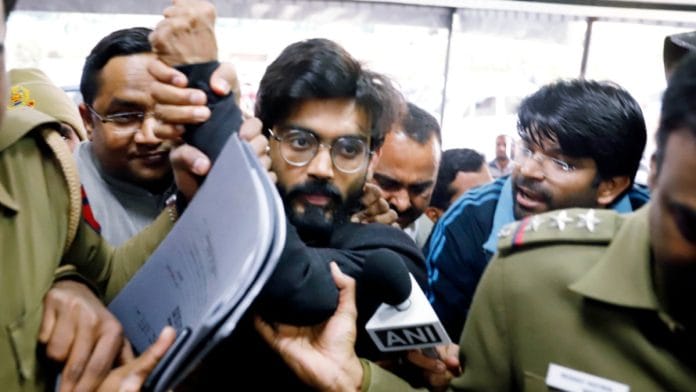

Sharjeel Imam has been an undertrial since January 2020. A republic confident of its Constitution would have either conducted a trial by now or freed him. I say that first because I disagree with most of the long interview he has given The Quint from prison, serious as it is.
His argument runs like this. The Constitution, he writes, “has enshrined centralisation, denied Muslim representation” and prohibited reservation for Muslims. The Republic was born of the refusal of Muslim demands, so the Muslims who stayed were to get “token representation” and “no statutory guarantees”. Muslims should therefore “start from where the reformist and democratic project was paused in 1947”, which means Jinnah’s programme and the Cabinet Mission Plan of 1946.
A smaller minority
I am a practising, turbaned Sikh. At the last Census, my community numbered 2.08 crore, about 1.7 per cent of India. Muslims numbered 17.22 crore, over 14 per cent. If any minority has reason to fear being outvoted, it is mine. I spent four of my pre-school years in Malerkotla, Punjab’s only Muslim-majority town. And on 20 September, I objected in ThePrint when a columnist turned a critique of Muslim politics into a verdict on 20 crore people.
On statutory guarantees
The guarantees exist, and they sit in the fundamental rights chapter, which ranks above any statute. The Constitution gives the Muslim every right it gives the Hindu: equality, the vote, the freedom to profess, practise and propagate his faith. Then it gives minorities something more. Muslims, Sikhs, Christians, Jains, Buddhists and Parsis each have a fundamental right to set up and run educational institutions of their choice. Such an institution can reserve up to half its seats for its own community, even when it runs on government aid. The caste reservations the government may impose on other private colleges do not apply to it, and its schools are exempt from the 25 per cent quota under the Right of Children to Free and Compulsory Education Act, 2009.
Now take a Hindu trust that builds a college entirely with its own money. It has no such fundamental right. It can be made to reserve seats, its school must admit the quota, and it has no constitutional entitlement to prefer children of its own community, except in the few states where Hindus are themselves a minority. I know of few constitutions anywhere that give minorities rights, nay fundamental rights, which the majority does not have. I am a beneficiary of that generosity, and so is Imam.
There is more. A Muslim’s marriage, divorce and inheritance follow his own personal law. His endowments have a dedicated statute in the Waqf Act, 1995, amended in 2025. Imam complains that waqf bodies were filled by nomination when the community could have elected them. I agree with him, and I argued in these pages that the government hired the Muslim middleman for its own convenience.
A central university founded for Muslim education runs on public money. On 8 November 2024, a seven-judge Bench of the Supreme Court overruled, by four to three, the 1967 Azeez Basha ruling that had denied the university minority status. It left a regular bench to decide, on the tests now laid down, whether the university is a minority institution. That question is still pending. For decades, until 2018, the exchequer also subsidised the pilgrimage to Mecca.
Where Sharjeel Imam has a point
On two matters Imam is right. Muslims are a seventh of the country, yet they hold only about two dozen of the 543 Lok Sabha seats. Proportional representation is a fair debate, for Dalits, backward castes and small parties as much as for Muslims.
He is right, too, about the Constitution (Scheduled Castes) Order, 1950, which denies Scheduled Caste status to Dalits who are Muslim or Christian. Sikhs were admitted in 1956 and Buddhists in 1990. My community is on the favoured side of that line, and I cannot defend it. The question is before the Supreme Court.
On reservation generally, he overstates. The Constitution bars quotas on the ground of religion alone, and it bars them for every faith. Following the Mandal Commission recommendations and the Supreme Court’s 1992 Indra Sawhney ruling, numerous socially and educationally backward castes among Muslims—collectively referred to as Pasmanda communities—were integrated into the Central Other Backward Classes (OBC) list, allowing them to share the 27 per cent reservation in central jobs and educational seats. The poor among the rest qualify for the 10 per cent quota for economically weaker sections (EWS) introduced in 2019.
Co-authors of the Republic
Imam writes of Indian Muslims as a people kept out of the system. The record says otherwise. Those who stayed in 1947 chose this Republic over a country made in their name, and Maulana Azad, its first education minister, laid the foundations of its universities. Three Muslims have been president: Dr Zakir Husain, Fakhruddin Ali Ahmed and Dr APJ Abdul Kalam. Havildar Abdul Hamid won the Param Vir Chakra in 1965 at Asal Uttar, in what was then the Amritsar district where I later served as Deputy Commissioner. The civil services examination, the IITs and the armed forces ask for no certificate of faith, and every year’s merit list carries Muslim names.
What was paused in 1947
Here a Sikh must speak plainly. The Cabinet Mission Plan that Imam refers to placed the whole of Punjab in a compulsory group of Muslim-majority provinces. It gave the Sikhs within it no safeguard of the kind the Muslim League demanded for Muslims at the Centre, and the Sikh leadership rejected the plan in June 1946 for that reason. Decentralisation, as Jinnah framed it, protected one minority and forgot the next. Historians will go on arguing over who wrecked the plan. Nobody disputes that the Radcliffe Line ran through the Sikh heartland.
Nor were separate seats simply “denied”. In May 1949, the Constituent Assembly’s minorities committee, chaired by Sardar Patel, gave up reserved seats for religious minorities, with Muslim members such as Begum Aizaz Rasul speaking for the change. I served in Amritsar from 1992 to 1996, as Punjab counted the cost of a decade in which genuine grievances were recast as a separate destiny. Sikhs recovered their place through ballots, regiments, farms and enterprise.
The Indian Muslim holds constitutional guarantees that Pakistan never gave its own minorities, the Ahmadiyyas among them. He should press those guarantees in court and claim his share of representation at the polling booth.
KBS Sidhu is a former IAS officer who retired as Special Chief Secretary, Punjab. He tweets @kbssidhu1961. Views are personal.
(Edited by Prashant Dixit)