



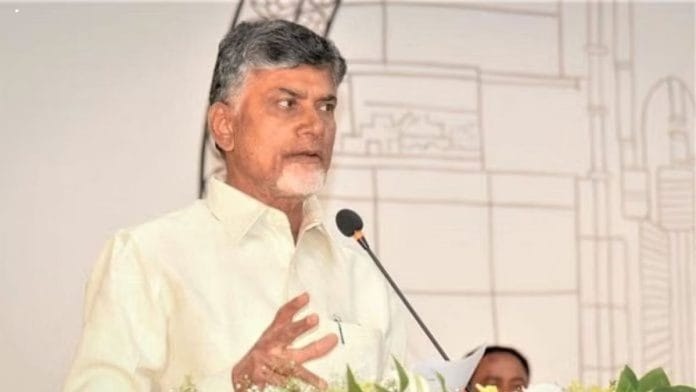
Hyderabad: The Andhra Pradesh government plans to increase the number of operational airports in the state from six to 15 in the next five years to boost regional connectivity as it seeks to expand its aviation ecosystem under its new aviation policy for 2026-31.
The plan is in line with Chief Minister N. Chandrababu Naidu’s decentralised industrial policy under which the state government aims to ensure every citizen in the state is within 150 km of an operational airport.
It is also part of the state’s efforts to build the state’s aviation ecosystem—including cargo facilities and training schools—after the 2014 bifurcation stripped it of its primary aviation hub in Hyderabad.
The government kicked off with its announcement on Monday of a new airport at Palasa in Andhra Pradesh’s north-coastal plains by Union Civil Aviation Minister K. Ram Mohan Naidu.
Next on the list are five new airports in the near term to supercharge regional connectivity and industrial growth as Andhra Pradesh aims to scale passenger capacity from 6.2 million to 30.38 million by 2047.
The Union cabinet has also approved a public-private partnership (PPP) for a Nellore airport at Dagadarthi, in addition to confirming airport proposals for Kuppam, Srikakulam, Ongole, Amaravati International Airport and Nagarjuna Sagar. These projects have either received feasibility approvals, TEFR clearances, land acquisition progress, or formal government backing.
An aviation upgrade in the works
The Andhra Pradesh government and the Ministry of Civil Aviation (MoCA) have approved an estimated total investment of approximately $1 billion to build and upgrade aviation infrastructure across the state.
Currently, Andhra Pradesh has six operational airports: Visakhapatnam (Vizag), Vijayawada, Tirupati, Rajamundry, Kadapa and Kurnool. Once the new airports are ready, the state will have a network of 15 commercial airports, including the flagship GMR-built Bhogapuram International Airport, off Visakhapatnam.
Officials who drafted the state’s aviation policy and consultancy firms, such as US-based GraySpace and Gomsons Aviation, envision building a future-ready aviation training, innovation and workforce development hub.
“India’s aviation sector is entering a phase of significant growth, and states that invest early in workforce development and training infrastructure will be well placed to support both domestic demand and international opportunities,” GraySpace said in its submission to the government.
“The strategic opportunity for Andhra Pradesh is to position itself as a major centre for aviation training and innovation serving India and other emerging aviation markets,” it added.
An official from the Andhra Pradesh Economic Development Board (APEDB) outlined the rationale behind the aviation surge.
“With the 2014 bifurcation stripping the state of its primary aviation hub in Hyderabad, Andhra’s 1,200-km linear coastline lacks a singular urban centre, which has necessitated a polycentric network of decentralised regional nodes,” the official told ThePrint.
The chief minister has often used the 150-km accessibility target to justify no-frills airports in distant locations such as Kuppam and Srikakulam. Kuppam is Chief Minister Naidu’s constituency, and Union Minister of Civil Aviation K. Ram Mohan Naidu is the MP from the Srikakulam constituency where the Palasa airport is planned.
APEDB officials and the state secretariat also said that some of these airports along the coast would help Andhra Pradesh build significant air cargo facilities and develop maritime and industrial logistics.
According to the Andhra Pradesh Aviation Policy (APAP), the state generates marine exports worth $7.4 billion annually, but nearly no cargo is flown from any of the existing airports.
New airports strategically located next to deep-water ports, pharmaceutical clusters, and aqua zones could change this dynamic, with the airports being able to handle an aggressive target of 4.27 lakh metric tonnes of cargo by 2035, the policy says.
“In the last 15 years, the way we look at aviation policy in India has changed. We are looking at an airport not merely as a transit hub for shuffling passengers, but as a cargo and logistics hub, as aviation training schools, and as centres for drone testing and operations for the unmanned ecosystem,” said P.A. Praveen, a policy expert who helps southern states implement their aviation policy.
With the Ovrakal Drone City coming up in Kurnool, Praveen said that newer airstrips will need to be dedicated to research and development, since commercial aviation centres are deemed unfit for defence-related activities. He said the booming economic and industrial activity around the upcoming airports could help Tier-II and Tier-III cities economically.
What aviation experts say
Aviation and infrastructure experts say the aggressive aviation policy needs economic caution.
“Airports are being viewed as critical infrastructure today rather than as a liability. The return on investment may not be visible right away, but that must not stop us from asking the question whether state budgets allow such an extravagant expansion,” said Praveen.
Even as the state is leveraging the central government’s modified regional connectivity schemes, such as UDAN and the liberalised Open Sky policy, to attract airlines to Tier-II cities, it will need to support private players with viability gap funding, or VGF, in addition to providing land for airport construction.
Sky-high capital costs, fluctuating passenger traffic projections and unviable regional airstrips, combined with the unsteady availability of aviation turbine fuel, have to be considered, experts said.
Andhra Pradesh’s population at the time of the bifurcation in 2014 stood at 537 crore, spread across largely rural and mid-sized agro-commercial towns rather than concentrated in megacities.
While development around the upcoming capital city, Amaravati, and the state’s functional capital in Vijayawada is spurring substantial air travel, transportation experts told ThePrint that small greenfield airports in locations like Palasa or Tuni-Annavaram create highly fragmented catchment areas.
In other words, the location of the airports is such that neither airport can claim a dedicated air passenger population that can justify its existence.
“The reliance will be dependent on passengers with high disposable urban incomes. Building airports without a dense corporate or traditional high-income demographic will result in low asset utilisation,” Praveen said, while highlighting that Tier-II or III operational airports like Rajahmundry, Kadapa and Kurnool (Orvakal) still manage just under 1 million fliers annually.
Conversely, existing hubs like Vijayawada saw a massive 504 percent traffic spike over 12 years to 1.4 million in 2026, while Visakhapatnam handled around 3 million. Travel sites such as MakeMyTrip and EaseMyTrip have often charged passengers a high one-way fare of Rs 18,000 from Hyderabad in recent times, airline officials pointed out.
A transportation expert, who advises state governments in India on rail and airport networks, said that traffic growth in Andhra Pradesh is currently sharply skewed toward the top three gateways: Vizag, Vijayawada and Tirupati.
Pouring capital into nine additional low-capacity nodes creates a high risk of “ghost terminals” if passenger demand fails to scale organically beyond religious tourism and baseline migration.
The expert cited the global example of Spain heavily subsidising regional airports based on the assumption that infrastructure generates its own demand. But airports in Ciudad Real and Castellon, amongst others, became infamous “ghost airports” due to a lack of core traffic, proving that connectivity cannot substitute for genuine economic density.
Experts said passengers may end up using the rail network more often than airports.
“The logic behind Andhra Pradesh’s aviation expansion is structurally sound from a long-term maritime logistics and decentralised growth perspective,” the transportation expert said.
“However, from a passenger traffic perspective, it borders on over-optimism. To avoid the financial pitfalls seen in regional American and European projects, the state must prioritise building industrial cargo ecosystems at these airports over merely hoping for commercial passenger growth,” the expert added.
(Edited by Sugita Katyal)
Also Read: How Andhra Pradesh plans to use Rs 1,010-crore pooled municipal bond to fund urban growth
Edited but still didn’t see the 537 crore population !! cant take anything seriously with this level of competence
Merely building airports is not the solution. Income levels of the populace must rise to such levels too in order for airports to be of any utility.