



Hyderabad: The Andhra Pradesh government’s approval for a landmark Rs 1,010-crore pooled municipal bond framework is set to dramatically alter its urban landscape by accelerating civic development across 123 municipalities and 17 municipal corporations.
This market-driven capital will directly fund critical water, sewerage, and road infrastructure projects, thereby helping the state reduce its reliance on annual budgetary grants.
By pooling civic infrastructure projects from multiple municipalities worth Rs 1,122.86 crore, this structural reform creates the scale needed to fund long-term civic projects.
With many big-ticket projects sprouting in different cities and industrial zones in Andhra Pradesh, the proposal to raise capital through market-related debt instruments is part of the state’s Swarna Andhra@2047 vision to develop sustainable and citizen-centric urban centres.
The minister for municipal administration and urban development (MA&UD), P. Narayana, whose office issued the government order, said the state government has constituted a high-level screening committee headed by S. Suresh Kumar, principal secretary, MA&UD, finance secretary, and officials from the Andhra Pradesh Public Financial Corporation.
“This committee will oversee the implementation of the Pooled Municipal Bond Issue Framework and will supervise bid evaluation, selection of merchant bankers, and implementation of the framework, in addition to providing technical and secretarial support,” Narayana said.
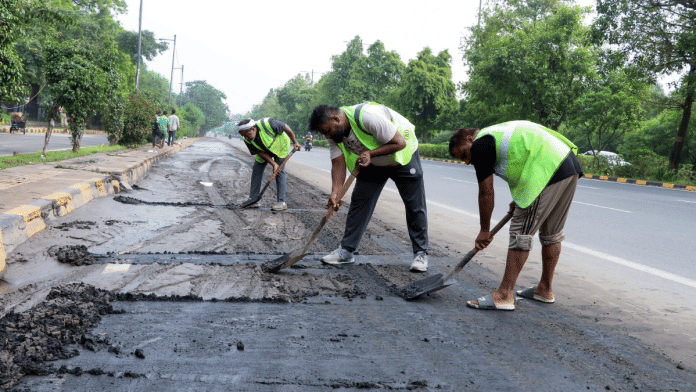
The minister said the framework would enable municipalities to mobilise long-term resources to improve drinking water supply, refurbish stormwater drains, build solid waste management plants, install street lighting, and provide other services for the common good.
Principal Secretary, MA&UD, S. Suresh Kumar added that market-led borrowing would also help strengthen municipal finances, improve governance standards and create an investor-ready ecosystem. He went on to explain that Andhra Pradesh was preparing for a Greater Visakhapatnam Municipal Corporation to explore green bonds for environmentally sustainable projects.
While cities such as Surat, Ahmedabad, Pune and Indore have raised funds from the market to fund urban infrastructure projects, Andhra Pradesh is the first state in India to raise more than Rs 1,000 crore at one go to fund its needs. The other cities have only raised up to Rs 400 crore via municipal bonds thus far.
Urban infrastructure expert Sahiti Yadav told ThePrint Andhra Pradesh’s initiative is a critical structural reform that helps create municipal assets alongside the Rs 50,000-crore Amravati capital city project implemented by the Capital Reconstruction Development Authority (CRDA), an arm of the municipal administration department.
“An investment in core infrastructure civic upgrades will also help Andhra unlock central government incentives,” said Yadav, referring to the high-value issuance exceeding the Rs 1,000-crore mark, which aligns with national fiscal incentives.
Under the Union Budget schemes announced this year, any single municipal bond issuance that crosses Rs 1,000 crore automatically triggers a Rs 100 crore direct financial incentive from the Central government. This incentive functions as non-repayable capital, immediately boosting the project fund without adding to the state’s interest-repayment liabilities.
There are other benefits to the pooled structural model of raising finances, too.
Smaller towns individually lack the revenue metrics, balance sheets, and transaction sizes needed to attract major institutional investors. An aggregation of capital requirements helps many urban local bodies (ULBs) function under a single collective debt offering. This, experts explained, drives down the overall cost of capital.
“Also, with the framework relying on the Andhra Pradesh Public Financial Corporation and the Andhra Pradesh Urban Infrastructure Asset Management Ltd (APUIAML) to manage merchant banking, bid compliance, and capital allocation, the process could be conducted in a transparent manner where investors could view capital deployment through the dashboard,” Yadav added.
However, a former finance secretary of the combined Andhra Pradesh, who did not wish to be identified, added that the success of raising capital through the market will be contingent on local administrations’ ability to optimise revenue and tax collection.
He cautioned that participating cities must enforce strict evaluations by credit rating agencies such as CRISIL or ICRA, which could attest to their creditworthiness to repay investor capital.
“Municipalities and governments must guarantee that the capital cannot be redirected toward non-utility government salaries or administrative overheads,” he said.
(Edited by Sugita Katyal)
Please visit ss nagar yendada beside mk gold coast albaik restaurant lane it’s hell on earth with numerous pot holes our vehicles gets damaged,while walking our legs get twisted when it rains it floods ,it’s a pity,please get the roads laid properly on priority basis,