





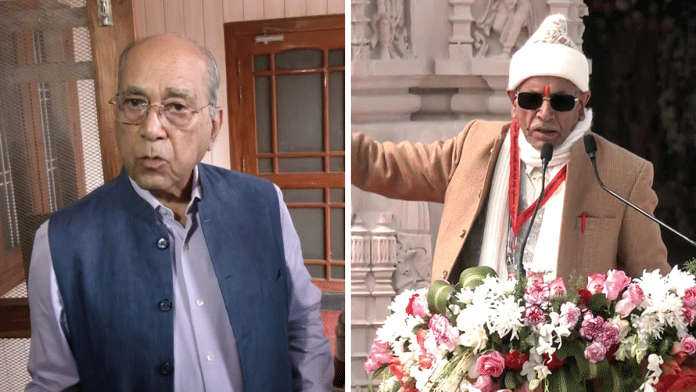

New Delhi: Days after getting a clean chit from the Special Investigation Team (SIT) probing the alleged irregularities in Ayodhya donations, former Ram Janmabhoomi Teerth Kshetra Trust general secretary Champat Rai in an open letter has mentioned the role of Nripendra Misra in the construction of the temple.
The nine-page letter gave details of how Misra was responsible for all the construction-related activities and every single decision was taken solely by him.
“(A former NBCC chairman) always accompanied Nripendra Misra to the temple construction committee meetings. These meetings were held monthly, and for a time, once every fortnight. Every decision was made by this committee. Not a single decision was made without a committee decision,” it said.
In case, Rai said, “even if a decision was made, it was not accepted. If something was done, it was overturned”. Misra, he added, “always considered himself the primary decision-maker for all temple construction decisions”.
Rai had stepped down as the general secretary of the trust after his resignation was accepted at a meeting on 6 July following the alleged irregularities. The donation theft controversy surfaced after an audit conducted by the Ram Temple trust reportedly indicated possible discrepancies involving cash and other items collected through donation boxes.
Following the audit, CCTV footage from the temple premises and donation collection areas was reviewed. Investigators reportedly found the conduct of an employee suspicious, prompting an internal inquiry. The matter was initially kept confidential.
The letter mentioned that following the Supreme Court’s decision on the Ram Mandir construction, the Centre established Shri Ram Janmabhoomi Teerth Kshetra and that a total of 15 trustees were appointed.
Misra was appointed as chairman of the temple construction committee, he added.
“On the Government of India’s suggestion, a senior administrative officer was appointed as the chairman of the temple construction committee and the committee responsible for managing all temple-related activities. Today, Nripendra Misra holds this position.”
Larsen & Toubro (L&T) was selected for temple construction on Misra’s suggestion, he said, adding that Noida-based Design Associate was chosen for the design and construction of other buildings.
“The efforts and suggestions of late Ashok Singhal were conveyed to Nripendra Misra, on the basis of those suggestions Larsen & Toubro was selected for the construction of the temple and an organization of equivalent level should be the project consultant, hence Tata (TCE) was selected.”
“Temple architect Chandrakant Bhai Sompura, a resident of Ahmedabad, was selected by late Ashok Singhal in 1986. He was retained for the construction of other buildings. Noida firm Design Associates (firm head Jai Kaktikar) was selected by Nripendra,” he added.
Rao added that Misra “added some people of his interest in the temple construction committee to assist him, one of whom was called to Ayodhya only once or twice in the last 6 years, suggestions related to security works were taken from another, a third member was Anoop Mittal”.
Mittal, a former NBCC chairman and member of the Temple Construction Committee, was Misra’s advisor on engineering, he wrote.
At the same time, Rai praised Misra acknowledging that the latter was instrumental in getting the project done amid the Covid period.
“This is solely the result of Nripendra Misra’s efforts. Whenever any obstacle arose, he immediately called India’s most qualified people in the relevant field to Ayodhya, and based on their advice, the obstacle was removed,” Rai wrote.
“It is also true that most of the scholars made suggestions out of a spirit of service, meaning they did not take any remuneration from the Shri Ram Janmabhoomi Teerth Kshetra.”
The 70-acre premises of the trust complex has been divided into two parts, he said.
The first part includes the construction of the temple, the construction of four temples around it, the construction of six temples in the Parkota, the construction of a retiring hall on the western side of the temple, and the construction of the Saptarishi Temples, facilities for pilgrims, roads, sewage and power infrastructure, among other works.
The second part, he said, includes a guest house with 23 rooms, a 500-seat auditorium, the trust office, and parking facilities.
For this, the Uttar Pradesh Rajkiya Nirman Nigam was tasked with the construction work and Engineers India Limited was appointed as the consultant.
Rai said that the bank account of Shri Ram Janmabhoomi Teerth Kshetra is a chequeless account and all payments are made through bank transfer only.
“Hence there is transparency in financial dealings. All transactions are conducted in strict compliance with government regulations. All persons associated with the Trust are treated as employees,” he added.
Rai added that taxes are deposited to the government and that there has never been any evasion in any government tax.
The trust’s accounts are maintained with the State Bank of India, the Punjab National Bank and the Bank of Baroda, with payments made through online bank transfers, the former Ram Temple trust general secretary said.
Rai had maintained earlier that no irregularities had been detected in the handling of temple donations. Subsequently, trust officials coordinated with the SIT and provided administrative support to facilitate the investigation.
“The trust has not obtained any cheque books from the banks, meaning all payments are made online (RTGS), and no other method is available. Internal audits are conducted by a Delhi-based audit firm, followed by statutory audits by another renowned Delhi-based firm, V. Shankar Iyer,” Rai added.
(Edited by Tony Rai)
Also read: Amid donation theft row, Ram Temple trust introduces instant digital receipts, jewellery records