





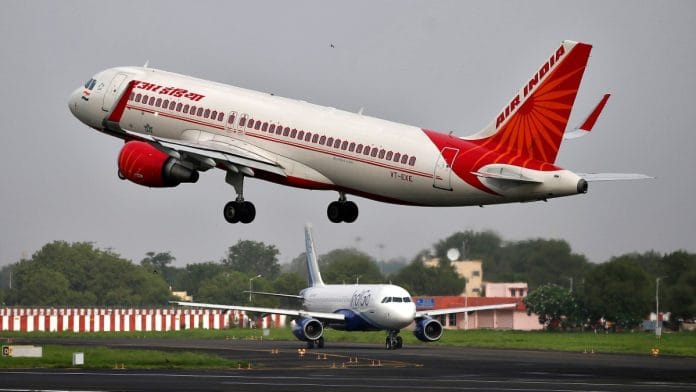


New Delhi: Air India and IndiGo, India’s two largest airlines, have decided to scale down flight operations due to rising aviation turbine fuel (ATF) prices, prolonged airspace restrictions and weakening travel demand, ThePrint has learnt.
Sources in Air India told ThePrint that the carrier has cut nearly 25 percent of its domestic flights for the months of June and July, along with around 27 percent of its international operations. IndiGo, too, will reduce roughly 12-13 percent of its domestic schedule for the coming quarter, while its international operations will remain unaffected, sources in IndiGo told ThePrint.
The cuts are significant given the scale at which both airlines operate.
Air India currently operates around 4,400 services a week, including about 3,600 domestic and 800 international flights. IndiGo operates between 2,200 and 2,700 services daily across its network, with over 1,800 domestic flights every day.
In response to a request for comment, Air India told ThePrint, “In continuation of our previously announced adjustments to select international services between June and August 2026, we have temporarily rationalised operations on certain domestic routes during the same period, with a reduction in frequencies on select routes. These adjustments are driven by the sustained impact of high fuel prices on overall operations.
“Air India will continue to monitor demand and operating conditions closely, with a view to restoring frequencies as conditions stabilise. Passengers impacted by these changes will be proactively assisted with re-accommodation on alternative flights, complimentary date changes, or full refunds, as applicable.”
ThePrint reached IndiGo for an official response but had not received a response by the time of publication. This report will be updated if and when a response is received.
The Directorate General of Civil Aviation (DGCA) had earlier signalled an industry-wide slowdown. On 23 March, the regulator announced that airlines would operate just over 23,000 weekly domestic flights during the summer schedule starting 29 March—around 10 percent lower than last year.
The reduction had effectively pointed to a broader 10-12 percent scale-back across the sector.
Air India has already reported a record comprehensive loss of more than Rs 26,700 crore for the financial year ending 31 March 2026 — its biggest annual loss since the Tata Group took over the airline in 2022, according to Singapore Airlines’ annual statement.
IndiGo is expected to announce its quarterly results Friday amid growing concerns over profitability.
Industry estimates suggest airlines operating to and from India have been losing nearly $ 8.75 billion (Rs 80,500 crore) every week since the West Asia conflict escalated in late February, with cumulative losses crossing Rs 8 lakh crore.
“The losses have been mounting. We cannot outprice the market, but it is difficult to stay afloat right now. These steps have only been taken to deal with the prevailing circumstances,” a senior executive at a leading airline told ThePrint.
In a letter dated 26 April, the Federation of Indian Airlines (FIA) warned the government that soaring operational costs had pushed carriers to the verge of a shutdown. The central government later moved to support airlines through a proposed Rs 5,000 crore relief package under the Emergency Credit Line Guarantee Scheme (ECLGS) 5.0 announced on 5 May.
Air India CEO Campbell Wilson had also informed employees on 8 May that annual salary increments would be deferred by at least a quarter, citing Pakistan airspace closures, the West Asia conflict, the falling rupee and a sharp spike in jet fuel prices. He said the combined impact had sharply raised operating costs and weakened travel sentiment.
Airlines sector experts, however, argue that airlines cannot blame the crisis entirely on external factors. They say operational inefficiencies, fleet-related problems and aggressive expansion plans have also worsened the situation.
Mark D. Martin of Martin Consulting told ThePrint that airlines were overstating the crisis to push for government support. “Airlines need to find a better alibi. IndiGo’s losses are now publicly known to be largely self-inflicted, while Air India’s troubles stem from operational and safety shortcomings, weakening market share and the Boeing 787 crash. Global jet fuel prices have also stabilised since mid-April and India has enough ATF reserves to meet demand,” he said.
(Edited by Amrtansh Arora)
Also Read: Longer, messier, costlier: War in Iran cripples Indian airlines & fliers, fares spike as high as 14x
The more you fly, the more you lose. The less you fly, the more you lose.