







New Delhi: Air travel is becoming expensive—and complicated. For Indian carriers, already hit by the closure of Pakistan airspace, the ongoing volatile situation in West Asia could not have come at a worse time.
The Iran conflict has forced them to take longer and costlier routes, leading to a surge in operational costs.
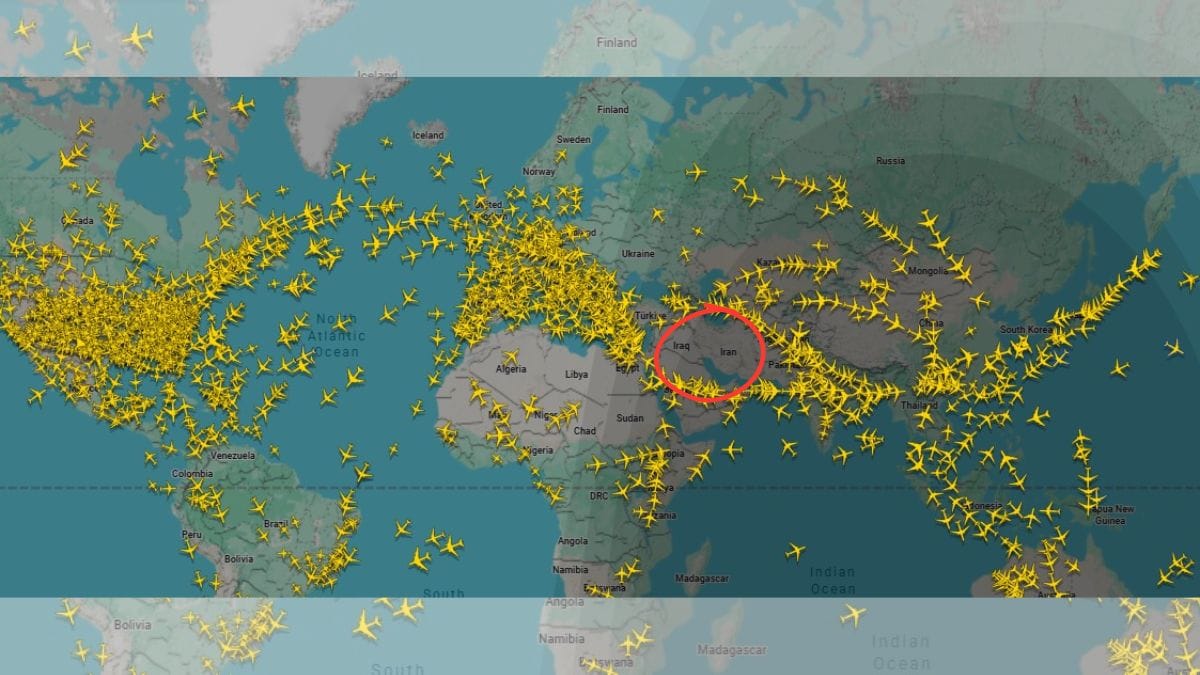
Since 28 February, when the conflict started, most West-bound flights from India have been avoiding the Iranian airspace and its adjoining region including Iraq, Israel, Qatar, Kuwait, Bahrain and the UAE.
Flights from India to Europe, North America and the Gulf are the most affected, particularly routes to countries like the UK, France, Germany, the US, Canada, the UAE, Qatar and Saudi Arabia.
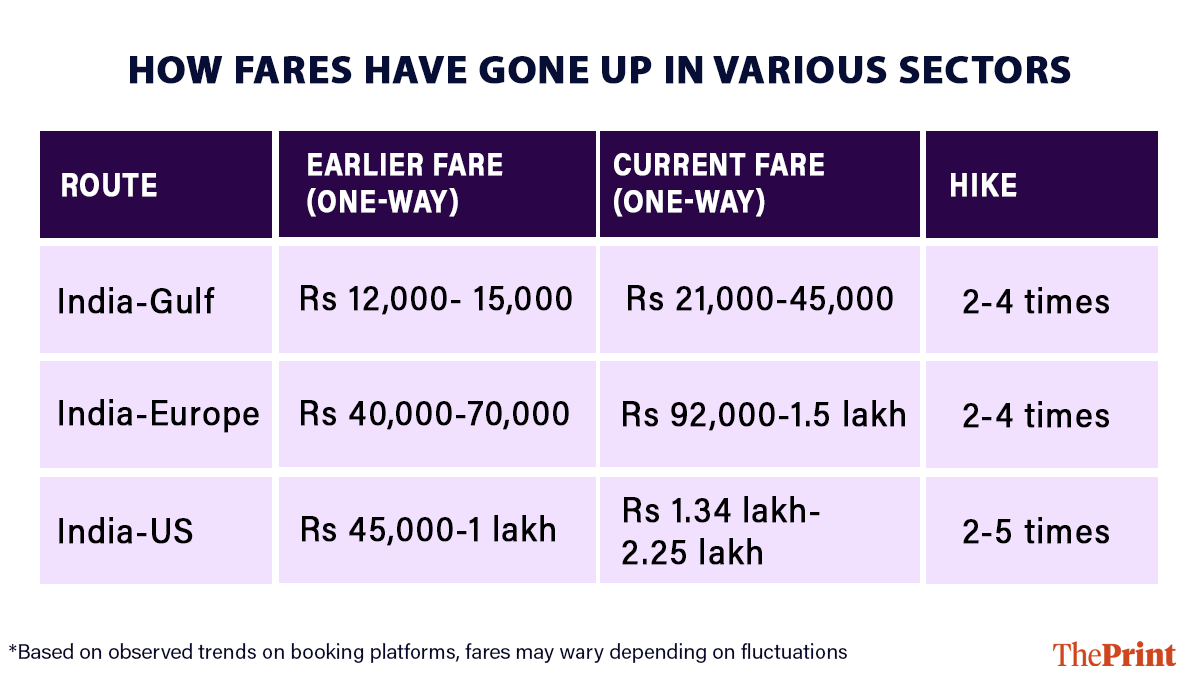
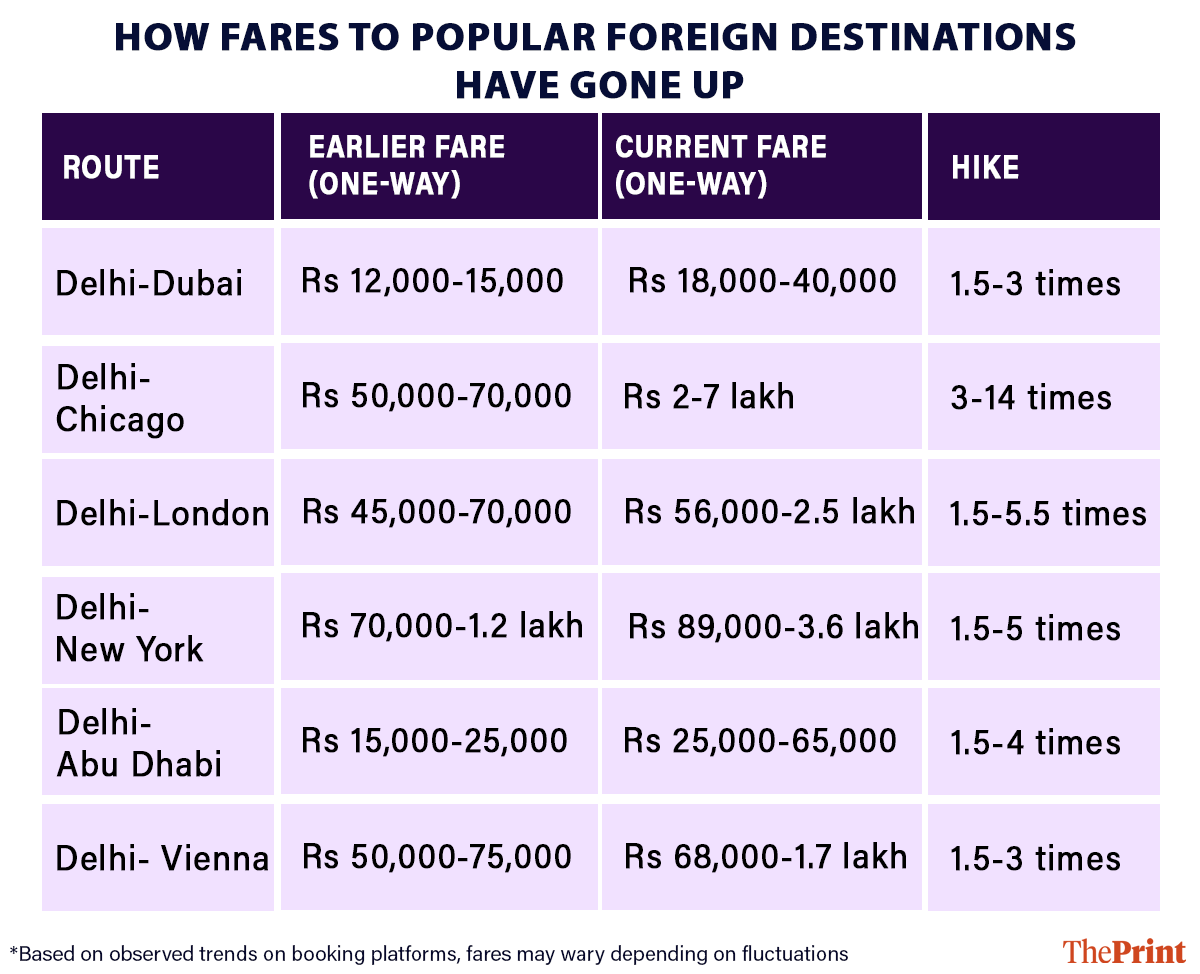
What it invariably means for Indian fliers is international fares going up at least three-fold courtesy longer flight paths and higher fuel costs. Now, factor in the large scale flight cancellations—an unprecedented troubling time for air travellers.
Indian carriers have cancelled more than 10,000 flights since late February when the US-Israeli coordinated military operation against Iran started. Daily flights to West Asia have plunged from 300–350 to just 80–90, which means nearly 250 flights are being cancelled every single day, adding up to almost 2,000 cancellations a week, according to a senior civil aviation ministry official.
That’s not all. Global average jet fuel prices surged nearly 100 percent in a month, rising from about Rs 9,300 per barrel at February-end to over Rs 18,000 for the week ending 27 March, according to industry estimates.
The sharp rise in Aviation Turbine Fuel (ATF) prices has invariably affected airfares. The Air India group has revised its fuel surcharge on both domestic and international routes.
“Corporate travel has almost stopped, families aren’t booking international vacations anymore, with the fuel prices high the airlines have no choice but to hike prices which is dissuading the traveler, but there is no profit either, it is a lose-lose situation” an airline executive told ThePrint.
The disruptions in flights to and from India are estimated to cost Indian and international carriers nearly 8.75 billion dollars (approximately Rs 8.06 lakh crore) each week if the war continues, according to industry experts’ estimates.
Aviation is one of the worst hit industries, which has led to a cascading effect on sectors ranging from tourism and exports to healthcare and education. The impact of airspace closures is not limited to Gulf routes alone.
ThePrint reached Air India and IndiGo for comment regarding the price surge. This report will be updated as and when their responses are received.
Also Read: Air India CEO Campbell Wilson steps down amid turbulent times, to remain till successor is announced
Major corridors impacted
The worst-hit sectors include flights between India and the Gulf, followed by those to Europe and North America sectors.
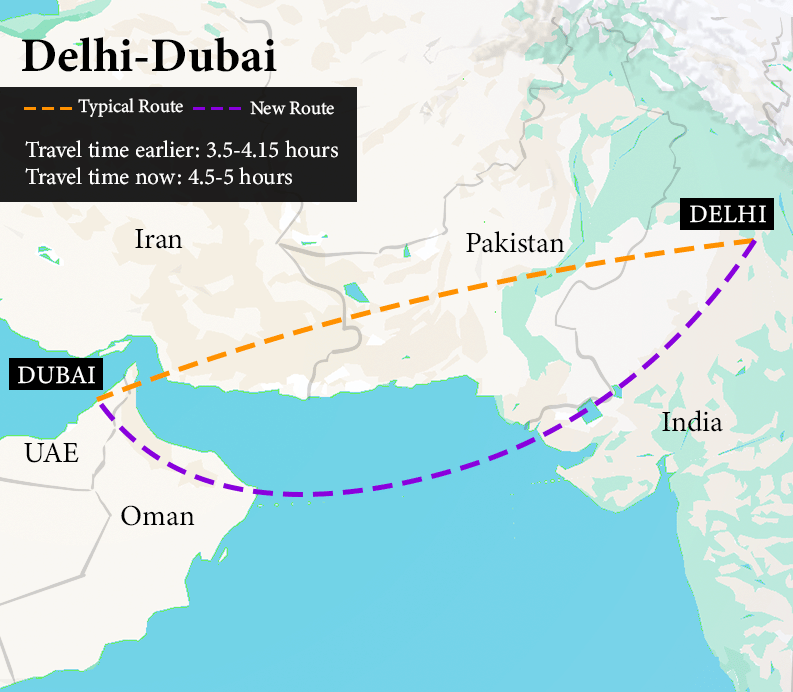
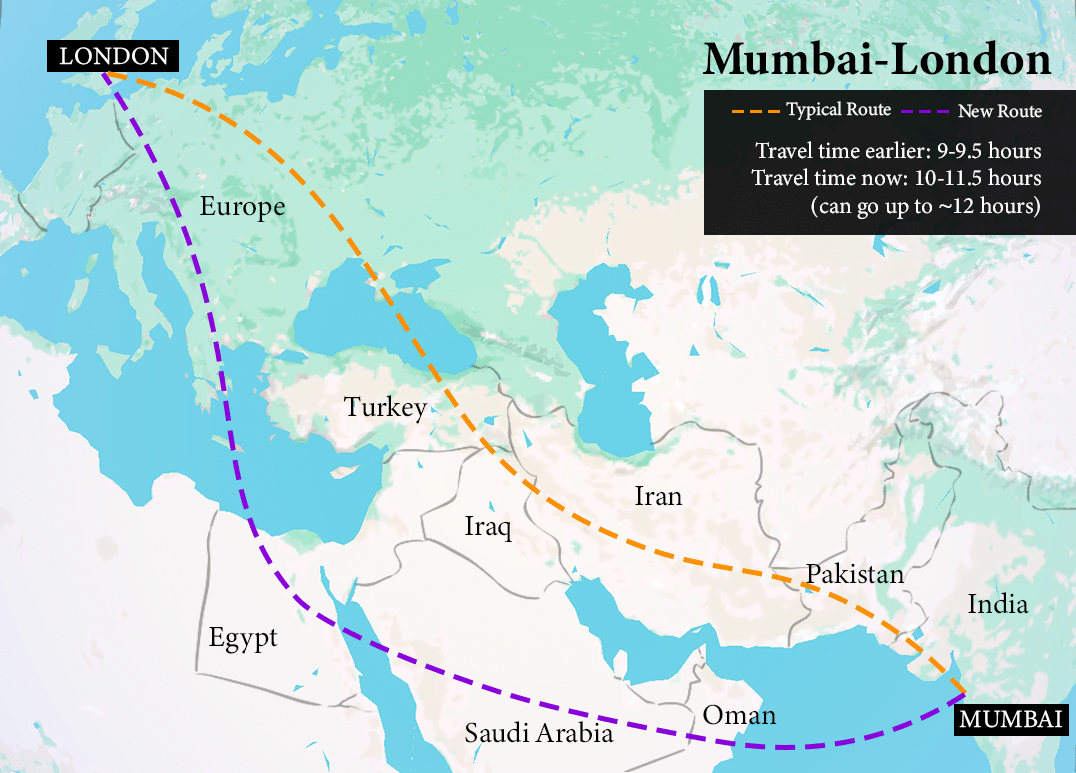
Under normal conditions, a Delhi-Doha/Riyadh/Dubai flight would head west across Arabian Sea and Iran. But due to the regional unrest, the flights have to detour over the southern corridors over Arabian Sea, Oman and the Gulf, avoiding Iranian airspace.
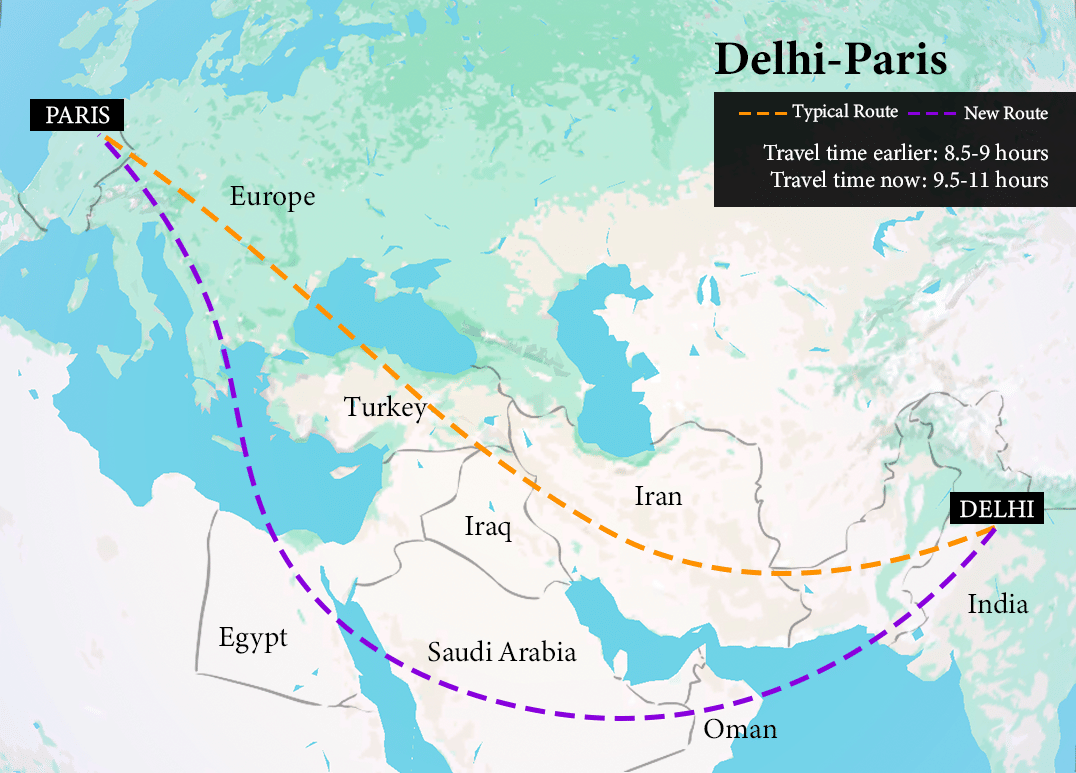
When it comes to Europe, flights earlier flew over West Asia to reach their destinations. Air carriers now take circuitous routes over Oman or across the Arabian Sea into the Gulf and then turn towards Turkey. Some flights also have to fly over Africa, increasing fuel demand exponentially.
When it comes to North America (destinations in the US and Canada), planes used to take the north-west route over Central Asia, Russia, and the Arctic, or through European airspace. A flight that used to fly directly from Delhi to New York has to take a routine stop at Rome. Currently, Air India operates flights on this route. Similarly, a Mumbai-Toronto flight has to go via Europe, adding at least 1.5 hours of travel time.
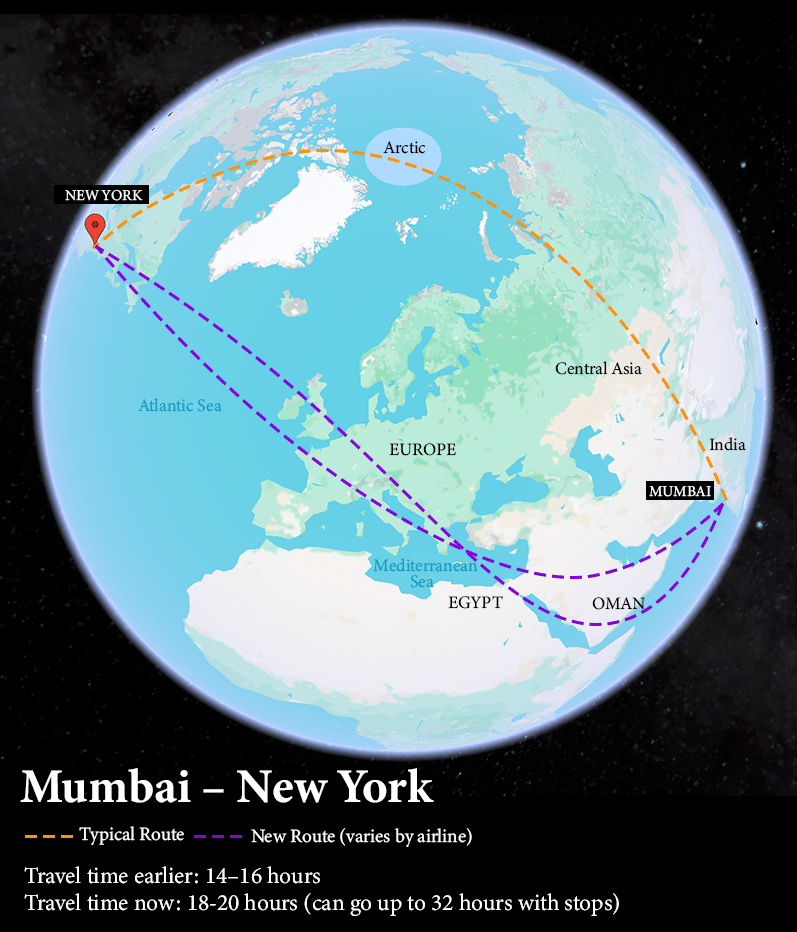
While the steepest increases are being seen in last-minute travel, the impact is particularly visible on long-haul routes, wherein flights are taking longer paths and, in some cases, requiring additional stops for refuelling. These factors not only increase travel time for passengers but also add to airline costs.
Apart from the rise in ATF prices, the longer routes mean higher fuel consumption, greater mileage, and increased crew and operational costs. Together, these factors are making flights expensive and journeys more time-consuming.
One of the results of the geopolitical tensions is congestion in the “safe” corridors in West Asia. This has further added several hours of flight time with some services requiring technical stops for refuelling.
Sample this: A Delhi–Chicago flight, which typically takes around 15 hours, is now taking anywhere between 19 and 36 hours with at least 1 stop. Flights on the Delhi–London route, too, now take more travel time. Under normal conditions, the journey takes around 8.5 to 9 hours. It is now stretching to 11–13 hours as airlines are forced to take longer detours over the Arabian Sea.
Most flights between Delhi and New York are now taking 15 to 21 hours on an average. Flights to Paris, Frankfurt, Amsterdam, Zurich, Vienna, Chicago, Toronto and Vancouver amongst others have been impacted.
Also Read: 2nd incident in 10 days: Air India A350 turns back mid-air due to ‘excessive noise’
Larger financial implications
This year, Indian carriers will operate fewer flights in the upcoming summer schedule, (i.e., from 29 March to 24 October). Indian carriers will operate around 3,000 fewer flights in a week (or for the March-October period) amid rising costs and uncertainty due to the situation in the Gulf region.
The disruptions in flights to and fro India are estimated to cost Indian and global carriers nearly 8.75 billion dollars (Rs 80,500 crore) each week. The airspace closures could raise quarterly airline operational costs by about 30 percent, according to industry experts.
“We’re looking at a tough three to five months ahead, with the peak summer season set to take a hit. While the domestic market and Far East routes offer some support, high ATF prices remain a concern. Airlines have already trimmed nearly 3,000 flights from their summer schedules,” Sanjay Lazhar, aviation expert and CEO Avialaz Consultants, told ThePrint.
Sources in multiple airlines flying international said the situation is leading to compounding losses, with no clarity on when the airlines will return to normal operations.
“Insurance premiums are excessive, while narrow body operational flights are costing up to Rs 30 lakh round-trip, large wide body planes cost up to Rs 90 lakh in premium; this will lead to a substantial rise in airfare, which in turn, will dissuade the traveller,” one of the sources told ThePrint.
Flights operating to West Asia are flying without schedules, almost empty, along with multiple sets of crew as the FDTL (Flight Duty Time Limitation) norms differ for India and countries in West Asia, compounding the losses for the airlines, another source added.
Flyers ‘helpless’
Management executive Vijeta Srivastava, who lives in Abu Dhabi, had planned to be with her family in Pune for her father’s death anniversary. She had booked her ticket to travel 3 March. But at the last moment, her flight was first rescheduled and then cancelled.
“My mother is all by herself. I haven’t seen her in two years, and I couldn’t be there for such a personal event; not even a day has passed when I have not felt helpless,” she told ThePrint over the phone.
Several others have been caught unprepared in sudden cancellations and disruptions as airspace closures continue to impact travel, with flights no longer operating along their usual routes.
Engineer Sunil Gupta took to social media platform X, expressing frustration over his flight being cancelled at the last moment due to disruptions. He said he was left without money, support, or clarity.
“I’m completely stranded at Moscow airport… alone and helpless. No one from the airline or booking platform is responding. I have no cash left—not even for food or water. I don’t know how I’m going to get home,” he posted.
I’m completely stranded at Moscow airport… alone, helpless, and running out of hope.
No one from @makemytripcare or @etihad is answering my desperate messages.
Russia doesn’t accept Visa or Mastercard anymore.
I have ZERO cash left. Not even for food or water.
The Etihad…
— Sunil Gupta (@HeySunilGupta) March 2, 2026
‘Unprecedented’
A senior executive, who has been managing operations for the last 30 years at an airline, described the phase as “unprecedented”. “We haven’t seen things this bad in over four decades. Losses are piling up, and there’s no clear sense of when things will start getting better; no one saw this coming,” he told ThePrint.
Domestic credit rating agency ICRA has revised its stance on India’s aviation industry from stable to negative. The agency estimates net losses of Rs 170-180 billion in the financial year of 2026.
It further predicted that the Industry’s interest cover is expected to weaken to 0.7-0.9 times in FY2026 from 1.8 times in FY2025 owing to additional airport charges, flight cancellations, rerouting for select long- haul international flights and currency depreciations due to the war.
“Every market has a threshold… you cannot outprice the market, otherwise the revenue coming in will also not come,” an insider said.
Safety Matters Foundation founder Amit Singh said that the aviation industry should brace for a long-term disruption.
“Not only will fuel prices surge, uneconomical routes, security enhancement and outage of the GPS will increase cost. It’s also an opportunity for airlines in India to establish a hub replacing the Middle East hubs,” he told ThePrint.
(Edited by Tony Rai)
Also Read: IndiGo gets new CEO 4 months after major operational crisis, to take over 3 August