


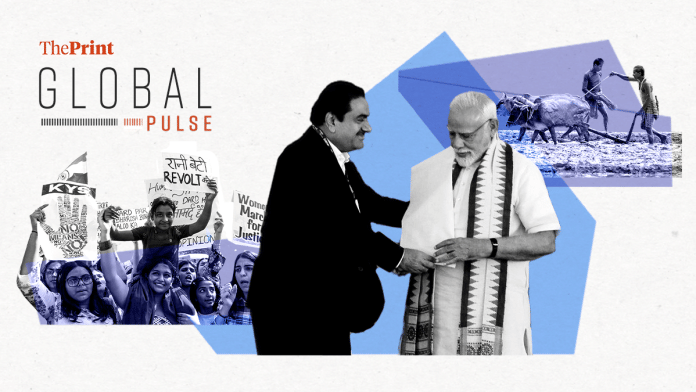
New Delhi: From the growing presence of women in India’s public life to the climate cost of its agricultural success, international publications this week examine the contradictions shaping the country’s growth.
In a report by Fabiana Negrin Ochoa, the Wall Street Journal (WSJ) looks at US investment firm KKR’s growing interest in India’s renewable-energy sector through its minority investment in the Indian business of Gentari, a clean-energy company established by Malaysia’s state-owned oil and gas giant Petronas.
The deal is aimed at tapping the “need for continued investment in India’s energy infrastructure” as demand for reliable power grows rapidly. The investment will provide Gentari with growth capital to expand its operations, although the financial terms have not been disclosed.
KKR believes that “scaled platforms” capable of delivering “increasingly sophisticated renewable energy solutions” will play an important role in meeting India’s growing electricity demand, said Hardik Shah, the firm’s Asia-Pacific infrastructure partner.
Also Read: Global media questions India’s investment appeal, climate record and Olympic aspiration
Leo Mirani, in The Economist’s The World Ahead series, looks at the changing role of women in India’s public life, beginning with the appointment of B.V. Nagarathna as the first woman chief justice in 2027.
For the first time in India’s “nearly eight decades as a constitutional republic”, a woman will head its highest constitutional court. But Nagarathna is due to retire just over a month after taking office. “It is a fitting metaphor for the place of women in India’s public life,” Mirani writes.
The article draws a parallel with the Women’s Reservation Act passed in 2023. Its implementation, however, was tied to a delimitation bill making the goal of women’s empowerment “subservient to an unrelated political drama”. Following the 2024 general elections, women accounted for just 14 percent of MPs.
“Women are under-represented in India’s public life. Indeed, they are under-represented in nearly all walks of life,” Mirani writes.
The disparity extends beyond Parliament. India’s female labour-force participation rate stands at around 35 percent, against a global average of 49 percent. Mirani attributes this limited visibility partly to “a conservative culture in which a woman’s place is still often considered to be at home”. Concerns over safety, he adds, “give even liberal parents and in-laws a reason to insist that women stay cloistered.”
Yet, Mirani identifies signs of change. Women were prominent in the youth protests in mid-2026, an occasion marked by “the robust participation of women”. Girls outnumber boys in school enrolment and higher education, while female voter turnout in the 2024 general election was higher than male turnout “for the second time in a row”.
With seven states heading to the polls in 2027, the larger shift is in women’s growing participation in public life. They may still lack adequate representation in Parliament, he concludes, but are “increasingly studying, working and deciding who represents them.”
A report in The Economist looks at the climate cost of India’s agricultural success, as the country overtakes China to become the world’s largest rice producer. India produced 154 million tonnes of rice last year, accounting for 28 percent of global output, with around 22 million tonnes shipped abroad.
“The paddies also generated millions of tonnes of methane, a powerful greenhouse gas,” the magazine writes, noting that Indian rice fields account for 16.5 percent of global methane emissions from rice cultivation.
The problem extends to livestock. India is home to nearly 200 million cattle, more than anywhere except Brazil, and “the burps from those cows and buffalo account for roughly one-third of India’s agricultural methane emissions”.
The magazine outlines several ways to tackle the problem, including periodically draining flooded paddy fields, using rice varieties that can be directly seeded and changing cattle feed. Some of these methods could substantially reduce methane emissions. “Unfortunately, none of this appears to be a priority,” it observes.
India’s climate targets do not specifically address methane reduction, and it did not sign the 2021 global pledge to cut methane emissions by at least 30 percent by 2030.
But changing farming practices comes with its own risks. “Farmers often worry that experiments and unfamiliar practices are risky,” says Prakashan Veettil, an economist at the International Rice Research Institute. “Direct-seeded” rice gained popularity in Punjab and Haryana during the Covid pandemic, but farmers abandoned it once labour markets recovered.
“India’s farmers need to adjust their practices, and not just to adapt better to the changing climate,” the magazine writes. It points to another contradiction—India’s dairy animals produce less milk per head; it also grows more rice than it can consume, store or export. As the article concludes, making the transition worthwhile means giving farmers “more protection against failure”.
Also Read: Global media profiles ‘strategic’ environment minister whose political pragmatism could prove useful
In a Financial Times’ Big Read feature titled, ‘Tycoon at the heart of Modi’s India’, Michael Stott and Andres Schipani examine how Gautam Adani rebuilt business empire after a series of allegations and legal challenges, while becoming an increasingly influential figure in Prime Minister Narendra Modi’s economic vision for India.
The report opens at the $25 billion Khavda renewable-energy project in Gujarat, a 538-square-kilometre expanse of solar panels and wind turbines. “The site stretches as far as the eye can see, a seemingly limitless expanse of solar panels blanketing remote salt flats,” the reporters write.
Describing it as “the world’s biggest renewable energy complex”, they note that the project is only one part of Adani’s sprawling infrastructure empire “The $25bn Khavda scheme gives a sense of the scale of Adani’s ambition” and his group’s role in building infrastructure that “underpins Prime Minister Narendra Modi’s economic vision for India”.
The FT traces Adani’s rise alongside Modi’s political journey. Both men hail from Gujarat, and the reporters write that Adani’s ties to the Prime Minister’s government are longstanding, with his rise having “mirrored the prime minister’s”. Modi’s push to transform India into a modern, developed economy has enormous consequences for Adani’s infrastructure businesses, “and vice versa”.
Then came the Hindenburg reports. Adani recalls the period in a rare interview at his Ahmedabad headquarters: “We faced financial and political attacks. We had to retain investor confidence, serve customers and keep building.”
The group says all 24 investigations initiated by the SEBI into the Hindenburg allegations were settled. Its companies recorded a 45 percent increase in underlying earnings and a 71 percent rise in after-tax profit in the financial year following the report, citing “resilient and predictable business growth”.
Stott and Schipani look at the legal challenges facing the group in America, including allegations of fraud and bribery also that the subsidiary imported Iranian liquefied petroleum gas into India through an intermediary, allegedly violating US sanctions.
They examine the group’s influence over the political and media landscape. International non-profit organisation Reporters Without Borders accuses Adani Group of “waging an unprecedented legal war against journalists and media outlets” through civil and criminal defamation cases, particularly in Gujarat. Adani responds: “We can neither choose our critics nor silence every accusation. We can choose our conduct, respect scrutiny and keep delivering.”
The report recalls Rahul Gandhi’s allegation at a rally that Modi was “being remote controlled by Ambani and Adani”. Adani rejects the suggestion that his business depends on political patronage. “Governments and policies change, but Indians’ need for energy, infrastructure, jobs and opportunity will not.” He adds that the group works across states governed by different parties because “the need for infrastructure and jobs is the same everywhere”.
The FT asks a larger question: how much of India’s infrastructure development now depends on a handful of powerful business groups.
Nirmalya Kumar of the Indian School of Business argues that only a few entrepreneurs have the capacity to execute projects on this scale. “So if they want to build 100 airports, there’s only Gautam Adani who can do it… if you want to do import substitution manufacturing, you have to rely on the Tata Group… If you want digital infrastructure, you have to rely on the Ambani group.”
Looking ahead, Adani is betting on India’s economic growth, including the expansion of artificial intelligence and renewable energy. He believes India “can become a major foundation for the global AI economy”.
(Edited by Tony Rai)