



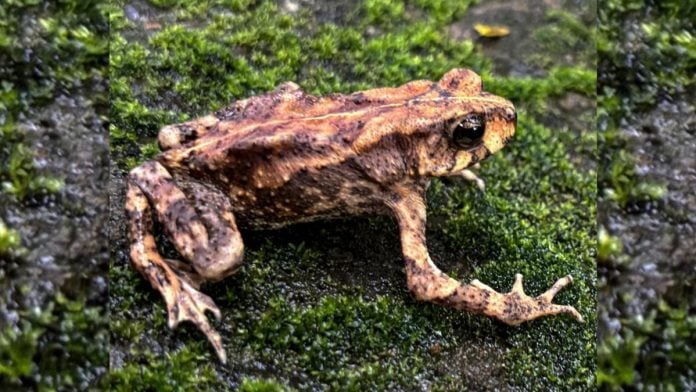

New Delhi: Two new species of frogs have been found in Mizoram and named after the state’s capital, Aizawl, and its highest peak, Phawngpui.
“The discovery of this species (Phawngpui) reinforces the view that the amphibian fauna of Mizoram and northeastern India remains incompletely documented despite its high biogeographic significance. Such efforts are especially urgent in the face of ongoing environmental change, including habitat alteration and climate-driven shifts in montane ecosystems, which may disproportionately affect narrowly distributed amphibian lineages,” read a study published on 13 September in Taprobanica, describing the discovery of Phawngpui.
According to the study, northeast India is a hotspot for Asian amphibians and forms one of the most “species-rich and threatened regions globally”. This region includes parts of India, China, and the Himalayan range.
Although there has been more documentation of amphibian diversity recently, the study highlighted that no surveys have been conducted in several parts of Mizoram, especially the “forest-edge habitats”. The lack of surveys, limited number of specimens, and sparse data about their populations size, distribution, and needs, makes it hard to judge if they are at risk or not.
“Additional targeted sampling across Phawngpui National Park and adjacent upland regions will be essential to determine whether the species is narrowly endemic or more widely distributed within the southern Indo-Burma hill complex,” the study said.
Also read: 70% of seabirds can be wiped out in UK by climate change, finds new report
The two frogs
According to the researchers, the 56-mm long toad Phawengpui was discovered at an elevation of nearly 2,000 metres. The little yellowish-brown creature is a reminder that isolated mountain peaks are like “sky islands”. They limit the interaction of species with others of its kind, creating local varieties that exist nowhere else. This makes the discovery important from a conservation perspective too.
“Such elevationally restricted systems are also inherently vulnerable to climate change, as rising temperatures may force species to shift to higher elevations where suitable habitat may be limited or absent,” the study added.
Meanwhile, Aizawl was mistaken for another frog for nearly two decades. Scientists who often found it in the Mizoram University campus, thought it belonged to the Ingerana boralis, a common species in the region.