





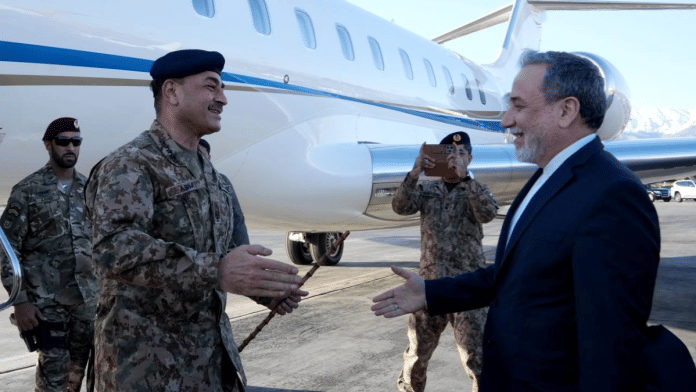

New Delhi: Amid Islamabad’s role as a peacebroker in the West Asia war, Pakistan allowed its Nur Khan airbase to shelter Iranian military intelligence aircraft, CBS News reported.
The arrangement, described by several US officials who spoke on the condition of anonymity, suggested Iran was seeking to preserve portions of its military aviation fleet from possible American strikes as the region edged closer to a wider war.
According to the officials quoted in the report, Iran transferred multiple aircraft to Pakistan Air Force (PAF) base Nur Khan, a strategically important installation near the garrison city of Rawalpindi, shortly after US President Trump announced a ceasefire in early April. Among the aircraft was an Iranian Air Force RC-130 reconnaissance plane, a surveillance variant of the Lockheed C-130 Hercules used for intelligence-gathering missions.
Iran also moved civilian aircraft into neighbouring Afghanistan as part of a broader effort to disperse aviation assets across the region, American officials said. It was, however, unclear whether military aircraft were also flown into Afghan territory as well.
A senior Pakistani official denied that Iranian aircraft had been stationed at Nur Khan, calling the allegation implausible given the base’s location near densely populated urban areas.
“Nur Khan base is right in the heart of the city,” the official was quoted as saying. “A large fleet of aircraft parked there cannot be hidden from public view.”
The Pakistan foreign office has dismissed the CBS report as “misleading” and “sensationalised”.
“The Iranian aircraft currently parked in Pakistan arrived during the ceasefire period and bear no linkage whatsoever to any military contingency or preservation arrangement. Assertions suggesting otherwise are speculative, misleading, and entirely detached from the factual context,” it said in a statement.
“Following the ceasefire and during the initial round of the Islamabad Talks, a number of aircraft from Iran and the United States arrived in Pakistan to facilitate the movement of diplomatic personnel, security teams, and administrative staff associated with the talks process. Some aircraft and support personnel remained temporarily in Pakistan in anticipation of subsequent rounds of engagement,” the statement added.
In Afghanistan, an aviation official said that a civilian aircraft operated by Iran’s Mahan Air landed in Kabul shortly before the conflict intensified and remained there after the Iranian airspace was closed. The official said Taliban authorities later relocated the aircraft to Herat, near the Iranian border, amid fears that Pakistani airstrikes targeting militant groups could endanger Kabul airport.
Zabihullah Mujahid, the chief Taliban spokesperson, told CBS News that there were no Iranian aircraft in Afghanistan and dismissed suggestions that Tehran required such assistance.
The disclosures come as Pakistan’s strategic alignment with China has deepened sharply over the past decade. Chinese officials have publicly praised Islamabad’s role in facilitating indirect communication between Iran and the US during the West Asia crisis.
At the same time, diplomatic efforts to stabilise the cease-fire appeared increasingly fragile. Iranian state media reported over the weekend that Tehran had proposed terms for ending the conflict that included American war reparations, recognition of Iranian sovereignty over the Strait of Hormuz and the lifting of US sanctions.
The dispute threatened to overshadow Trump’s planned meetings this week in Beijing with President Xi Jinping, where the war in Iran is expected to feature prominently alongside tensions over trade and Taiwan.
The report soon sparked backlash in Washington, with US lawmakers raising doubts about Islamabad’s neutrality in the mediation efforts. In a post on X, senior Republican senator and Trump’s close ally Lindsey Graham called for a reassessment of Pakistan’s diplomatic role in the crisis.
“If this reporting is accurate, it would require a complete reevaluation of the role Pakistan is playing as mediator between Iran, the United States and other parties. Given some of the prior statements by Pakistani defense officials towards Israel, I would not be shocked if this were true,” he wrote on X.
Trump had agreed to extend the ceasefire, citing a request from Pakistan army chief Asim Munir and Prime Minister Shehbaz Sharif. However, little progress has been made on central issues, including Iran’s enrichment programme and its stockpile of highly enriched uranium.
Despite the ceasefire announcement, Iran-US tensions remained high. According to the Iranian state media, Tehran sought US war reparations, recognition of its sovereignty over the Strait of Hormuz, and the lifting of American sanctions as part of a proposal aimed at ending the conflict.
The US President has dismissed Iran’s counterproposal as “totally unacceptable,” although he did not clarify which specific demands he was referring to.
There is also a growing sense that the Iranian leadership views the negotiation process less as a genuine effort at resolution and more as a strategic maneuver directed against them.
“In Tehran, there have been growing fears that the US is using the talks as a ruse to resume the war, as Trump maintained the naval blockade and boasted this week that Iran had agreed to most of his demands,” according to an FT article on how Pakistan became the mediator between the two.
According to Farzana Shaikh, associate fellow at Chatham House in London who is quoted in the article, “Pakistan is not truly a neutral party in this. It has a patron-client relationship with the US and Gulf states, and a vested interest in foreclosing Iran’s path to a nuclear weapon.”
This is an updated version of the copy with statement from the Pakistan foreign office
(Edited by Tony Rai)
Also Read: Pakistan issues demarche as ties with Afghan Taliban go into tailspin after Bannu car bombing