



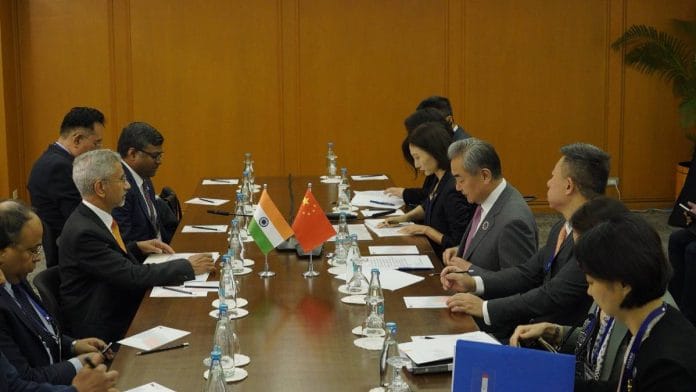
New Delhi: External Affairs Minister S. Jaishankar Wednesday “welcomed” the steps taken towards normalisation of India-China ties, while pointing to the need to address market access and trade issues, during a bilateral meeting with Chinese Foreign Minister Wang Yi in Manila.
“We believe that a stable and cooperative relationship can best be developed on the basis of mutual respect, mutual interest and mutual sensitivity. Such a relationship can make a valuable contribution to a multi-polar Asia and a multi-polar world,” Jaishankar said in his opening remarks at the meeting.
“However, there are also important dimensions of our ties that need to be addressed. Fair market access and trade balance rank high in that regard. There are also concerns about predictability of supply chains.”
Jaishankar met Wang on the margins of the ASEAN Foreign Ministers’ Meeting in the Philippine capital. Ahead of the meeting, Jaishankar participated in the Quad Foreign Ministers’ meeting along with US Secretary of State Marco Rubio, Australian Foreign Minister Penny Wong and Japanese Foreign Minister Toshimitsu Motegi.
In his talks with Wang, the EAM reiterated the agreement between Prime Minister Narendra Modi and Chinese President Xi Jinping to not let “differences” become “disputes”. India-China ties have moved towards stabilisation since Modi and Xi met in the Russian city of Kazan on the margins of the BRICS summit in October 2024.
The two countries have since resumed direct flight services and restarted the Kailash Mansarovar Yatra in the summer months of 2025. Visas have been issued by Indian authorities to Chinese tourists, and the two countries have continued to disengage at friction points across the Line of Actual Control (LAC). However, a full deescalation between the two neighbours has not yet been achieved.
“It is natural that as two large and important nations, and that too proximate neighbours, India and China would have their own particular interests. That is why our leaders had agreed that differences should not become disputes. It is the responsibility of diplomacy to properly manage them,” said Jaishankar.
Just days before the meeting in Manila, China flexed its muscle in the West Pacific and South China Sea, including live fire drills in the exclusive economic zone of Japan, as well as clashing with the Philippine Navy near the Second Thomas Shoal.
Jaishankar has held a number of meetings on the margins of the ASEAN talks and relevant mechanisms, including attending a meeting of the Quad foreign ministers, the second this year, following a ministerial meeting in May in New Delhi.
The Association of Southeast Asian Nations (ASEAN) is holding its annual summit, along with relevant meeting mechanisms including with strategic partners. India, Japan, the US and Australia are all strategic partners of ASEAN, alongside a number of other countries including China and Russia.
Also Read: China is worried about US–Philippines military exercises. It’s too close for comfort
Quad announces cooperation with ASEAN
The Quad foreign ministers announced future cooperation with ASEAN member-states to ensure a “free and open Indo-Pacific”, while maintaining the centrality and unity of the 11-member organisation.
“As ASEAN Comprehensive Strategic Partners, we, the Secretary of State of the United States and the Foreign Ministers of Australia, India, and Japan, met today in Manila to reaffirm our commitment to strengthening a free and open Indo-Pacific and our unwavering support for ASEAN unity and centrality,” a joint release stated.
“We discussed regional challenges and opportunities to strengthen our support for the practical implementation of the ASEAN Outlook on the Indo-Pacific (AOIP) through our shared priorities of maritime and transnational security, economic prosperity and security, critical and emerging technologies, and humanitarian assistance and emergency response.”
Jaishankar in his own statement on the Quad meet said the four leaders “reviewed the Indo-Pacific landscape” while discussing global developments. The minister reiterated the commitment to a “free and open Indo-Pacific, with a recognition of ASEAN centrality”.
He also held a quick bilateral meeting with Rubio. The two foreign ministers discussed trade and tariffs, energy, deficiency and security cooperation and artificial intelligence (AI).
US President Donald Trump Tuesday announced 0% tariff on generic pharmaceutical goods for two years, following by 100% for one year, and then 200%. The tariffs are likely to impact India’s exports, as the US market accounts for a third of its total pharma exports.
EAM brings up sailor deaths with Lavrov
Jaishankar also met with his Russian counterpart Sergey Lavrov. The meeting is significant as India summoned Russia’s Charge D’Affaires Vladimir Ladanov Tuesday and lodged a strong protest against the Russian attack on a merchant vessel in the Black Sea that left four Indian seafarers dead.
Russia’s presidential spokesperson Dmitry Peskov in comments late Tuesday suggested that the civilian vessel was a military target, promising to continue attacks against any ships connected to Ukraine’s armed forces.
“Reiterated our strong concern regarding the safety of Indian seafarers in the region. Discussed various aspects of our partnership, including trade & investment, energy & connectivity, science & technology, and mobility. Also exchanged views on the Ukraine conflict and the Gulf situation,” Jaishankar said on the meeting with Lavrov.
The Russian attack on MV GOLDEN LEO, a Guinea-Bissau-flagged ship, Sunday left at least nine sailors dead. The ship was crewed by 17 seafarers, including five Indians.
(Edited by Nida Fatima Siddiqui)
Also Read: India’s imports from Russia, powered by crude, grew by 52% in 1st quarter of FY26-27