



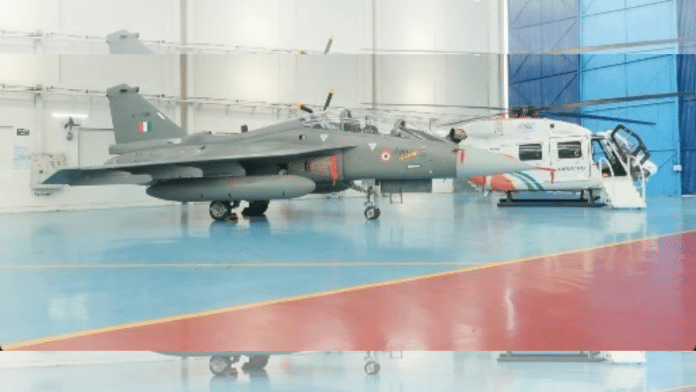
New Delhi: Sixteen years after the Indian Air Force (IAF) placed an order, state-run Hindustan Aeronautics Limited (HAL) has finally handed over the last two Tejas trainer aircraft from the original Mk1 programme. This closes an order that was meant to have been completed nearly a decade ago.
The two trainers, in Final Operational Clearance (FOC) configuration, were handed over in the presence of Defence Minister Rajnath Singh and IAF Chief of Air Staff Air Chief Marshal A.P. Singh.
The delivery completes the two separate Tejas Mk1 orders placed by the IAF in 2006 and 2010. On 31 March 2006, the IAF ordered 20 Tejas Mk1 aircraft in Initial Operational Clearance (IOC) configuration, comprising 16 fighters and four trainers. Deliveries were to be completed by December 2011.
On 23 December 2010, another 20 Mk1 aircraft were ordered in FOC configuration, comprising 16 fighters and four trainers. The contractual deadline for this order was December 2016.
Defence establishment sources said the fundamental problem behind the delay was that the aircraft’s development and certification lagged behind production contracts. IOC, originally expected around 2008, was achieved only in December 2013, while the first IOC-standard fighter was delivered in 2016-17.
The FOC version faced further delays because of air-to-air refuelling integration, structural modifications, flight-control software changes and associated testing. Sources said the IAF was clear that the remaining trainers would be accepted only after the required safety, structural and performance issues had been addressed.
With the original 40-aircraft order finally completed, attention now shifts to the much larger Tejas Mk1A programme. The IAF ordered 83 Mk1As, 73 fighters and 10 trainers, from HAL in 2021 for about Rs 48,000 crore. Under the contract, the first aircraft was to be delivered within three years, by February 2024, with the entire order to be completed over nine years.
ThePrint had reported then that one of the primary worries for the IAF was whether HAL will deliver on time or not.
But the first Mk1A, LA-5033, made its maiden flight from HAL’s Bengaluru facility only in March 2024. Two-and-a-half years later, HAL is yet to hand over a single aircraft to the IAF.
The IAF has not accepted the aircraft, pending completion and validation of key systems, including radar, weapons and electronic-warfare capabilities. HAL has given several timelines for beginning deliveries over the past two years, but has missed them.
While the shortage of GE F404 engines has emerged as a major bottleneck, the programme also has outstanding software, systems-integration and testing requirements. Over the last two years, HAL has given several delivery dates to the IAF, promising to finish the pending works but failed.
The IAF has actually compromised on several key promises made by HAL.
Defence Minister Rajnath Singh had taken a review meeting in June this year, and was of the view that HAL should sit down with the IAF and come up with a reasonable timeline, and that it should not overpromise and under-deliver.
With HAL getting a new Chairman and Managing Director, Ravi Kota, known as ‘LCA man’ within defence circles, the IAF is hopeful of HAL managing to turn things around. Contrary to the previous two CMDs, the HAL chairman in his interactions with journalists has admitted to delays and offered a more realistic time to finish off the pending work.
He estimates that the Mk1A programme is around 90-95 percent complete. “There are a few radar issues, and weapon integration is done. There have to be some tests for confirming standards. It’s only the software change, that’s all. But, having said that, when you put a missile, you need to go, bang, go up and come down. How the missile or the structure will behave – all those tests are required. It’s a process that has to be followed,” he told The Hindu Business Line.
Kota has said HAL has so far received 10 GE F404 engines, with another 12 promised by December, and that the company hopes to begin Mk1A deliveries by the end of the current financial year.
ThePrint has consistently reported that contrary to the popular perception and claims by the previous two CMDs of HAL, there are several other significant issues with the Tejas which HAL has not been able to address.
(Edited by Nardeep Singh Dahiya)
Also Read: IAF seeks minimum 40% indigenous content for 96 Rafale, final batch with 60%