





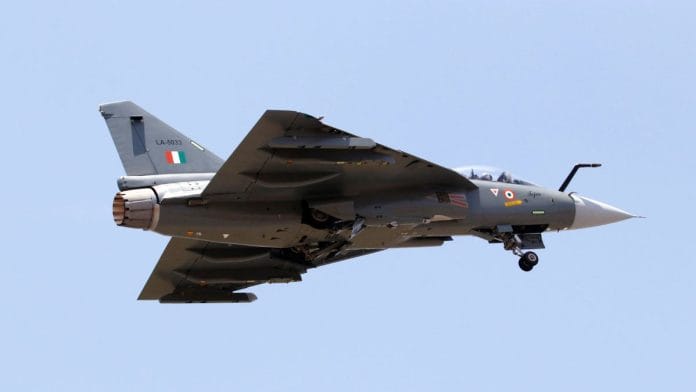


New Delhi: Hindustan Aeronautics Limited’s (HAL) new chairman and managing director, Ravi Kota, known within the aerospace community as the ‘LCA Man’, has prioritised the HAL Tejas Mk1A delivery to the Indian Air Force as the company’s top objective.
This delivery, however, will now likely miss even the June-July timeline ThePrint estimated earlier.
The delay comes despite the IAF agreeing to grant multiple concessions to HAL. The force, however, has also drawn clear red lines on what it would and would not accept before inducting the fighter aircraft.
Those red lines relate directly to the aircraft’s combat capability, particularly its missile firing functionality and the performance of its Electronic Warfare (EW) systems.
“The IAF is willing to compromise, and that is a call that the defence ministry will finally take because it has signed the contract. However, the IAF will not accept an aircraft which cannot be used in a conflict if it happens a few months after induction,” a source in the defence and security establishment told ThePrint.
According to sources, the IAF is willing to accept temporary workarounds and compromises in areas linked to pilot convenience and ease of operation, if that helps accelerate delivery timelines.
“For example, if the contract said that a certain aspect of flying will be automated, but the IAF is now told it will take more time and the pilot will have to operate it manually for now, the force is willing to compromise on it,” a source said.
Some of these pending works, added sources, might be completed just a year from now.
The fresh concessions are an expanded version of the exemptions decided between the IAF and the defence ministry earlier in February.
As reported earlier by ThePrint, the pending deficiencies were categorised as ‘minor’, ‘major’, and ‘not acceptable’.
Sources said the IAF was now willing to accept some deficiencies categorised earlier as ‘major’.
Kota, they added, recently met senior IAF leadership and briefed them on the revised timelines and the status of pending integration work.
The schedule outlined earlier by former HAL CMD D. K. Sunil included a critical review meeting on 9 May 2026. By that time, HAL was expected to complete major pending works on the Tejas Mk1A.
Kota, however, informed the IAF that crucial integration work, including linking the Israeli radar with the weapon firing controls and the electronic warfare suite, was still incomplete.
The previous HAL leadership had repeatedly revised delivery timelines.
There is now a growing perception within sections of the defence establishment that many of the earlier public assurances were more aimed at maintaining HAL’s stock price than accurately reflecting programme realities.
Sources said the IAF would begin aircraft acceptance trials after HAL, at next month’s review meeting, confirmed that critical pending integration work had been completed. The trials typically take roughly a month.
HAL has consistently cited delays in engine deliveries as the principal reason behind slippages. But ThePrint earlier reported that the problems run much deeper. The engine issue merely became the most visible explanation masking wider integration and systems-related delays.
(Edited by Madhurita Goswami)
Also Read: European giant MBDA signs agreement with IAF to develop homegrown maintenance hub for MICA missiles
The Tejas programme has taught the world how not to make a fighter jet.
I admire the IAF for taking a firm stand and refusing to accept a “jugaad” solution. Their insistence on a fully capable, dependable, and finished product is absolutely the right approach. IAF must continue to push relentlessly until every shortcoming and unresolved issue is addressed. They cannot afford to induct a platform that does not meet operational standards.This sends an important and necessary message to HAL: superficial demonstrations and showcase platforms designed merely to satisfy stakeholders will no longer be acceptable. What the nation requires is a reliable and combat-ready fighter aircraft, and HAL must recognize the seriousness of that responsibility.It is encouraging to see the new CMD acknowledge the areas where work remains incomplete. That honesty is a positive step. The leadership of the LCA program must now make an equally transparent, accountable, and realistic assessment of when the pending work can actually be delivered. Clear timelines, backed by responsibility and execution, are essential.With the recent change in leadership at HAL, there is hope that the organization will become more transparent, more accountable, and more disciplined in communicating and adhering to timelines. Given the increasingly threatening security environment around us, there can be absolutely no compromise on the reliability, capability, and readiness of our fighter aircraft.