





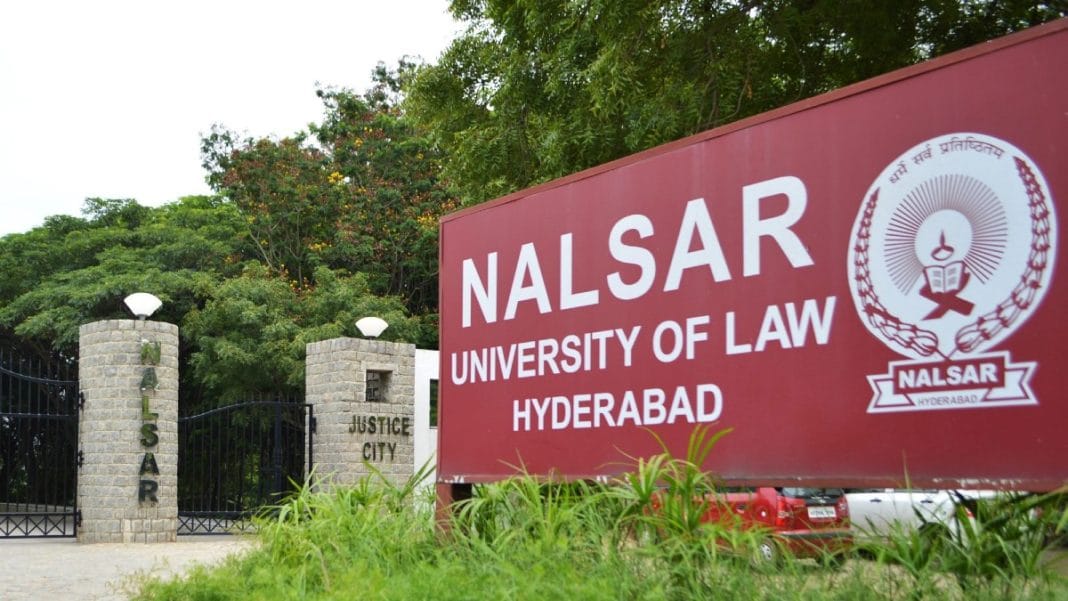


A disagreement between students and an institution should never become a threat to a student’s career. The recent controversy involving NALSAR University of Law Hyderabad, the Chief Justice of India (CJI), and the Bar Council of India makes us ponder upon an important question about the limits of regulatory power and the right to dissent.
NALSAR, one of India’s prominent legal universities, invited CJI Justice Surya Kant as the chief guest at the convocation ceremony of its 2026 batch. A section of students opposed the invitation because of concerns relating to earlier controversies involving the CJI and his comments on students, as well as NEET protests. Reports stated that approximately 450 students were against the invite.
However, opposition alone does not automatically mean disrespect.
The controversy took a serious turn when BCI Chairman Manan Kumar Mishra directed State Bar Councils to defer the enrolment of the entire 2026 batch of NALSAR as advocates. The BCI later withdrew this direction after finding that most students affected were innocent and had no role in the alleged disturbance. After backlash, the Chairman apologised to law students.
The matter reached the Supreme Court, where a three-judge Bench headed by the CJI himself questioned BCI’s action. The CJI observed that students have the fundamental right to express their views and that the disagreement was essentially between him and the students, which they had exercised in accordance with the Indian Constitution.
He further quoted his own experience of being involved in similar student activities in his younger days and made it clear that students should not suffer professionally merely because they expressed their views. The Court also encouraged the students to get enrolled at the bar and enter the legal profession while offering the opportunities to work with the Supreme Court.
This part of the controversy deserves serious consideration.
Article 19(1)(a) of the Indian Constitution guarantees freedom of speech and expression as a fundamental right, subject to reasonable restrictions. Students pursuing law are expected to analyse, question, debate and examine the decisions of the authority. They must not learn how to follow rules blindly, but to question them when necessary while abiding by the constitutional limits.
The BCI is an essential statutory regulatory body of the legal profession and legal education. It is responsible for maintaining professional standards and regulating legal education. But regulatory power must be exercised with utmost diligence because with power comes responsibility. A regulator like the body itself can take action against genuine professional misconduct, but punitive professional consequences for students who have merely expressed disagreement raise concerns of proportionality and fairness. This is a wrong way to teach a lesson, where many innocent students will have to suffer unnecessarily.
For a law graduate, enrolment as an advocate is not just any minor formality. It is a crucial step towards beginning their legal career. This becomes even more significant when taking into consideration the recent requirement of three years of practice for candidates seeking to appear for judicial service examinations. Any sort of unnecessary delay in enrolment can therefore have serious consequences for young graduates.
At the same time, the legal profession is simultaneously facing criticism for proposing Draft Advocates (Amendment) Bill, 2026, which raises the advocates’ enrolment cost from Rs 750 to Rs 22,500 as a mandatory requirement to get a license for practice. The bill proposes two weeks of mandatory training in Goa; however, it remains silent on who will bear the expenses for the same. Such reforms might be intended to improve professional standards, but they must also consider the financial position of young law graduates.
The NALSAR issue hence raises an important question: Should dissent with authority ever become a reason to put a student’s professional future at risk?
The answer should obviously be NO, unless there is clear misconduct violating the law established through a fair process.
Students’ actions are a separate matter of concern. The more important question is whether they had the right to express their disagreement peacefully.
A democratic nation must have space for healthy criticism. A regulatory body must have authority, but authority must always remain within the limits of law, fairness and reason and not transform into dictatorship.
The saying that power tends to corrupt, and absolute power corrupts absolutely fits well here. The BCI’s withdrawal of its decision and subsequent apology depict that institutions no matter how powerful can make mistakes but they can always take up the responsibility to recognise their error and correct it instead of covering them.
Law students are being trained to guard the Constitution and question laws, challenge decisions and defend unpopular opinions. They should not be taught or forced to exercise those very principles that can cost them their degree and overall professional future.
A mature democracy does not demand silent and blind compliance of rules from its students. Instead it teaches them to disagree responsibly, criticise constructively while institutions learn to lend their ears and work on the valid corrections.
Yashika Srivastava is a student at Atal Bihari Vajpayee School of Legal Studies, Chhatrapati Shahu Ji Maharaj University, Kanpur. Views are personal.
Also Read: Is India really the model example of democracy?