





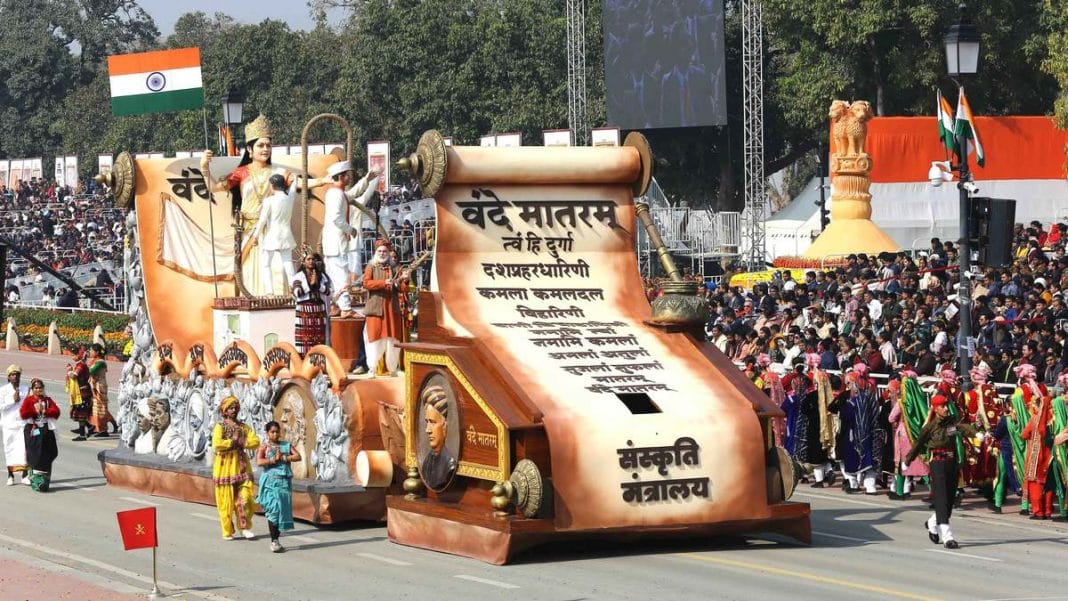


The Prevention of Insults to National Honour (Amendment) Bill, 2026 was passed by the Rajya Sabha on 29 July, and by Lok Sabha on 30 July through voice-vote.
It was introduced with the primary objective of extending statutory protection to Vande Mataram as given to the National Anthem by amending Section 3 of the Prevention of Insults to National Honour Act, 1971.
If anyone intentionally “prevents the singing of the National Anthem or the National Song”, or “causes disturbance to any assembly engaged in such singing”, he/she could face imprisonment of up to three years, or fine, or both.
Legislative history of Vande Mataram
Vande Mataram was written by Bankim Chandra Chatterjee, and became popular among Indians during the Indian Independence Movement. The poem had appeared in the 1882 novel Anandamath, where it was composed in Sanskrit but was written in Bengali script. In the expression “Vande Mataram”, Vande means “to praise or celebrate” whereas Mataram means “mother”. Rabindranath Tagore first publicly recited the poem at the 1896 session of the Indian National Congress in Calcutta, now Kolkata. In 1937, the Indian National Congress adopted the first two-stanzas as India’s National Song.
There has historically been a distinction between National Song & the National Anthem. The greater significance was given to the National Anthem because our Constitution imposed a duty on citizens to respect the National Anthem & National Flag. However, the same recognition was not extended to Vande Mataram.
On 24 January 1950, then President, Dr Rajendra Prasad, suggested in the Constituent Assembly debate that Vande Mataram shall be honoured equally with the ‘Jana-Gana-Mana’.
National symbols, fundamental rights & extent of statutory imposition: The Bijoe Emmanuel Principle
The National Song was never mentioned in any landmark case, but the National Anthem was certainly discussed in many seminal works. For instance, in the case of Bijoe Emmanuel vs State of Kerala, there were a considerable number of constitutional questions that arose during the whole trial. The constitutional question, accordingly, was whether fundamental rights such as 19(1)(a) & 25 of Constitution of India, should prevail over the Prevention of Insults to National Honour Act, 1971, or not.
The Apex court answered graciously that the negative of a Fundamental right is also protected as well as the right to remain silent is also a part of freedom of speech and expression under 19(1)(a). With respect to Article 25 which guarantees freedom of conscience and free profession, practice and propagation of religion however it is subject to public order, morality and health.
In the same case, three students who belonged to the Jehovah’s Witnesses refused to sing the National Anthem, which resulted in their expulsion from the school. The Apex court clarified misinterpretation of Article 51-A(a), where there’s a duty on citizen “to abide by the constitution and respect its ideals and institutions, the National flag and the National Anthem”, that respect to the National Anthem can be shown even by standing up when the National Anthem is sung, respect cannot only be shown by joining in the singing. The National Anthem & flag are constitutionally recognised and the similar interpretation can be extended for National Song as well, however, National song has not been recognised.
Punishment prescribed under Section 3 of the Act, is the same as the three years even now in the new amendment bill of 2026. A apposite analogy while analysing the proportionality of the prescribed punishment with Section 197(1)(d), Bharatiya Nyaya Sanhita, 2023 (BNS), where the prescribed imprisonment is up to three years for the “publication of false or misleading information, jeopardising the sovereignty, unity and integrity or security of India. Likewise, Section 3 of the said act, also provides the same punishment for three years.
This analogy does not imply that these two offences are similar or equal in gravity. However, it raises a lot of questions of proportionality of punishment, whether failure to sing the National Song should carry the same maximum punishment up to three years imprisonment as conduct entailing aspects that may threaten interests as fundamental as the sovereignty & integrity of India?
Conclusion
Vande Mataram has a notable place in India’s constitutional and historical sensitivity and justifies its rightful place. However, the question is how justified this three-year punishment is with regards to showing respect. And another is whether the National Song should be honoured. Indeed, it should be, however, the constitutional issue is whether National Song’s official recognition means that it should also be given the same legal treatment.
Therefore, the proportionality of the punishment ought to be examined in isolation. This requires assessing the gravity of the forbidden act, the type of detriment that the law seeks to prevent, the deliberation of the person who commits the act, and whether this three years of imprisonment is justified in this regard.
Utkarsh Yadav is a student at Damodaram Sanjivayya National Law University, Visakhapatnam. Views are personal.
Also Read: How Hindi can learn from China’s Mandarin diplomacy and global soft power