





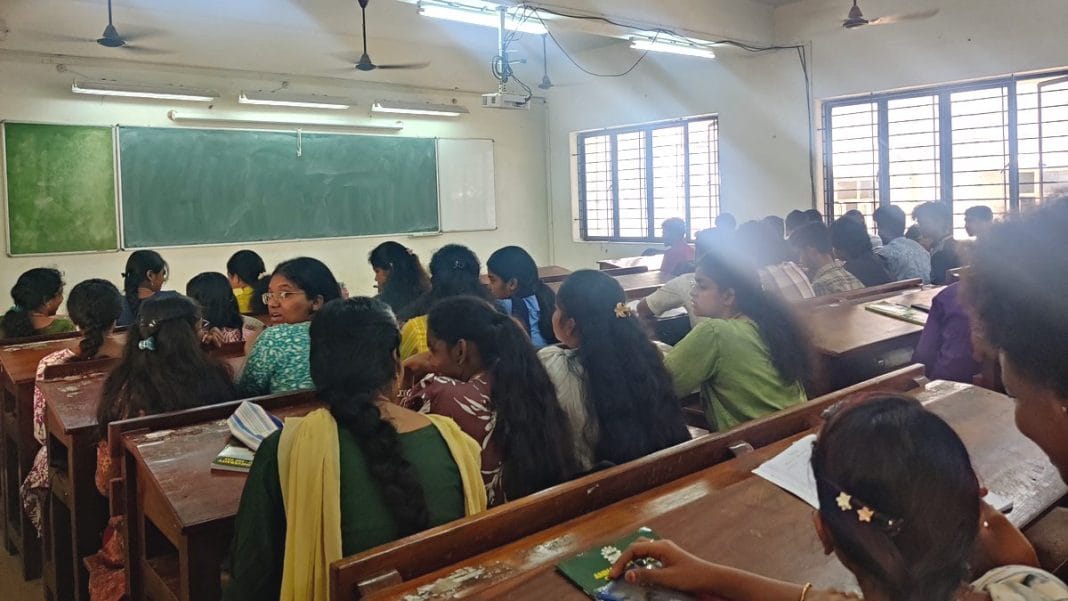


Many of India’s doctors, engineers, and people aspiring to be doctors or engineers accept wholeheartedly that scientific knowledge is undoubtable.
Answers are absolute; empirical knowledge is unquestionable; everything is either correct or incorrect.
I want to first attempt to clearly and concisely explain the problem of induction, a counterargument to this line of reasoning.
Then, I shall argue why we need the philosophy of science in secondary and senior secondary STEM education, and then I will come to potential ways to implement the philosophy of science in school curricula.
Inductivity
You see an orange and black tiger in the moist, deciduous forests of Bandhavgarh national park; the first you have ever seen. Fascinated by the creature, you decide to spend two whole years at the park, where you observe over a thousand such felines. Based on your observations, you conclude that “all tigers are striped orange and black”.
This is what is called an “inductive” conclusion. You noticed a pattern that was true for every tiger you saw, and then used it to create a general principle.
Crucially, induction is the paradigmatic base of science: scientific knowledge is necessarily of an inductive form. We know, scientifically, that a certain chemical acts in a certain way because we have observed it act that way hundreds of times.
But there is a very old and prominent objection to the inductive form, presented by Hume, which argues that there is a ‘problem’ with induction. To put it simply, induction is a well-supported guess. Unfortunately, there is no obvious reason to trust that such a guess is accurate.
Indeed, our original inductive conclusion is incorrect: all tigers are not striped orange and black, as Siberian tigers, for instance, are white and black. We may even ask why a principle of ‘counter-induction’ is unfeasible. Why does the fact that the sun has risen every day before today imply that it shall rise again tomorrow? Why might it not imply that the sun shall never rise again? There seems to be no obvious answer to this question in the philosophy of science. Therefore, we have reason to doubt the validity of the inductive method.
This is not, though, an attempt to argue for the validity of the problem of induction. The point is that there exist clear arguments against the empirical methods that we dogmatically adhere to. And this is why the philosophy of science is needed in secondary and senior secondary STEM education.
Need for philosophy of science
Article 51A(h) of the Constitution argues that every citizen has a duty to develop a “scientific temper” and the “spirit of inquiry and reform”. The current state of science, that being an unquestionable base of facts, prevents a “spirit of inquiry and reform” from being appropriately developed.
Consider Newtonian mechanics, taught to CBSE students from Class 9 to Class 11. A key problem with the way Newtonian mechanics is taught is that it is presented as fact, and not as a theory that has in reality been surpassed in the context of modern physics. The important thing to note is that any mathematical model of the physical world can be questioned, doubted, or possibly improved upon, as can any other scientific endeavor. A lack of real deep introspection on these issues is therefore leading to less awareness.
The usual target of blame is the competitive examination system, which often leads to students prioritising results over curiosity. While I agree that change is needed, the competitive examination system has received thousands of detailed takedowns. A more feasible immediate solution may be the implementation of a more rigorous philosophy of science curriculum in science classes all throughout 9th-12th grade.
The philosophy of science is useful here as it creates scientists aware of the methods of science, the way science operates, and the questions science cannot answer. Dogmatism is the enemy of science, and so it is in our best interest if we wish to create good scientists to encourage them to simultaneously be good philosophers.
Methods of implementation
What would such a curriculum change involve? What may it include? How could the philosophy of science be incorporated into school curricula?
To start, I do not think a curriculum addition should focus on any sort of canonical thinkers or philosophical terminology. Rather, the aim of such an addition should be to get science students thinking about the science with which they are engaged. This can be done through a focus on questions rather than thinkers. I propose three main questions:
- What is the role of intuition in science?
- To what extent is science an accurate model of reality?
- Are mathematical truths discovered or invented?
An examination of these three questions, split perhaps into three course components, starting in Class 9, would certainly encourage the sort of reflection we wish to promote.
Implementation would be relatively simple. One would just need to update the NCERT curricula (as has already been done recently) to add the philosophy of science to traditional mathematics, biology, chemistry, and physics courses, or even to the “science stream”. This could be kept short – one 30-minute class a week may be sufficient.
One valid objection I concede is the possibility of a lack of proper teachers to facilitate this goal. However, it is possible that such a course requires little teacher intervention indeed.
Class time could be divided roughly between analysis of philosophical content at an introductory level and discussion time. From my anecdotal experience, kids are more than willing to engage in such intellectual discussions, in fact, a complaint that many of my peers in CBSE schools bring up is that there is not enough discussion within the “science streams”. We should not doubt the capability of our youth to pursue and be engaged with such a course, particularly considering the low amount of teaching hours needed.
Conclusion
All in all, there are problems with the way science is currently presented to secondary and senior secondary school students. The incorporation of the philosophy of science alongside traditional STEM education is a possible solution I propose to this dilemma. Such a solution can be implemented through short 30-minute blocks focusing on questions rather than ideas, with a great deal of discussion time.
The addition of the philosophy of science into traditional science curricula would therefore, I argue, make our next generation of STEM thinkers more reflective and scientific, an enviable goal indeed.
Neel Tripathi is a student at Ascend International School. Views are personal.
Also Read: In the age of AI, India’s education system needs to cultivate skills, not just board exam scores