



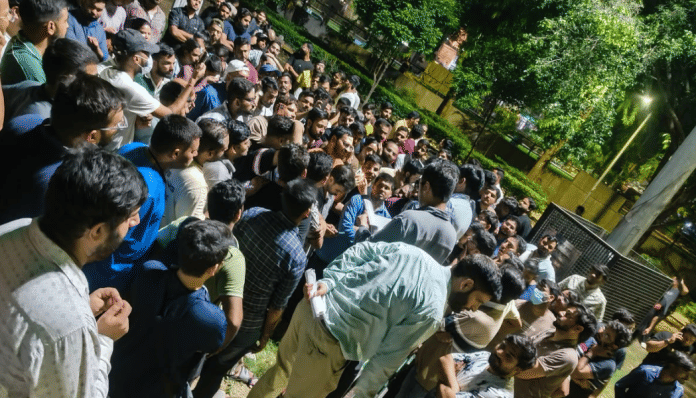
New Delhi: Hundreds of foreign medical graduates are protesting against the National Medical Commission in Delhi’s Gautam Nagar. This come a month after just 12.38 per cent of candidates cleared the June Foreign Medical Graduate Examination (FMGE).
Aspirants are now demanding to see the answer key after an expert panel rejected their demand for grace marks but recommended a series of changes to the examination system.
“They have accepted our demands such that they will simplify the exams, the difficulty level will be less than 30 per cent, answers will be provided within 24 hours, and they will provide extra biometric time. And the exam will be held three times a year, but they didn’t agree on the grace marks and compensation,” said Ashish Kumar, one of the candidates leading the protest.
Aftermath of the June exam
Several candidates found the paper conducted on 28 June very difficult and struggled to finish the National Board of Examinations in Medical Sciences (NBEMS) introduced video-based questions without prior information.
They also complained about the poor examination facilities. Students are now demanding transparent evaluation and raising the issue of the absence of an official answer key.
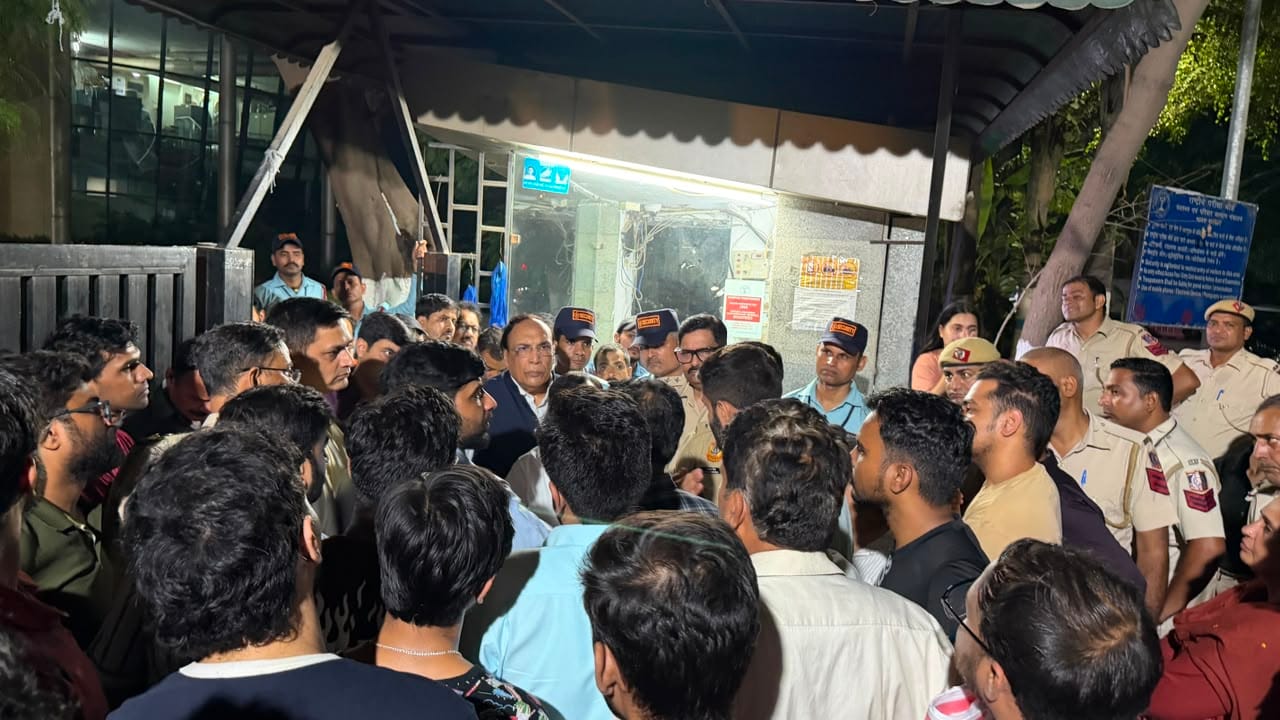
In the exam, only around 12 per cent of candidates (37,448) cleared it. The low pass percentage intensified protests by FMGs, who subsequently met NBEMS officials on 3 August.
Soon after the meeting, a three-member expert committee was constituted to examine the concerns. The committee, chaired by retired Air Marshal Dr Pawan Kapoor and comprising Dr Mahesh Verma and NBEMS vice-president Dr Minu Bajpai, met student representatives on 18 August.
What did the committee find?
In a written letter sent to the All India Medical Students’ Association (AIMSA) on 20 August, the NBEMS said that the committee had completed a “comprehensive and objective review” of the exam and made recommendations for changes in the examination system.
However, the committee did not recommend any compensatory marks for candidates who appeared in the June session.
The students had specifically sought compensation or grace marks, citing the introduction of video-based questions and what they described as a sudden increase in examination difficulty.
“The officers said go to Supreme Court, but we are gathering in Gautam Nagar and inviting others to participate in this,” Kumar added.
The committee said it did not find sufficient evidence to establish that the video-based questions or difficulty level had a material adverse impact on the examination result. It also cited the existing legal framework governing the FMGE qualifying cut-off and said it did not provide for grace marks.
The committee, however, recommended several changes.
It suggested increasing the proportion of questions at the lower difficulty level to 30 per cent, while retaining about 20 per cent difficult questions. It also recommended that the mean difficulty level should not exceed 5.5 and the median should not exceed 5 on a 10-point scale.
It further recommended examining the feasibility of conducting FMGE at least three times a year, reviewing the examination fee, and introducing a mechanism from future sessions through which candidates could view their recorded responses, corresponding correct answers and marks awarded for individual questions.
On examination-centre complaints, the panel recommended a comprehensive review of environmental conditions at centres, particularly those in areas prone to extreme temperatures. It also said that if video or other multimedia questions are used, candidates should be informed sufficiently in advance so they can familiarise themselves with the interface. The committee recommended that the re-introduction of video-based questions in FMGE be deferred for at least one year.
(Edited by Insha Jalil Waziri)