





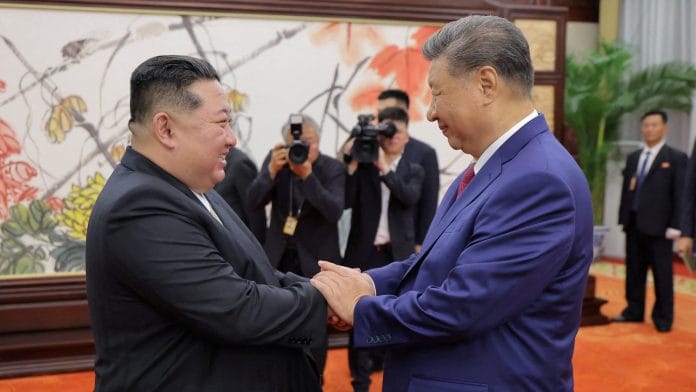


New Delhi: Chinese President Xi Jinping arrived in North Korea in a likely bid to reassert Beijing’s influence over an emboldened Kim Jong Un, a neighbor with a rapidly expanding nuclear arsenal and deepening alliance with Russia.
Xi, accompanied by his wife Peng Liyuan, landed in Pyongyang on Monday morning, the official Xinhua News Agency reported. His top aide Cai Qi and Chinese Foreign Minister Wang Yi are part of the delegation.
The two-day visit marks the Chinese leader’s first to its neighbor in seven years, and comes weeks after he hosted US President Donald Trump and Russia’s Vladimir Putin in Beijing for high-profile summits in quick succession.
Xi’s trip underscores his efforts to remind the world — and Kim — that Beijing remains Pyongyang’s most important political patron and economic lifeline — even as North Korea’s defense partnership with Russia has provided new diplomatic leverage and room for maneuver.
Xi’s outreach will showcase his argument that China serves as a stabilizing force capable of engaging with all sides at a time when geopolitical fault lines are gapping wider across the world. By contrast, Trump has been alienating allies and roiling global markets with his war on Iran and by raising trade barriers.
A day before Xi’s trip, Kim’s sister, Kim Yo Jong, said the country’s atomic weapons program was “absolutely non-negotiable” and that “officials in the United States have failed to wake from their escapist and anachronistic dreams,” sending a clear message about North Korea’s red line on denuclearization.
South Korea and the US will be watching Xi’s trip for any sign China is shifting its long-held stance on a nuclear-free Korean Peninsula. On his last visit to North Korea in 2019, Xi told Kim he was “dedicated” to that goal, and said the world wanted Pyongyang to make progress in nuclear talks with the US.
“Prioritizing improved relations with Pyongyang to preserve and expand China’s influence over North Korea” is now more important to Xi than pushing the nuclear issue, said Tong Zhao, a senior fellow in the Nuclear Policy Program at the Carnegie Endowment for International Peace.
Much has changed since Xi’s last visit. Kim has accelerated his pursuit of atomic weapons, days ago unveiling what appeared to be a new uranium enrichment facility and touting a doubling of nuclear production capacity. The US and Israeli war on Iran has likely only deepened Kim’s conviction that possessing a fully operational nuclear arsenal is essential to regime survival.
Speculation has been growing that Beijing has tacitly accepted North Korea as a de facto nuclear power. When Kim visited Xi in Beijing last September, official readouts made no mention of denuclearization — a striking departure from previous summit statements. China’s latest white paper on non-proliferation also skipped stating “denuclearization” as a goal for the peninsula.
As Xi travels to Pyongyang, South Korean President Lee Jae Myung marked his first year in office with a press conference. Lee has avoided Trump’s ire, kept relations with Japan from veering off track and even improved ties with China. North Korea remains a sore point, with Lee’s calls for engagement rejected by the Kim regime.
Xi’s decision to make Pyongyang his first foreign destination of the year highlights the importance Beijing attaches to its only military ally. In an op-ed published Monday in North Korea’s Rodong Sinmun, China’s leader called for stronger strategic communication with Pyongyang and for both countries to oppose “hegemonism and power politics.”
The last time Xi visited, he brought his wife, took an open-top ride with Kim through crowd-lined streets of Pyongyang and attended an elaborate celebration marking 70 years of diplomatic ties between the two Communist regimes.
Ties cooled during the pandemic, when North Korea’s self-imposed isolation choked trade with China, while growing ties with Moscow complicated the picture. Relations began warming after Kim — and Putin — visited Beijing on the sidelines of a military parade last year. The two neighbors recently restarted train and plane services between their capitals.
For Kim, who has hosted a flurry of high-level visits this year, rolling out the red carpet for the leader of the world’s second-largest economy further burnishes his image as a global statesman. Observers will also watch whether Kim — the son and grandson of North Korea’s only other rulers — will bring his teenage daughter to the high-profile event, adding to recent public appearances alongside her father.
Russian Partnership
For decades, Beijing was Pyongyang’s closest economic partner and sole formal security ally. But in 2024, North Korea and Russia signed a comprehensive partnership agreement that included a mutual commitment of military assistance in times of war.
Putin-Kim bonhomie was in plentiful display during the Russian leader’s visit to North Korea that year, as the duo popped up together in a Russian-made limousine — inviting comparisons with whatever imagery emerges from Xi’s visit.
Going beyond personal vibes, North Korea also dispatched troops to help Russia with its war on Ukraine, likely gaining access to military technology and economic help in return. Supplying weapons and personnel to Russia has given Kim a windfall worth as much as $14 billion, according to a recent study.
Russia’s battlefield momentum stalled this year, with Moscow’s weakening position potentially a factor in Kim’s decision to invite Xi, analysts said. Historically, North Korea’s strategy has been to balance ties between China and Russia to extract benefits from both.
A backdrop of deepening military ties among Asia Pacific allies of the US — including Japan, the Philippines and Australia — could also be sparking desire in Beijing and Pyongyang to boost bilateral engagement.
Any explicit move by Xi to declare North Korea’s right to have nuclear weapons would mark a major breakthrough for Pyongyang. Leaders across the region will be watching for any such departure from a longstanding Chinese position.
–With assistance from Jing Li, Soo-Hyang Choi, Heesu Lee and Alan Wong.
This report is auto generated from the Bloomberg news service. ThePrint holds no responsibility for its content.
Also Read: Russia’s role is now to feed China. The Xi–Putin bond is like a loveless marriage