





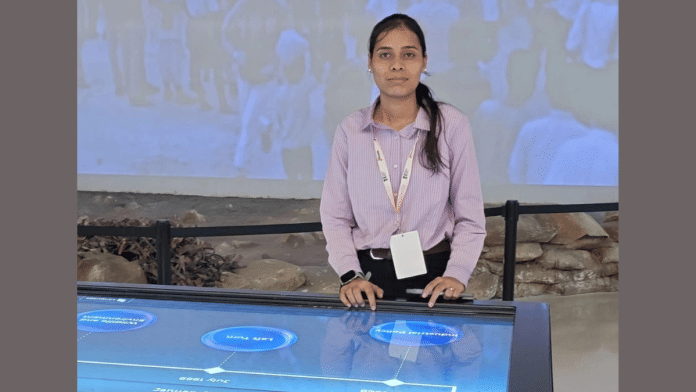


New Delhi: When 23-year-old Sujit Shaw graduated with a Bachelor of Commerce (B.Com) degree from Calcutta University two years ago, he found himself in a familiar position shared by many young Indians—qualified on paper, but unsure of how to enter the corporate world.
“There was confusion about what to do next and where to apply,” Shaw recalled.One day while browsing LinkedIn, he came across an advertisement of the Prime Minister Internship Scheme (PMIS), the Centre’s flagship initiative launched in October 2024 to bridge the gap between education and employability.
The scheme was launched with an ambitious target of providing internship opportunities to 1 crore youth over five years. But as ThePrint reported earlier, only 16,060 candidates physically joined the programme across the first two pilot rounds.
Keeping that aside, the scheme’s promise of industry exposure and workplace learning seems to have found positive response from Shaw and others who completed the internship.

Shaw applied for an internship opportunity close to his home and was selected as a finance intern at ITC’s Khidderpore plant, a cigarette manufacturing unit. For the B.Com degree holder with no corporate exposure, the opportunity was transformative.
“I had just completed B. Com graduation and never thought that I would get an opportunity to do an internship in a big company like ITC,” Shaw said. “During internship, I got an opportunity to work with rank holders, CAs [chartered accountants] and CMAs [certified management accountants]. It was a turning point in my career.”
Over the course of the 12 months, Shaw worked in ITC’s finance department, handled procurement, direct and indirect taxation under the guidance of a designated mentor. Alongside finance-related work, he also assisted with Human Resource Management System (HRMS) processes.
The exposure eventually shaped his future. Once the internship was over in November 2025, Shaw received two full-time employment options in engineering and human resources (HR) from ITC itself. He chose the HR role due to prior experience and has been working full-time at the plant since January.
Today, Shaw manages payroll operations and earns a six-figure annual salary that helps support his father, who runs a grocery shop along with Shaw’s two elder brothers.
The scheme
Designed to provide internship opportunities to 1 crore youth over five years, the PMIS targets candidates from non-elite educational backgrounds in Tier-2 and-3 towns by placing them in some of India’s leading companies.
Under the original structure, candidates received a monthly stipend of Rs 5,000–Rs 4,500 from the government and Rs 500 contributed by companies through Corporate Social Responsibility (CSR) funds—along with a one-time grant of Rs 6,000 from the Centre.
The Ministry of Corporate Affairs (MCA), which manages the scheme, positioned PMIS as a way to create a “job-ready and skilled workforce” by exposing candidates to real corporate environments.
At a CII event last month, MCA secretary Deepti Gaur Mukerjee described the scheme as both an “economic necessity” and a “talent-building” exercise, urging India Inc. to view it as an investment in future workforce development.
Shantanu Rooj, founder and CEO of TeamLease EdTech, said internships are becoming increasingly important because employers today look for a combination of education, skills and evidence of work experience.
“Classroom learning alone is no longer enough. Students who have worked in live environments understand workplace expectations, develop soft skills and become productive much faster,” he told ThePrint, adding that even a modest stipend helps young people build confidence and gain financial independence early.
Also Read: Why flagship PM Internship Scheme is off to a stuttering start with low turnout, high attrition
From internships to employability
For many candidates, the internship translated into practical workplace experience and, in some cases, resulted in full-time employment opportunities like for Shaw.
Anushka Saini from Roorkee described her 12-month internship at Wipro’s Haridwar office as her first introduction to corporate work culture. “It’s been an amazing journey for me,” the 24 year-old told ThePrint. “I learned new things like MIS [management information system] reporting, stock verification and software systems which I didn’t even know about.”

After completing the internship in May, Anushka is exploring opportunities closer to her home town. She remains in touch with Wipro’s HR team and plant leadership regarding future openings.
A similar experience was shared by Kanika Sharma, who secured a full-time job after completing her internship at GAIL India’s Delhi office.
While pursuing an M Com degree via distance learning from IGNOU, the Delhi girl interned at GAIL’s finance department and handled software such as SAP FICO (Financial Accounting and Controlling) and SAP TRM (Treasury and Risk Management).

“Coaching institutes charge around Rs 25,000 to teach these software systems. At GAIL, I learned them for free and also got paid during the internship,” she said.
Now working as a junior accountant at Aprazer Healthcare Pvt Ltd, the 25-year-old said the internship experience helped her secure a full-time job. “During my interview round, they asked me about my projects at GAIL India and the software that I learned. This helped me clear the interview round.”
Similarly, Pratima Kaushik from Uttar Pradesh’s Hathras town vouched for the hands-on industrial exposure that she said would have otherwise been difficult to access. Her internship ended in December 2025.
With a diploma in engineering from MG Polytechnic, she applied for multiple applications for internships before being selected for Adani Ambuja Cement’s Rabriyawas plant in Rajasthan, where she worked on Alternative Fuels and Raw Material (AFR) projects and gained exposure in project execution, site supervision and industrial safety practices.
“During internship, I gained valuable practical knowledge and hands-on experience in various aspects of civil and industrial projects.”
The 22-year-old secured a full-time role with Adani Foundation in Rajasthan’s Nagaur district, where she manages rural infrastructure development projects.
Coming from a family with four sisters and a father dealing with health issues, she said that job brought both professional growth and financial stability. “I am grateful for the opportunities I received, as they helped me grow professionally and develop strong technical and communication skills.”
The government-backed PMIS, TeamLease EdTech founder Rooj said, can help students access opportunities that may otherwise remain out of reach, particularly for youth from smaller towns and less privileged backgrounds.
The PMIS revamp
Despite such positive experiences, PMIS participation numbers in the first two pilot rounds remained below expectations, according to data shared by the government in Parliament.
In the pilot round, companies made over 82,000 internship offers to more than 60,000 candidates. Of these, only 8,760 candidates eventually joined, and nearly 54 percent dropped out midway. Eventually, 3,605 candidates completed the full 12-month internship in round 1 as of March 2026.
The second round, launched in April 2025, followed a similar pattern. More than 83,000 offers were made to over 71,000 candidates, but only 7,300 joined. As of March 2026, 7,292 candidates had exited the programme midway across both rounds.
As reported by ThePrint in February, the government has attributed it to concerns such as relocation challenges, low stipend amounts and the relatively long 12-month duration.
Rooj attributed the lukewarm response partly to a mismatch between student expectations and internship realities. “Many candidates were unsure whether the internships aligned with their educational background, while others faced relocation challenges after receiving opportunities far from their hometowns.”
Following the underwhelming response, the government revised key aspects of the scheme in March to improve participation and retention. ThePrint had first reported the proposed changes.
The monthly stipend was increased from Rs 5,000 to Rs 9,000, with the government now contributing Rs 8,100 and employers contributing Rs 900. The eligible age bracket was widened from 21-24 years to 18-25 years to attract a larger pool of applicants.
Perhaps, the most significant change was the reduction in internship duration to between six and nine months, depending on employer requirements—a move aimed at addressing concerns around long-term commitment and financial sustainability for candidates.
The third round of applications began in April with the revised structure and, according to an MCA official, the initial response has been better this year.
While the scheme is far from achieving the scale originally envisioned by policymakers, the experiences of successful candidates suggest that for at least some of the applicants, the PMIS has functioned as intended—an entry point into a professional world that previously felt out of reach.
(Edited by Tony Rai)
Also Read: Floundering PM Internship Scheme used less than 1% of Rs 10,831 crore set aside for it in FY25-26