





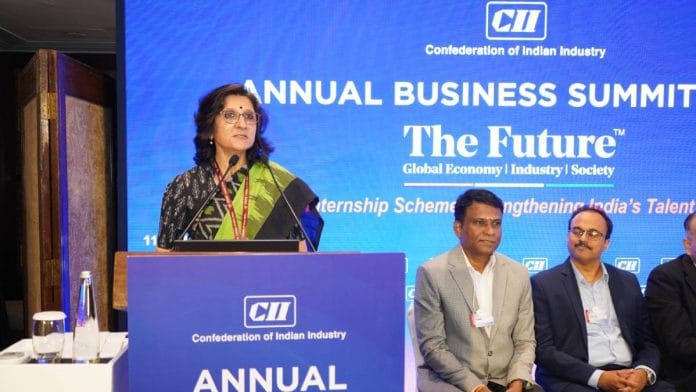


New Delhi: At the CII Annual Business Summit 2026 in New Delhi Tuesday, Deepti Gaur Mukerjee, Secretary at the Ministry of Corporate Affairs (MCA), made a strong pitch to India Inc. to scale up participation in the government’s flagship internship initiative, PM Internship Scheme (PMIS), positioning it as both an economic necessity and a corporate social responsibility (CSR) obligation.
Mukerjee traced the origins of the scheme to discussions in the Prime Minister’s Office, where policymakers examined the gap between India’s demographic dividend and industry’s persistent struggle to find job-ready talent despite a large education and skilling ecosystem.
“The industry was saying we need people, we need talent, but we are not getting it,” she said, adding that existing skilling systems often remain too rigid and slow to adapt to changing industry requirements.
Designing new courses, securing accreditation and building certification systems, she noted, made traditional pathways cumbersome and time-consuming.
The idea behind the internship scheme, she said, was to shift the design burden towards industry itself. “Can we give the onus to industry so that they can prepare people the way they want them to be?” she asked, describing the scheme as a flexible, fast-track alternative in which companies define job roles and training structures, while the government supports a significant part of the internship cost.
Mukerjee emphasised that the scheme was announced in the Union Budget 2024-25 and forms part of a broader national effort to scale up skilling. Its design, she said, deliberately reduces bureaucratic friction, enabling companies to focus on mentoring and skill-building rather than procedural approvals.
Unlike conventional government programmes, she stressed, implementation of the PM Internship Scheme is entirely industry-driven. The MCA and its partners do not conduct enrolment drives or on-ground mobilisation.
Instead, industry associations play a central role in outreach, while digital platforms and social media are used extensively to connect with young applicants, particularly from smaller towns and cities.
A key focus of the scheme, Mukerjee said, is inclusion. It is aimed largely at students from Tier 2 and Tier 3 cities and institutions, which she described as an under-recognised reservoir of talent. “Talent does not lie only in IITs and IIMs,” she said, arguing that smaller colleges produce students with strong motivation and hunger to perform.
She urged companies to look beyond aggregate numbers and see the programme as a long-term investment in human capital. The pilot target of 110,000 internships, she said, should not be treated as a statistic but as 110,000 individual life trajectories shaped by exposure to real workplace environments.
Mukerjee also highlighted the generational shift underway in India’s workforce, pointing to a widening perception gap between employers and young employees. While industry often laments that younger workers lack discipline or long-term commitment, she said, there is an equal need to understand changing aspirations and expectations.
“If there is a disconnect between what the youth are thinking and what we expect them to think, the country cannot progress,” she said, warning that ignoring these shifts could deepen labour market mismatches.
With India’s median age at 28, she noted, the country’s growth trajectory will depend heavily on how effectively it integrates young people into formal employment systems.
She also echoed Prime Minister Narendra Modi’s emphasis on quality over quantity, arguing that India must move beyond scale alone and focus on improving standards across education, infrastructure and industry engagement.
The internship scheme, she said, reflects this shift by prioritising hands-on learning and structured mentorship over rote training models.
Concluding her address, Mukerjee described the programme as a collaborative opportunity between the government and industry to “create not just jobs, but futures”, urging companies to treat participation not as compliance but as commitment.
“It is about making a difference in somebody’s life,” she said.
(Edited by Nida Fatima Siddiqui)
Also Read: Floundering PM Internship Scheme used less than 1% of Rs 10,831 crore set aside for it in FY25-26