








For two days, the carcasses of the hunters lay stretched out on the ice sheets of Karatash mountain alongside their prey, the sacred Argali ram. Alexander Kosopkin, the presidential envoy to the State Duma, the senior Parliament official Sergey Livishin, the beer tycoon Boris Ivanovich Belinsky, the folk musician Vasily Vyalkov, Anatoly Bannykh, the deputy prime minister, Viktor Kaimin, the official guardian of wildlife.
The friends had commandeered a helicopter operated by Gazpromavia, a subsidiary of the state-owned energy giant Gazprom, to corral and hunt down the critically endangered Argali with automatic weapons, ignoring laws banning shooting wildlife from the air.
The men had much to celebrate in that new year, 2009. Though few knew it, plans had been put in place to drive a massive gas pipeline through Altai, bringing enormous wealth to one of Russia’s most backward regions. The hunting ended in tragedy, though. As the helicopter manoeuvred to retrieve the slain ram from the mountain, battling minus 26 degrees Celsius temperatures and sharp winds, the pilots lost control of the Mi-171.
Four years later, the original pipeline project was shelved as Gazprom shifted to a new eastward alignment. Then, the world changed: The Altai pipeline, also known as the Power of Siberia 2 pipeline, is back.
Asia’s new order
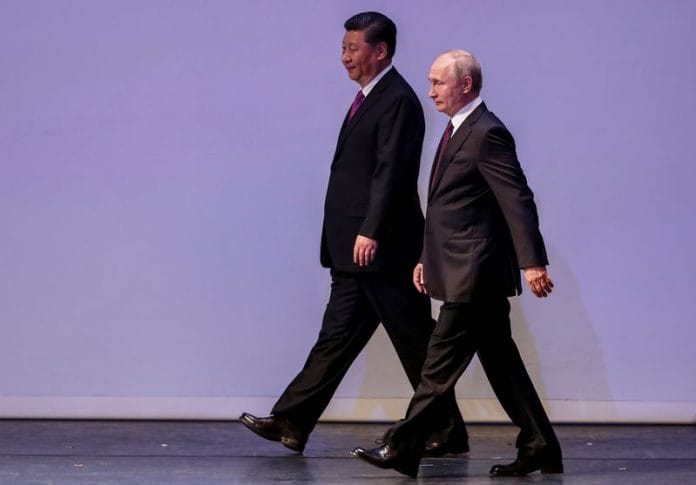
Last week, when Russian President Vladimir Putin and his Chinese counterpart Xi Jinping met in Beijing, the leaders agreed on a plan that will bind their nations with ties of steel. The plan was abandoned amid disagreements over pricing, and Moscow’s worries that it would end up dependent on a single buyer. The Siberia pipeline was instead stretched east towards Vladivostok, to serve markets in Japan and South Korea, with a fork turning southward into China.
Few details have been released, but experts believe the loss of Gazprom’s markets in Europe—brought about by the reported Ukrainian sabotage of the undersea Nord Stream pipeline in 2022—led Russia to agree to lower prices and a pipeline that will have a single customer.
The Russian government most likely sees wisdom in securing a channel outside the reach of American and European sanctions. Finally, Russia likely wishes to sell what it can to its largest market before China permanently slashes its dependence on crude oil and LNG.
For its part, China has been working to reduce its dependence on imported hydrocarbons, but sees value in having access to secure gas supplies insulated from the Middle-East crisis, instability in Pakistan, civil wars in Myanmar, and American geopolitical pressure. The gas smells even nicer, energy expert Erica Downs has noted, because it comes from a region far outside America’s military reach.
Ever since the 17th century, Asia’s two great land empires have eyed each other warily—their suspicions sometimes flaring into wars. Even though Russia—mired in a demographic collapse and frayed economy—needs China, it also knows that its neighbour sees it as a junior partner. The analyst Alexey Martynov, writing just days before the Putin-Xi meeting, complained that Beijing seeks to “preserve a carefully managed partnership in which China remains the senior partner while minimising its own obligations.”
Few countries would embrace such subordination—but Russia is aware that poor political choices, economic mismanagement and the cold workings of demography have left it with no real choices.
Also read: Chinese commentators are overthinking the timing of Putin’s China visit
The heart of Asia
Even though American marketeers proclaimed Afghanistan the heart of Asia—wilfully or otherwise lifting an idea from the anthem of the ill-fated Islamist warlords who ruled from 1992-1996—other nations have long claimed that position. The Afghan anthem, composed by the ethnic Kashmiri musician Qasim Jo, rested the nation’s claims on its invocation of jihad, and promise that the Quran would be the country’s guiding principle.
China claimed Asia’s heart lay near Xinjiang’s provincial capital, Urumqi, based on a map asserting the continent stretches from Cyprus to Japan. The Russians put the centre in Kyzyl, in the Altai, a territory seized from China in the 19th century.
Leaving aside questions of geographical exactitude, the fact is the Altai was the cradle in which Asia was born: Frozen mummies of the ancient Scythians, preserved perfectly by the extreme cold, were discovered from 1929 on, along with ritual monuments and petroglyphs—many of the Argali ram, hunted down by the ill-fated hunters in 2009, as well as other totem animals, like bear and wolves.
The region is also important for reasons unconnected with ancient history: The remote province is perched at the crossroads of Kazakhstan and Russia, the two largest reservoirs of hydrocarbons in Asia, and the world’s second-largest economy, as well as Mongolia. The R256 highway from Novosibirsk to the Mongolian border, built by Gulag forced labour under Joseph Stalin, is part of the Asian Highway, which stretches on to Urumqi, and from there to Shanghai or Karachi.
From the mid-nineteenth century, Russian merchants—many from sects escaping the growing power of the Orthodox church—had begun pushing east into the nominally independent state of Tuva, along the Altai. They were followed by Chinese traders. The scholar David Dallin—whose 1947 exposé on the brutal Gulag system in the Soviet Union preceded his colleagues by decades—discovered this account in the diary of an Imperial Russian officer who visited the Altai in 1913: “The Russian tradesmen, coarse and cruel, have not hesitated to extort the last sheep for a box of matches given on credit a few years earlier or to grab the best pastures and hay harvests.”
Tuvan resentment, though, was no match for Imperial Russian power. Local rulers, official records show, were compelled to yield their tribal seals and symbols of power to the Russian authorities. The city of Belotsarsk was founded in 1914, the same year Tuva formally became a protectorate of Russia.
Following the Soviet revolution, the modern world blew apart Tuva’s culture and civilisation. The country briefly regained independence, but the monk-turned-Prime Minister Donduk Kulaar aroused Stalin’s ire by seeking to set up a Buddhist theocratic state. A coup d’état followed in 1929, and pro-Soviet leaders were installed in power. The Soviet Union dramatically transformed Tuva, dismantling organised Buddhism, destroying monasteries and forcing shamanism underground.
Like many Russians, Tuva’s people suffered and sometimes supported these changes. The region donated its gold reserves to the Soviet Union after war broke out with Nazi Germany, and many from the region served in the Red Army. Tuva’s reserves of gold, platinum and uranium brought some prosperity to the region, while others welcomed the introduction of modern medicine, schools and settled agriculture.
Also read: Trump-Xi summit reveals a rivalry too deep to decouple, too tense to cooperate
Tuva at the crossroads
Following the collapse of the Soviet Union, Tuva was plunged into economic crisis. Gazprom proved a generous supplier of public services and employment, but activists warned against environmental degradation and the impacts on Tuva’s demography. To no one’s surprise, Gazprom won these battles, but the corruption and cultural arrogance demonstrated in 2009 angered many local communities.
Gazprom’s money did little to solve problems like violent crime, alcoholism and unemployment. Tuva’s young people have been volunteering to serve in Ukraine, hoping government benefits will drag them out of poverty.
Will China prove the god that didn’t fail? Little doubt that the new pipeline will draw investment and jobs. How much of that benefits the people of the Altai, though, is unclear. The returns on the first pipeline, though, energy economist James Henderson has shown, were lower than Russia had held out for. The second phase will, almost certainly, have involved even more Russian concessions.
Where Russia was once a significant exporter of cutting-edge technologies and manufactured goods, it is now merely a supplier of energy, nickel, and even food. Like Kazakhstan or Turkmenistan, Russia’s role is simply to feed the dragon. Low energy prices help Beijing, not Moscow, but Russia has little choice in who it can sell to, and for what.
The network of steel pipelines stretching across Eurasia shows Russia has tied itself to the new order in Asia. Like all loveless marriages, the relationship Putin has led his nation into is a prison, but there is nowhere to escape to.
Praveen Swami is Contributing Editor at ThePrint. His X handle is @praveenswami. Views are personal.
(Edited by Saptak Datta)