






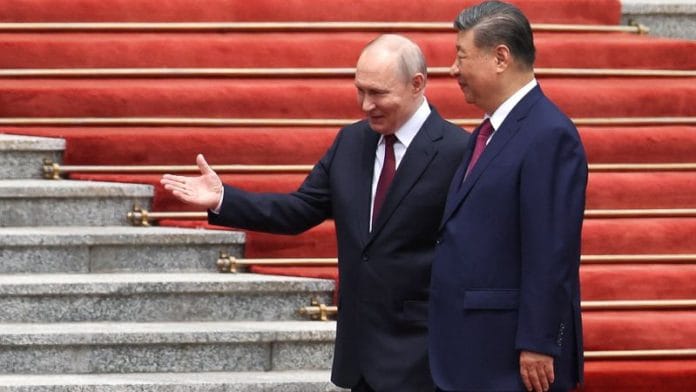


Russian President Vladimir Putin’s 25th visit to China has attracted significant attention on Chinese social media. The two-day state visit beginning Tuesday has been framed as yet another sign of deepening strategic alignment between Beijing and Moscow. The phrase “Putin arrives in China” quickly trended across Chinese media and social platforms.
On Weibo and other platforms, related hashtags gained widespread traction, accompanied by narratives highlighting the long-standing “generational friendship” between China and Russia and their perceived role in maintaining global stability.
Commentators noted that the Chinese and Russian flags along the expressway from Beijing Capital International Airport symbolised the strongest phase in bilateral relations.
Some online posts claimed that five Russian Il-76 military transport aircraft had landed at the airport on Tuesday, generating the kind of online buzz seen during US President Donald Trump’s visit. Putin’s trip, coming shortly after Trump’s, fuelled speculation about deliberate political messaging even as many cautioned against comparing or linking the two visits.
On a macro level, the discussion reinforced an image of China as an increasingly important diplomatic centre and high-level visits as evidence of shifting global alignments. Chinese commentary presents Beijing as a key stage for global diplomacy in 2026. One analysis argued that the steady flow of global leaders, including representatives from all five permanent members of the UN Security Council, mirrors China’s growing international influence.
The broader argument is that China’s political stability, vast consumer market, manufacturing strength, and technological advances are drawing countries toward deeper engagement with Beijing. In this view, the world is gradually moving away from a Western-dominated unipolar order toward a more multipolar system in which China plays a central role.
Chen Fengying, a researcher at the China Academy of Contemporary International Relations, noted that such high-level exchanges show that the international community “understands China better, gets closer to China, and trusts China more.”
Projection of stronger China-Russia ties
A recurring theme across Chinese strategic commentary is the insistence that Putin’s visit, during which he is accompanied by five deputy prime ministers and eight ministers, should not be interpreted through the lens of Trump’s recent trip. Analysts stressed that the Russian leader’s visit had been planned well in advance and that the timing was coincidental rather than politically choreographed.
Straight News special commentator Bing Chen reasoned that the visit serves three broad purposes. First, it marks important milestones in bilateral relations, the 30th anniversary of the China-Russia strategic partnership and 25 years since the signing of the Treaty of Good-Neighborliness and Friendly Cooperation. Second, it advances practical cooperation through expected agreements in trade, political coordination, and education, including the launch of a “Russian-Chinese Education Year.” Third, it provides an opportunity for both sides to exchange views on shifting global dynamics, particularly amid growing uncertainty in US and European politics.
Shen Yi, professor of the Department of International Politics of Fudan University, offered a similar assessment, arguing that China-Russia relations have entered a more stable and institutionalised phase. In his view, the “30+25” milestone highlights how deeply embedded the partnership has become. He claimed that high-level exchanges such as Putin’s visit are now routine rather than reactive and should be seen as part of a long-term diplomatic rhythm instead of short-term geopolitical signalling. Shen also pointed to expanding cooperation in energy, trade, technology, and governance, alongside closer coordination within platforms such as the Shanghai Cooperation Organisation and BRICS.
Former Global Times editor-in-chief Hu Xijin echoed this argument, cautioning against overreading the timing of Putin’s visit. Writing on Weibo, he described Putin’s trips to China as part of a long-standing pattern of institutionalised engagement between the two countries. In his view, the relationship has deepened further since the Ukraine war and the imposition of Western sanctions on Russia. China’s continued economic engagement, particularly in energy and supply chains, has reinforced what he characterised as a mutually beneficial partnership that enhances both countries’ strategic resilience.
Chinese discussions also focused on expected practical outcomes from the Beijing meetings. Commentators highlighted efforts to expand local currency settlements to reduce reliance on the US dollar, deepen energy cooperation, especially oil and gas projects in Russia’s Far East, and strengthen coordination within multilateral platforms. The war in Ukraine remained a backdrop, with expectations of continued alignment, or at least managed convergence, on key geopolitical issues, with a possibility of China playing a mediating role.
Also read: India can’t ignore Russia-China bonhomie. Pursue CNP with a grand strategy
Eurasian vision and strategic coordination
Some Chinese scholars are using the visit to revisit broader questions about the Eurasian order. Cui Hongjian, professor at the Institute for Advanced Study of Regional and Global Governance at Beijing Foreign Studies University, argued that China-Russia cooperation now plays a stabilising role across Eurasia, particularly in Central Asia. He suggested that Eurasia could increasingly be imagined as an interconnected space linking Asia, Europe and the Arctic through infrastructure, trade and shared security arrangements. In this vision, China contributes manufacturing and technology, Russia provides energy resources, and Europe offers capital and expertise. At the same time, Cui acknowledged that ongoing conflicts — from Ukraine to the Middle East — continue to disrupt connectivity and erode trust across regions.
A similar emphasis on strategic coordination appeared in remarks by Feng Shaolei, director of the Russian Research Center at East China Normal University. Feng said China-Russia ties are guided by strategic independence and shaped primarily by each country’s development priorities rather than by opposition to third parties.
Chinese commentary has also pointed to a shifting technological dynamic within the relationship. One commentator noted that while Russia once shared expertise with China in areas such as defence and industrial technology, the balance has gradually changed. Russia is now seen as looking to China for support in emerging sectors such as artificial intelligence and robotics.
Also read: What do Chinese think of Beijing-Moscow partnership? Russia is both ‘comrade and problem’
Russia’s larger goals
A minority strand of Chinese commentary interpreted Putin’s visit through the lens of shifting US-China-Russia dynamics. A commentator at Zhejiang University of Foreign Studies argued that the timing — shortly after Trump’s China visit — was deliberate, signalling that improving China-US ties would neither undermine China-Russia relations nor create space for division. Instead, Russia was portrayed as reaffirming its role as a major power alongside China.
At the same time, some discussions acknowledged the structural pressures pushing Russia closer to China. One commentary argued that Russia’s economic space is shrinking as access to European markets narrows and pressure from the US complicates its position in India. Under such conditions, China increasingly becomes Russia’s most important economic partner. Energy exports remain the lifeline of Russia’s foreign economy, and as opportunities elsewhere diminish, the importance of the Chinese market continues to grow.
Russia’s renewed emphasis on the Russia-India-China (RIC) framework was interpreted as part of Moscow’s broader eastward pivot in the post-sanctions environment. While long presented as a platform for Eurasian coordination, Chinese analyses noted that RIC has remained constrained by weak trust and diverging interests, particularly between China and India. The renewed focus was seen as reflecting Russia’s effort to deepen non-Western partnerships and preserve its role within an increasingly multipolar order, while India continues balancing Western ties with energy-security needs and China favours broader multilateral formats.
On a similar note, Zhang Chenyi, who holds a PhD in International Relations from Moscow State University, argued that Russia views RIC as a flexible Eurasian platform for diplomacy, economic cooperation and sanctions resilience. In his assessment, the framework reinforces the broader narrative of multipolarity while helping Moscow sustain its relevance as a Eurasian power. However, he also noted that deep China-India mistrust, India’s strategic autonomy and weak institutionalisation make it unlikely that RIC will evolve beyond a largely symbolic dialogue mechanism
Notably, discussions surrounding Putin’s visit contained far less rhetoric about jointly countering the West or the US than in previous years. This likely reflects the timing of the trip, which came immediately after Trump’s visit to China, as Beijing appears cautious about signalling that improving China-US engagement is being offset by closer coordination with Moscow. What stands out in current Chinese commentary is the relative absence of overt anti-Western rhetoric and a greater effort to present China-Russia ties as mature, durable and driven by long-term strategic convergence rather than immediate geopolitical confrontation.
Sana Hashmi, PhD, is a fellow at the Taiwan-Asia Exchange Foundation. She tweets @sanahashmi1. Views are personal.
(Edited by Prashant Dixit)